'More than the pollution': A research effort at the Tijuana River estuary seeks justice in conservation
Published in News & Features
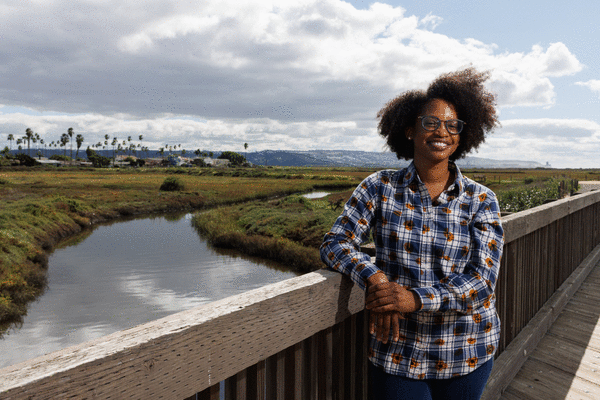
It was through her work as an outdoor recreation planner for the National Park Service that Shanasia Sylman began to ask more questions related to conservation and recreation.
Her interest is in how to manage shared, outdoor spaces in the long term, working with conservation organizations, public land managers, conservation land trusts, and the like, to understand how to create and maintain parks, and think about the future. It was in doing this work that she started to have more justice-oriented questions about conservation.
“One of the things that came up in my work was land ownership and who owns the land, which does not always align with who stewards the land, who has the vision for what these outdoor spaces can look like in the long run. That’s kind of what led me to think more critically about where the direction of conservation, as a whole, is going in the U.S.,” she says. “Of course, this is in a post-2020 era where racial and social justice issues were very prominent, so there were more conversations about things like repatriation, land back. A lot of that was coming up in my work life, but I didn’t really have the time to dive deeper while doing my day job, so that was a signal to me to take the opportunity to take these questions back to school.”
A fifth-year doctoral student in city and regional planning at Cornell University, she completed a two-year fellowship earlier this year at the Tijuana River National Estuarine Research Reserve. She was granted a research fellowship from the National Oceanic and Atmospheric Administration; the Margaret A. Davidson Fellowship, through the National Estuarine Research Reserves system, pairs each of the country’s protected reserves with a researcher for two years. She has been based in Imperial Beach, working with the reserve staff on (land) management issues. Sylman, who will continue working at the Tijuana reserve through the first half of 2027 to finish her dissertation research, took some time to talk about her work, the land back movement, and collaborating on building better relationships with Native communities. (This interview has been edited for length and clarity. )
Q: Why do you find California to be central to conversations about land justice?
A: I think it’s a mix of factors. Part of it has to do with the question of how California became a state, and its evolution as a state, as it relates to both Indigenous and Black communities, but also in the position that the state government has taken on a lot of these kinds of land questions as an inequitable access to land and land ownership opportunities. At the state level, I believe, in 2019, the governor issued an apology to California Native American communities about the violence and the land theft, and many other experiences that happened, specifically to that community in the state. In California, I think in 2022, there was a directive about public land in California and making it more accessible to Native communities. (AB 30, the Equitable Outdoor Access Act, includes a subsection that states, “Before European contact with the American continents, tribal nations, Native American tribes, and tribal entities managed and stewarded the state’s terrestrial and marine resources using traditional ecological knowledge and a wide array of traditional practices and techniques to maintain an environment capable of supporting large, thriving human, plant, and animal populations. Today, tribes continue to use these practices, which vary from tribe to tribe, but are generally focused on ecosystem interconnectivity, respecting the carrying capacity of the land, and viewing humans as an integral part of the environment. Tribal methods of protecting and managing the land are an essential and fundamental part of a concerted effort to successfully rebalance the climate and restore biodiversity.”) So, California is unique because it’s having all of these really big conversations about land at the state level, and how the state can do better in responding to dispossession, of land back, things like that.
Q: After arriving here for your research, you say you realized that there was so much programming already taking place that you chose to observe, listen, and then determine where you could contribute. What was the result?
A: Yeah, I was new to this area, I don’t have any background or ties to California and the Southern California region, let alone San Diego and the Tijuana River estuary, so as a social scientist, there’s a lot of learning I have to do, and that is just good research ethics. What I found myself learning and adding value to were these deeper conversations that a lot of land management agencies and organizations are having around what does it mean to do tribal relationship building better? These are big mandates coming down from the state level, at the federal level, but it’s still something a lot of organizations stay committed to, so what does it mean to do it differently, to do it better? What are the opportunities that they should be looking for? How do they navigate certain challenges or constraints that come up along the way? It really became focused on more of how to understand what it means to do this tribal engagement work in a different way. There are legal obligations that a lot of these public land management agencies, state agencies, are required to do when they’re working with the land. Tribal consultation is a legal obligation. It’s a little different in California, but in other states, co-management agreements are working through different types of access to different resources within public lands. It’s a formal process that Native communities go through, so there are these tried and true pathways that agencies have always been following. They can always do them better, but this is what they’ve always been doing and it’s not enough to really get at what these movements-for reparations, land back, land justice-are really asking for, and that’s for some real reparative justice. So, that’s a different type of relationship building that cannot be confined to these very structured, legal processes, and we started having these conversations about what that means, what it looks like, how to create those opportunities and enter into those spaces.
Q: Can you help people understand what the “land back” movement is?
A: For those who are unfamiliar, the land back movement is about giving land back to Indigenous communities. It’s a global movement that has to be different in different countries because different countries have different relationships with their Indigenous communities. In the United States, that involves the many federally recognized and unrecognized tribal communities. It’s really about the work that Native communities do to reaffirm and maintain the connection to their homeland, that we now know as the United States. There’s no one way that land back looks, but in terms of what you often see reported in news stories, it can look like buying back land, returning land to Native communities, creating different types of access or legal agreements to improve access, to allow opportunities for social practices to return to the land. One of the things that I try to emphasize when I explain the movement is that it’s not totally about who owns the land. That’s how we understand property in our modern-day sense, but what Native communities are fighting for is a different type of relationship, a different representation, in the current system. A lot of that becomes very apparent when we talk about land stewardship and how we take care of the land. The practices that have been passed from generation to generation, within Native communities, is a different type of knowledge, a different way of being and connecting to place. Land back is really about doing the work to remove the barriers so that those connections can continue to endure, can manifest in a way that supports Native communities, pride, and priorities, such as language revitalization, foodways, cultural practices, ceremonies that need to happen in certain places, or the gathering of certain foods, or engaging in relationships with different species. It really is community- and place-specific.
Another piece of the land back movement is also about futures, resisting the narrative of Native communities being in the past. What does it mean to actively plan for their future in these places? That’s what I’ve kind of been able to gather in terms of how to reshape the conversation about what this work can be about in public land spaces, in particular. Not to say that public lands aren’t also being given back, they are, and that’s part of the work, too; but it’s really about reaffirming those relationships and planning to support those relationships into the future.
Q: How has your perspective about restoration and stewardship within the context of returning land rights and management to Indigenous nations evolved over the course of your fellowship work?
A: The Tijuana River estuary is a very popular place, everybody knows it. I wish it were for better reasons, but the cross-border pollution issue is a very dominant narrative for the landscape. Doing this work here and really focusing on the tribal engagement element, helps remind me and the staff, and hopefully the broader community, over time, that the estuary is more than the pollution. That’s part of the restoration work and it’s not just about restoring the quality of the water, the quality of the air. Those are critically important, but it’s also about restoring the people connection to the place, which ties back to land back and how I was describing it. It’s about really reaffirming the Kumeyaay connection to that landscape, and that cascades into the broader community’s connection to that landscape. It’s so hard for people to stay connected to the landscape because of these difficult conditions that have been chronic for the communities surrounding the region, but we don’t want to lose that in the effort to make sure that the water is clean, the air is clean, the species are protected. We don’t want to lose the fact that this landscape also involves people, and what it means to restore those social, cultural connections in this overall process. That, to me, is probably the biggest thing, is really taking that holistic view of what restoration is, and can achieve.
_____
©2026 The San Diego Union-Tribune. Visit sandiegouniontribune.com. Distributed by Tribune Content Agency, LLC.





Comments