Colorado food banks contend with rising food, fuel prices as they try to deliver for holiday season
Published in News & Features
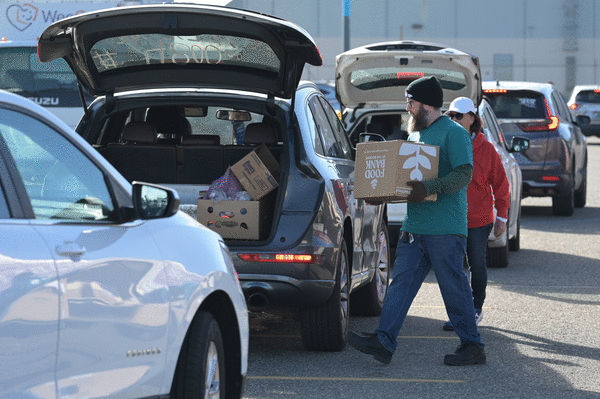
Colorado’s food safety net is strained more than ever heading into this year’s holiday season.
Federal funding cuts, coupled with soaring food and fuel prices, have put compounding pressures on food banks and their networks of local nonprofits across the state.
Colorado households are also buckling under many of the same costs, exacerbated by rollbacks of the Supplemental Nutrition Assistance Program, or SNAP, the nation’s largest anti-hunger program.
A recent poll showed that food insecurity rose this year. Of the 600 Colorado adults who responded to the Colorado Health Access Survey in April and May, 17.8% — more than 1 in 6 — said they couldn’t afford all of the food they needed, up from 10.5% who said so around the same time last year.
“While we’re seeing that increase in need, we have less support … (and) really less government support,” said Erin Pulling, the president and CEO of Food Bank of the Rockies, “and we’re seeing just the same kind of cost inflationary pressures that consumers are seeing, but many times over.”
Food providers remain undeterred from their mission of delivering food to Coloradans in need.
But with the approaching end-of-year holidays — when attention on anti-hunger efforts is especially high — nonprofit leaders are seeing just how great their challenge will be.
Food Bank for the Rockies, a Feeding America affiliate that provides food to more than 30 Colorado counties and has two distribution centers in Aurora and Grand Junction, has seen a dramatic rise in costs for provisions for holiday food drives. It’s seeing a 39% increase in the cost of turkeys this year compared to last, equal to just under $19,000 more per truckload, of which it purchases two a year. Green beans are up 30%, or $6,500 per truckload, with the food bank typically purchasing five truckloads per year.
Food inflation is costing the organization an extra $100,000 more per month compared to last year for the same volume of food, according to Pulling.
“The net effect of all of this is that we are more dependent on the generosity of our community for both volunteers and, especially, financial support than we’ve ever been before,” Pulling said.
Food providers are also contending with less food provided by the federal government.
Nate Springer, the CEO of Colorado Springs-based Care and Share, also in the Feeding America network, said the food bank last year served 20 million pounds of food, down from 25 million in 2024, after hundreds of millions of dollars in cuts were made by the Trump administration to the U.S. Department of Agriculture’s food distribution programs.
The food bank has built back its supply this year to close to 22 million pounds, thanks to increased donor support, Springer said. It relies on the federal government for about 20% of its food supply, which it sends to food pantries and organizations across 29 counties in southern and eastern Colorado.
“What we see both in southern Colorado, in Colorado at large and nationally is that there’s just less food in the charitable food system,” Springer said.
Those federal reductions come as Springer reports a roughly 15% increase in demand on average across the food bank’s more than 300 partner organizations.
A major driver of that, he said, is new restrictions on SNAP benefits enacted under the sweeping tax and spending law, dubbed the One Big Beautiful Bill Act, passed last year by congressional Republicans. The new law expanded work requirements, including an end to exemptions for veterans, homeless people and youth who are leaving foster care.
More than 600,000 Coloradans were enrolled in SNAP in 2025. A report from the Center on Budget and Policy Priorities, a liberal-leaning Washington, D.C.-based think tank, shows that since the OBBBA’s passage, over 33,000 fewer Coloradans had accessed SNAP benefits through June of this year.
Springer said it will be impossible for food banks to fill the gap left by SNAP reductions. For every meal a food bank is able to provide, SNAP can provide nine, he said.
“The SNAP program is the nation’s absolute No. 1 nutrition program aimed at the most vulnerable populations in the United States,” Springer said, “and then food banks are really just a safety net toward that program.”
In mountain towns, food providers are waiting nervously to see what the end of the year will signal for winter conditions after last season’s abysmal snowfall wrought heavy economic pain.
“People would arrive in town ready to work, and their positions were delayed because there wasn’t enough snow to bring them on,” said Sue Fegelein, the executive director of LiftUp Routt County, which runs a Steamboat Springs-area food pantry. “… That lack of snow affected people and brought people through our doors.”
In 2025, LiftUp served nearly 4,300 people, or about 1 in 7 Steamboat-area residents. The food pantry serves people earning up to 300% of the federal poverty line — equal to just under $4,000 per month for a single person — an acknowledgment of just how severe income disparities are in ritzy ski towns.
While many working locals and seasonal employees make too much to qualify for SNAP, the cutoff for which is 130% of the federal poverty line, they still struggle with sky-high costs — most notably housing — that far outpace the rest of the state.
“We want to serve those who qualify for government assistance, but we also want to serve those who face the ‘cliff effect’ — when they make too much to qualify and it looks great on paper, but in real life, they’re not making ends meet,” Fegelein said.
LiftUp relies on the Food Bank of the Rockies for about two-thirds of its food, the rest of which it purchases from other vendors. Some of those have begun adding a fuel charge, Fegelein said.
“I know it’s affecting food banks everywhere, because it increases the cost of providing food to your community,” Fegelein said. Her organization budgeted $334,000 for food purchases this year, up from $307,000 the year before.
Still, food providers say they continue to see a swell of community support that not only has helped them weather harsh financial conditions, but has also allowed them to expand access at a time of heightened need.
LiftUp is close to raising $5.5 million to complete construction on its new food bank building, which will also house a thrift store and offices, in Steamboat Springs. The facility is set to open in November 2027 and will roughly double the nonprofit’s old space.
Food Bank of the Rockies opened its new 270,000-square-foot Aurora distribution center in February, increasing food storage capacity by 67%.
Food providers hope to see more support during the holiday season.
Springer, with Care and Share, said people can sign up for rolling volunteer opportunities at any of its three distribution centers or mobile markets.
Pulling, with Food Bank of the Rockies, said financial donations can have a supercharged effect on food banks’ spending power, since they’re able to purchase bulk items for pennies on the dollar.
“We can purchase more fresh produce, more high-quality ingredients, more holiday food staples with financial gifts that we receive,” Pulling said.
______
©2026 MediaNews Group, Inc. Visit at denverpost.com. Distributed by Tribune Content Agency, LLC.






Comments