Commentary: Horror is having a well-deserved Oscar moment
Published in Entertainment News
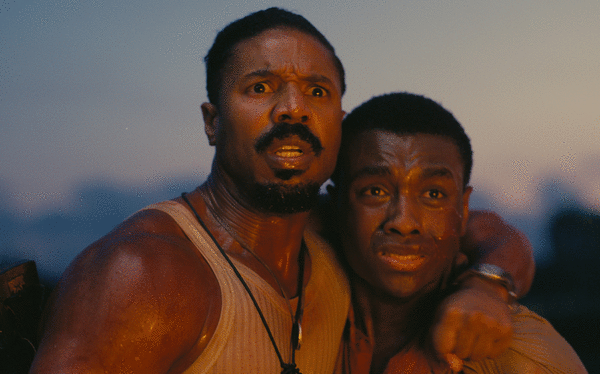
Fans of horror films can usually count on two things: a packed theater and Oscar snubs.
That’s why last week's nominations felt like a long-overdue turning point. "Sinners" led with 16 nods, "Frankenstein" pulled in nine, and "Weapons" snagged one — many of them in the prestige categories of writing, directing and acting, where the Academy has a history of ignoring the genre.
Every once in a while, a film breaks out to capture the cultural zeitgeist and earn one or more nominations, including "The Exorcist" (1973), "The Fly" (1986), "Aliens" (1986), "Bram Stoker’s Dracula" (1992), "The Sixth Sense" (1999), "Black Swan" (2010) and "Get Out" (2017). But these are exceptions rather than the rule. Further, many of the genre’s awards have been for costume design, visual effects, or makeup — categories that, while vital to storytelling, are distinct from the big prizes that crown careers and canonize films.
"Get Out’s" win for Best Original Screenplay in 2018 was significant, as was the dark romantic fantasy "The Shape of Water's" win for Best Picture, Best Director, and two others in 2017. The latter is not horror, but the Academy’s acknowledgment of such fantastical fare was highly notable. Ditto for this year’s arguably horror-adjacent black comedy "Bugonia," with its dark, somewhat gruesome third act that has earned four nominations for 2026.
It’s understandable why some critics haven’t always appreciated horror, especially in light of the dominant slasher wave of the ‘80s and ‘90s and “torture porn” glut of the ‘00s. Those trends became the genre’s public face, grabbing the attention and marketing dollars — and often drowning out the quieter, more imaginative gems, many of them in the supernatural realm.
On occasions when a horror film broke through the noise by bringing something sharper to the table, the desire to replicate its success often came with a catch. The first couple of "Saw" movies, for example, served up clever retribution for morally compromised characters, but the endless sequels dulled the effect. That’s where horror franchising can become the butt of jokes.
I’m reminded of what the late Roger Ebert wrote while contemplating Steven Spielberg’s much-lauded "Lincoln" back in 2013. “It’s a great film, in my opinion, but in the context of Oscar nominations, it also represents the kind of film the Academy loves to nominate: An important drama on a big subject by an industry veteran. The industry spends all year churning out product like ‘The Texas Chainsaw Massacre 3D,’ and then puts on its evening wear and poses as humanitarians.”
Big box office is obviously not an indicator of artistic quality, but even worthy horror movies are routinely shut out come awards season. Some examples of snubs include "The Ring" (2002), "The Orphanage" (2007), "The Awakening" (2011), "The Babadook" (2014), "The Witch" (2015), "Hereditary" (2018) and "Saint Maud" (2019).
The distinction Ebert drew between disposable product and true art looks blurrier more than a decade later. Last year, "The Substance" landed five nominations, "Nosferatu" got four, and "Alien: Romulus" had one. The combined nominations for 2026 are much greater and continue the trend.
Ryan Coogler’s "Sinners" is not just a story about vampires; in fact, it takes nearly 45 minutes before the movie even veers into that territory. Set in Jim Crow-era Mississippi, the film deals not only with racism but also the parallel oppression of African Americans, colonized Irishmen, and Choctaw Indians. Wrapped within that is commentary on the exploitative nature of the music industry and cultural appropriation. There are different levels on which to engage with the movie.
Zach Cregger’s "Weapons" is a more traditional creepy film told in an unconventional way, yet it also sheds light on the socially divided community that’s become the victim of a widespread supernatural abduction. Guillermo del Toro’s adaptation of "Frankenstein," while drawing mixed reactions from critics and fans, has found many champions who feel that it is a more emotional retelling of Mary Shelley’s famous novel. Yorgos Lanthimos’ "Bugonia" is a strange movie about two rural men who kidnap a pharmaceutical company CEO because they think she is an extraterrestrial with malevolent plans. The struggle to determine what is real emulates the social media discord happening in modern America.
While this year’s slate feels newly visible, horror has shown that it’s capable of doing this kind of serious storytelling for decades — whether it’s George Romero’s famed zombie series, the earlier work of David Cronenberg and Wes Craven, del Toro’s other Gothic horrors, or the recent films of Jordan Peele. William Peter Blatty, the novelist and screenwriter of "The Exorcist," once told me that he thought that film was really not a horror movie but a supernatural detective story.
Perhaps that’s the key to broader audience reach: having the horror reflect the subject matter, not just be tacked on for shock and awe. There’s certainly a place for straight-up scary thrill rides, too. "The Conjuring" and "Insidious" universes excel at that and bring massive revenue, but more filmmakers should veer toward deeper substance because, at its best, the genre grapples with audiences’ beliefs, histories and lived experiences.
As we get closer to the Oscars, it’s important to remember that while the awards are a flawed barometer, they’re still a loud one. Nominations and wins tell the mainstream what counts as art, what counts as serious, and what counts as worthy of attention — and, in turn, create more opportunities for filmmakers to make horror that helps viewers understand the world around them.
———
This column reflects the personal views of the author and does not necessarily reflect the opinion of the editorial board or Bloomberg LP and its owners.
Bryan Reesman is a New York-based journalist, the host of the YouTube channel "Side Jams" and author of "Bon Jovi: The Story."
©2026 Bloomberg L.P. Visit bloomberg.com/opinion. Distributed by Tribune Content Agency, LLC.









Comments