Q&A: As the stars of 'Outlander' embark on the final season, even they don't know how it ends
Published in Entertainment News
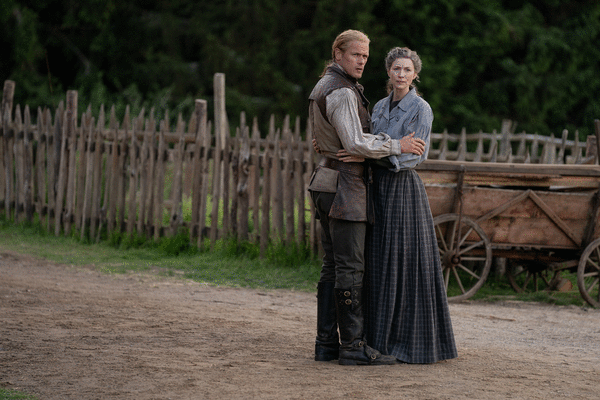
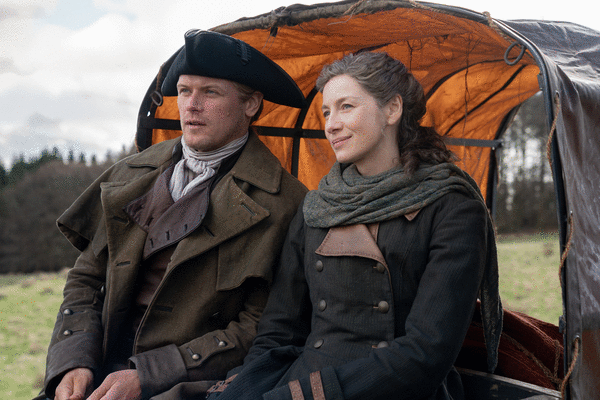


LOS ANGELES — Author Diana Gabaldon knew readers had been mentally casting the timeless main couple at the center of her "Outlander" book saga since the first novel's release in the early '90s — particularly its leading man, a tall and burly Scottish Highlander with striking red hair. She recalls a 50-year-old German actor who, she says, "always looked like he'd been dipped in cooking oil" among the imaginary candidates. Another was a 5-foot-4-inch race car driver. She quickly learned not to weigh in.
"They would keep asking me who I'd like to play Jamie — 'Nobody,' I kept saying because on the rare occasion when I mentioned some possibility, the immediate response would be shrieks of dismissive outrage and heapings of scorn that went on for days (online)," she says over email. Besides, she felt the whole notion of considering prospects was pointless because, as she puts it, it's not like Hollywood would want to adapt a 300,000-word book anyway.
However, Ronald D. Moore and Maril Davis, longtime collaborators through their Tall Ship Productions banner under Sony Pictures Television, did. And Gabaldon was thrust back into the casting debacle, watching test videos and learning not to judge a book by its cover — or actors (in this case, Sam Heughan and Caitriona Balfe) by the photos that pop up in a Google search: "Sam doesn't look like Jamie, and Caitriona doesn't look like Claire, but both of them can be those people, and that's all that matters," she says. And they were those people.
In 2014, the duo brought to the screen the epic story of Claire Randall, a British combat nurse who is mysteriously transported back to 1743 Scotland and marries Scottish warrior Jamie Fraser to survive. Together, they ignite a passionate romance that traverses decades and endures brutal separations, wars and time travel. After spinning its own sweeping narrative for more than a decade, the Starz series is launching its eighth and final season this week.
And it won't exactly be a by-the-book ending. The final season pulls from the remaining material in Book 8, as well as Book 9 — Gabaldon is working on a 10th installment, "A Blessing for a Warrior Going Out" — leaving Matthew B. Roberts, the showrunner, and the writing team to craft an original ending for television. In a signal of how much pressure there was to do right by the beloved fictional couple, four endings were written and filmed.
"Diana's been involved since Day 1 — she reads everything, she sees everything," Roberts said by videoconference. "I told all the endings that were going to be written. She briefed me a little bit of where she might be going, not the ending of the books, but just where the book might be going. I wanted to at least incorporate some of that in some of the endings that were written."
Can it be anything other than a happy ending? Maybe the clue is in "I Love Lucy." Lucy and Ricky Ricardo's love story was often a reference point for Roberts throughout his time on "Outlander."
"No matter what trouble Lucy got in, no matter what she was doing, never did you think they were ever going to break up," he says. "That's Jamie and Claire, no matter what happens, no matter what he goes through or what she goes through, no matter what trouble or what they tell each other sometimes, we'll never think they break up. And the audience knows that too, and we knew, if you just stayed true to that, then that love story would be successful."
Ahead of the show's final season premiere, The Times spoke with Balfe and Heughan to get their thoughts on bringing the historical romance to life and the journey to reach the final chapter.
Q: In the spirit of the Season 8 premiere, which has a moment where Claire and Jamie reflect on the early days of their story, let's travel back in time. Do you remember how this series was first presented to you and what went through your mind?
Balfe: I think the logline I saw was "nurse goes back to Scotland and then goes back 200 years in time and meets a Highlander." I think I had two lines. That was all I had.
Heughan: It sounded like it was never gonna work. I found out it was a book series, and I think we both read it, didn't we?
Balfe: Yeah, I read the book in four days before we tested. You'd already been cast at that point ... I was living in L.A. I had tiny bit parts in a few films, and I was definitely struggling. I had booked to go on a trip to India, sent my passport into the Indian embassy. Of course, that's exactly when I found out that maybe I had to travel to London for this test.
Heughan: At the time, I had failed attempts at pilot season, and I was back in London working in a bar and thinking, "I can't afford to do this and I'm 34 years old. I should probably think about giving up." Because there was no way I could support myself. I wasn't loving it.
Balfe: You were 33, by the way.
Heughan: Oh, yes. I was younger. Then this thing came through. And actually, to be honest, the logline and perhaps the dialogue, when I read it, I just thought, "I know this guy." There just was something very familiar.
Q: Tell me about the decision to say goodbye to this show and these characters. Does it feel like the right time?
Balfe: By the time we got to Season 7, that was our last season that we were contracted for, and there were conversations going around that they — the writers — felt that they had eight seasons [for this story]; that that was sort of an organic finish to it. But we were more than halfway through Season 7 before anyone came to talk to us. Actually, we had all scripts, bar the last two. And it wasn't ending. Before they came to us, it was like, "How is this gonna happen? Are they going to wrap it up in two episodes or are they coming to us?" It was a lot of pressure in a very short amount of time to decide, "OK, do we just wrap this up in two episodes or do we try and give it a season to properly say goodbye?" There's a lot of people's jobs, and there's a lot of people's livelihoods, and there's a whole ecosystem around it. We felt that it needed that kind of time.
Heughan: A lot of thought went into it. I think we were ready to move on or do something else. But also, there was this itch, like we hadn't finished it and it didn't feel satisfying for us and for the fans. We wanted to come back and really tie it up properly.
Q: The final season focuses on Claire and Jamie's struggles during the Revolutionary War, with the war having followed them home. What intrigued you about this final onscreen chapter of their story?
Heughan: Jamie's concerned about himself in the foremost because he has this information that he's going to die. But they've fought for eight seasons to stay together and to protect everyone they love and the greater community and I think that continues, but there's so many more distractions or more challenges along the way in this season from the inside.
Balfe: And the Revolutionary War has been circling them for a very long time. It was time for the culmination —
Heughan: [Laughs] Instead of saying "War is coming," it's "War is here.'
Q: The fandom around this property is active and devoted. There's good that can come from that — the engagement, the creativity — but some bad too, like when things get toxic. What was the learning curve of playing this beloved fictional couple and navigating the fandom?
Balfe: It was a bit of a baptism of fire.
Heughan: We were both quite green when we were thrust into it and engaged wholeheartedly.
Balfe: The landscape is very different. Twitter was Twitter before it was death pit, Instagram was far more innocent as well. In the beginning, it was really nice. I wasn't a mom. I had loads of time on my hands — well, not really, because we were shooting all the time — but anytime I did, it used to be nice and we would do these quick Q and As. That one-on-one connection with the fans was really, really lovely. I do think there was a moment where ... the tide shifted, and this sort of shipper-dom got very intense. I was getting married, and that was having an impact on the people in my life and and I think I had to then step away because I was like, "OK, this doesn't feel good for everyone in my life."
Heughan: Look, I think it's still there. It is a strange one to get your head around. People, in one way, are uber fans of the show, but in other ways, they're overtly intrusive in your life. But it is a small minority. I think ... perhaps we've done our job that well? It's not just about Jamie and Claire, it's about that person behind it and their life behind it, and their family behind it, that people want to get invested in. I don't know if it's a great thing for actors, to be honest, but in this current environment, we're always asked to give more of ourselves to engage with fans, but it's been something we've had to learn on the job.
Balfe: And I think there are times in your life when you have more capacity to be more open, and there's times in your life where you need to shut off a little bit more. The overall reception from the fans have been so positive and so supportive of things that we've done in our lives, and that is the thing that I choose to focus on with it.
Q: "Outlander" isn't strictly a romance, but that's what gives it power. You've spent more than a decade in this space. What have you learned about how that romance space functions and what the fans seek from these stories?
Balfe: I was sort of unaware of the need and the appetite that people have for it. Nowadays it's served an awful lot better, but I think it was an underserved demographic. Or it was not given the due that people needed. It's sometimes looked on as the second-class citizen of storytelling, in many ways, but I think it's a genre that allows you to really look at the beauty of humanity and ... the core things that we care about, which is love and family and connection.
Heughan: And comfort. It's comforting. This show proves that there's a real appetite.
Balfe: There's many more shows now. Everybody's talking about "Heated Rivalry." There's "Bridgerton." Maybe it's the emancipation of women in the last 50 years. It's like they are finally like, "Well, we want our TV that speaks to us as sexual beings and as mothers and as matriarchs and as professionals and whole round of people." Our show did that a lot.
Q: Have you taken stock of just how much Claire and Jamie have gone through as a couple?
Balfe: How many near-death experiences?
Heughan: Yeah, how many times they've nearly died or been attacked or assaulted.
Balfe: How many people they've killed. Claire, she's like a serial killer.
Q: I was wondering, because it's the last season, you can't get in trouble now, where would Caitriona or Sam have called it quits in this relationship? Like, this is too much, I need to move on.
Balfe: I don't know if Caitriona would have gone back 200 years in time.
Heughan: When she fixes his shoulder — that's pretty painful. She gets him in a lot of trouble and he puts himself in a lot of trouble. I wouldn't have gone past Episode 1 [he mumbles].
Balfe: See! I would have gone to Season 3.
Heughan: No, I think when he sends her through the stones and is like, "That's it. She's gone." But she keeps coming back. I thought I got rid of her, finally!
Q: Caitriona, you make your directorial debut on the show this season with Episode 2. Tell me about that experience.
Balfe: It was so fun. They gave me Episode 2, which allowed me to do my prep before we started. I was so lucky that Jan Matthys, who is the director of Episode 1, was an incredible mentor to me throughout the process. I just got to work with these guys in a totally new way, which was so amazing. I was buzzing. The whole first 10 weeks [of this season] felt like the very first 10 weeks again because you're learning all these new skills and you're just in such high operating point; you have to make decisions on the fly, I was also in scenes. It was just mad, but brilliant.
Heughan: You were also probably happy to take the corset off.
Balfe: To be able to walk around in proper wet weather gear and trousers and be able to go to the bathroom — not to be TMI, but it was so good.
They did not give me the easiest episode. Every day had its thing — obviously, the bear attack sequence. Three days before we were filming that, that was a cougar; we were going to have a live cougar. There was a whole thing planned. And a cougar attacks in a very different way than a bear does. So my whole shot list had to go out of the window and I had to rethink the whole thing. But that was kind of fun.
Q: Finales can be tough, given how viewers chime in on social media. You can't please everyone. But what was your vision for the ending of "Outlander"?
Balfe: I didn't really have one. I would not want to have had Matt's job because that's a really heavy load to bear, trying to finish this out. But I would say the season was unusual. Normally, we would get an overview of the season before we start. This season, we went into it blind so we weren't getting sort of any info about what was going to happen. Through the whole season, it was like finding out as the scripts came what was happening. And to be honest, we still don't really know the ending. We know bits that were filmed, but [not] how he's going to edit it.
Heughan: I definitely had a firm belief about a certain element of it. I spoke to a few people — few other execs and producers — and there was a common consensus, and I think that might be one of the directions, but it's going to be a surprise for us when we watch it. I don't know when we are going to watch it.
Q: Multiple endings were filmed.
Balfe: There was a few different things filmed.
Heughan: Hard to know what's [going to make it] — it's all in a same direction. But what direction that is ...
Q: Would you call it a happy ending?
Heughan: I don't know. It was such a secret on the call sheets and stuff.
Balfe: There was different versions of scripts that went out.
Heughan: There were fake people put in. There was a reduced crew.
©2026 Los Angeles Times. Visit latimes.com. Distributed by Tribune Content Agency, LLC.







Comments