Oscars 2026: 'Train Dreams' was filmed in Washington. Here's where
Published in Entertainment News
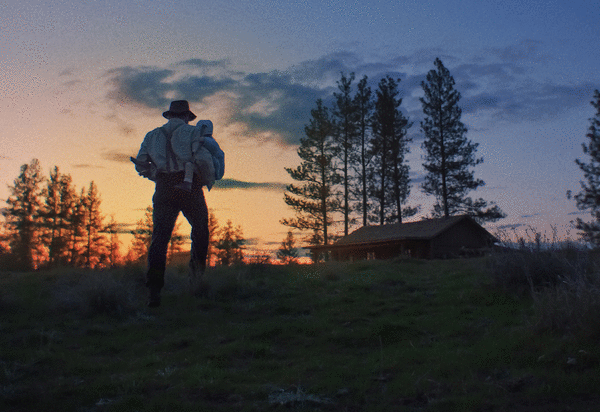
SEATTLE — “Train Dreams,” the haunting Oscar-nominated drama from filmmaker Clint Bentley, begins with birdsong and light. We see a train track curving its way out of a tunnel into a forest under a cloud-streaked sky, the trees a glowing rainbow of greens. We see a well-worn pair of boots attached to a tree trunk, their leather delicately fringed with moss. We see a stream rushing past us at sunset; an ancient stump on the shore with roots reaching out like silvery fingertips; a tree seemingly stretching to the heavens, then slowly falling to the ground.
And if all of this looks eerily and beautifully familiar, it’s because this is a landscape we know. “Train Dreams,” unlike so many films set in this region, was filmed entirely in the Pacific Northwest, mostly in Eastern Washington. The settings become a vivid, essential character in the film, silent yet nonetheless articulate. Based on a novella by Denis Johnson, the film is the story of a man named Robert Grainier (Joel Edgerton) who spends his life working and living in those Northwest forests, in the Idaho panhandle and throughout Washington state. “Train Dreams” is up for four Academy Awards Sunday night — best picture, best adapted screenplay, best cinematography and best song — and is currently streaming on Netflix.
Bentley, from the beginning, felt strongly that “Train Dreams” needed to be filmed in the area in which the book was set. “It’s one of those things that bother me as a viewer,” he said in an interview last month, “when I see a film, and they’re saying it’s Montana or saying it’s Washington, and it’s clearly not. I just think it’s disrespectful to the natural world to do that.” While he acknowledged that the production could surely have saved money by shooting in Canada, or even Eastern Europe, “the things that we gained by shooting in the actual area where the film was set, there were so many more of those considerations than anything that we gave up.”
With support from Washington Filmworks through its Production Incentive Program, which provides funding assistance to film projects shot in the state (the nonprofit declined to disclose the funding figure for “Train Dreams”), the movie was filmed in the spring of 2024. “They did a lot to make it easy for us to work there,” Bentley said.
Prior to that, a small crew — including Bentley and cinematographer Adolpho Veloso, neither of whom had made a film in the area before — had headed to Eastern Washington to scout locations. Veloso was, in fact, making his first trip to the state, and was dazzled by what he saw.
“It is so beautiful,” he said of Washington’s lush landscapes. Veloso described how he and Bentley, who previously collaborated on the 2021 film “Jockey,” like to work in a way that “is very reactive to the environment and to nature itself … to set everything in a way that we can almost shoot it as a documentary,” having the actors occupy real spaces. The scenic landscapes became a character in the movie, he said, rather than just a backdrop. The lush trees, the green moss, the changing light “gave us everything we needed.”
Bentley was impressed by the varied landscapes of the state and how the forests near Spokane look different from those closer to Seattle or Olympia. In the film, Grainier and his wife Gladys (Felicity Jones) build a cabin near a river; Bentley wanted to craft the story so that it was clear that “the area he’s living in, where they built their cabin, is distinctively different from the area where he’s going to cut. He’s going into all those old-growth forests.” The location of the couple’s home feels airy and open, full of possibility; the forests feel darker and more complicated, more set in their ways.
But scouting locations wasn’t just a matter of finding beautiful, evocative settings. Most of the film takes place in the early part of the 20th century, and the chosen locations needed to look unchanged by time. And, as Veloso pointed out, they needed to be near a road — “you need them to be untouched and in the middle of nowhere, but you need to be able to get there with your gear and your crew.”
Luckily, 21st-century technology was ready to help. “You go into these places that feel very untouched at first … and then you can see cars passing through the trees,” said Bentley, or a glimpse of a modern building in the distance. Visual effects supervisor Ilia Mokhtareizadeh was kept busy “painting out power lines and things like that.”
For the cabin where Robert and Gladys live with their baby daughter, the crew was lucky to find an idyllic patch of land near a river less than an hour from Spokane. (Bentley declined to give its exact location, as it’s on private property.) On that site, the cabin was built from scratch — “a real log cabin that anyone could move into,” Bentley said — by production designer Alexandra Schaller and her crew, with much help from local artisans.
Other settings can be more easily pinpointed. Webley Lumber, a family-owned lumberyard in Colville, Stevens County, that’s been around for many generations, became a key location. “Alex and her team stumbled on this place while they were looking for materials,” Bentley said. The crew built a logging village and shot many of the logging-camp scenes there, with support from the owners. “That family was very invested in the story we were telling because it was part of their family story,” Bentley said. “They really helped us out in a big way.”
Downtown Spokane’s vintage buildings make a few appearances in the film (watch for a quick glimpse of the elegantly curving tower of the 1890s Spokesman-Review building and the Davenport Hotel ), during Grainier’s few forays into the city, as does the historical downtown of the small town of Tekoa, Whitman County, about an hour south of Spokane. The neon exterior of the Empire, a 1940s movie theater in Tekoa now turned performing arts center, plays itself in “Train Dreams.” Across the street, in an old Tekoa bank building dating from the 1890s, Schaller’s crew built the general store in which Robert purchases supplies. And a charming 1880s wooden chapel, located on the campus of the Mukogawa Fort Wright Institute outside of Spokane, made the perfect setting for Robert and Gladys’ first meeting at a Sunday church service. “We didn’t have to do anything to it,” Bentley said of the beautifully preserved chapel. “It looked great.”
It was challenging for the crew to find a historic wooden trestle bridge in good order, but the production was able to shoot scenes using parts of an old trestle bridge in Metaline Falls, Pend Oreille County (in the far northeast corner of the state), and another across the Canadian border. Western Washington got into the act as well: Bentley said they filmed for several days outside Seattle, including a shoot at the historical depot at the Snoqualmie Falls Hydroelectric Museum (which stood in for the film’s Bonners Ferry, Idaho train depot). Bentley gratefully acknowledged assistance from the Northwest Railway Museum in Snoqualmie, which advised on the scenes featuring early 20th-century train travel.
The end result is a movie with an uncanny sense of place, whose images stay with you long after it’s over, caught in seemingly magical light. It’s a love letter to the Pacific Northwest, from visitors who fell hard for its beauty. Though the film’s roots sprang from Johnson’s book and language, Bentley said, the world we see on screen “really came from us being inspired by the state.”
©2026 The Seattle Times. Visit seattletimes.com. Distributed by Tribune Content Agency, LLC.











Comments