Sarah Green Carmichael: 'The Salt Path' is a lesson in what we want to believe
Published in Entertainment News
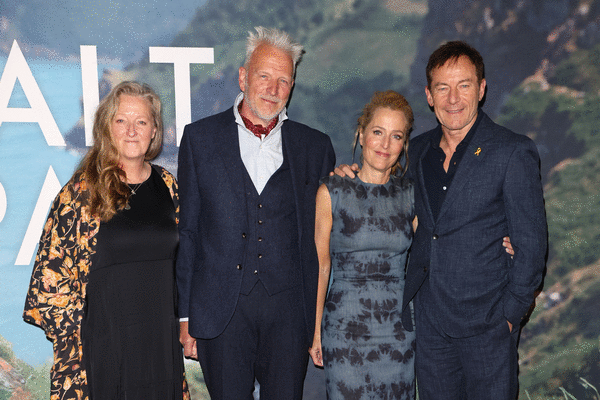
Arriving in theaters nationwide this week: "The Salt Path," based on Raynor Winn’s bestselling memoir of the same title. The film stars Gillian Anderson and Jason Isaacs as a British couple who, suddenly homeless and facing a dire medical diagnosis, take a life-changing hike along the dramatic Cornish coast.
"The Salt Path" got good reviews when it opened last year in the U.K.; critics lauded its message of resilience. Then a journalist presented evidence that almost all the key details of the book’s “inspirational true story” were false.
While Winn defended her account of events, the allegations put the story in the dubious company of other fabricated memoir controversies. And the mountain of evidence amassed by investigative journalist Chloe Hadjimatheou is entirely persuasive. That has turned the film into a strange cultural artifact. It arrives in the U.S. as a based-on-a-true-story movie that’s meant to be inspirational yet instead serves as a reminder of just how gullible and fallible we humans can be. How easy it is for grifters to turn our heartstrings into puppet strings. How thirsty we are for hope — even if it’s false hope. Even if we’re old enough to know better. Especially if we’re old enough to know better.
It all started with Winn’s 2018 memoir. In her telling, she and her husband lost their home after a bad investment in a friend’s business, got shellacked by his diagnosis with a terminal illness and then completed a 630-mile walk around England’s southwestern coast. The walk appeared to improve his symptoms.
Anderson was one of millions moved by the story, and she considered landing the role a coup. Marianne Elliott, a seasoned theater director, signed on to make her feature film debut, joined by screenwriter Rebecca Lenkiewicz and cinematographer Helene Louvart. It seemed fitting that a book written by a woman in her late 50s was brought to life by a group of women roughly the same age, particularly in an industry where only 14% of all films feature a woman over 40.
But just weeks after the film came out, a series of articles from The Observer reported that the real-life Winns were never destitute — they owned property in France. They’d lost their U.K. house when they couldn’t repay money they’d stolen. Multiple doctors told Hadjimatheou that the terminal diagnosis didn’t pass the sniff test, nor did the MAHA-style “nature cure.” Hadjimatheou also found that the hike itself — the whole narrative spine of the book — was suspect.
The exposure immediately punctured the story’s appeal, which was always grounded in its veracity. Anderson has said she hopes American viewers can nevertheless enjoy the film “as its own entity.” But this sordid backstory is now inevitably entangled with the experience of watching it.
Perhaps it’s also an opportunity, though. Why did so many find this story so moving? When we fall for a story like this, what does it tell us about ourselves — about what we want? About what we’re afraid of?
The effectiveness of any con rests on its ability to hijack the audience’s emotions, pushing logic and skepticism out the window. And Winn’s tale captures middle-aged hopes and fears around health, finances, love and success.
Among the fears: That our midlife security, as solid as it may seem, is fragile. That no one — not the legal system, not our families, not our friends — will rally to help us. That we’re one terrifying diagnosis away from disaster.
And the hopes: That even if we lose everything, we can start over. That although we may be in the second half of life, adventure is still possible. That serious illness comes with an escape clause. That it’s not too late to dream big — hike the 600-mile trail, write the bestselling book. That we’re not running out of time.
These worries and desires are broadly shared, but they feel especially salient for middle-aged women. So much in our culture tells women we’re less valuable as we grow older. Ageism hits women earlier than it hits men. We collectively spend billions on Botox and other injectables each year.
At the same time, paradoxically, many women report feeling greater confidence in midlife — shedding the people-pleasing habits of youth, putting new energy into our careers, ditching old habits that didn’t serve us.
Winn’s story, however flawed, managed to capture both the insecurity and the grit.
Anderson admitted to the Times that it felt like “a betrayal” when she heard the allegations that Winn’s story wasn’t true. Many readers feel the same. After all, the fears the book explored still seem entirely plausible, even as the hope it offered has been rescinded. Maybe midlife isn’t the seed of our next great adventure. Maybe we are, in fact, running out of time.
How deflating.
Nevertheless, I will watch the 50-something Anderson struggle up a windswept Cornish cliff — directed, filmed and scripted by a team of her peers — and I will let myself forget the book. The memoir was the work of one person; the film is a labor of love by a group of pretty darn impressive women. That gives me hope — and not the false kind.
———
This column reflects the personal views of the author and does not necessarily reflect the opinion of the editorial board or Bloomberg LP and its owners.
Sarah Green Carmichael is a Bloomberg Opinion columnist and editor. Previously, she was an executive editor at Harvard Business Review.
©2026 Bloomberg L.P. Visit bloomberg.com/opinion. Distributed by Tribune Content Agency, LLC.








Comments