Review: 'Saturday, Sunday, Monday' is a delightful sendoff at Stratford Fest
Published in Entertainment News
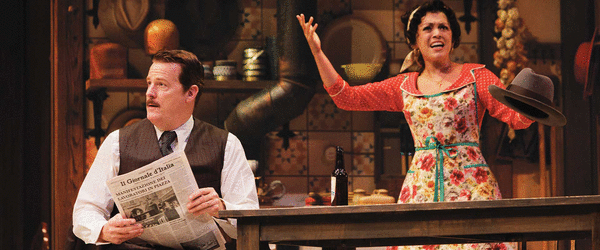
STRATFORD, Ontario — The Stratford Festival of Canada’s departing artistic director Antoni Cimolino chose William Shakespeare’s “The Tempest” as his valedictorian show in the huge Festival Theatre. Unsurprising, given how Prospero hacks on about “our revels now are ended” and so on and so forth, talking like an imminent retiree, albeit one more contemplative than most. Cimolino has been working at Stratford for some 40 years, so he surely deserved his “Tempest” and the show (which I wrote about earlier this summer) was both moving and self-effacing, a reflection of the great Canadian director himself.
But Cimolino’s heart beats faster in “Saturday, Sunday, Monday,” the actual last Stratford show of his tenure and a delightful recent autumn arrival in Ontario.
You’re perhaps not familiar with that title, even though a British revival of this 1959 play (“Sabato, domenica e lunedì”) by Eduardo De Filippo actually played on Broadway in 1974 directed by no less than Franco Zeffirelli. Cimolino speaks and writes Italian, so he has come up with a fresh translation. And whereas “The Tempest” has a dream-like melancholy at its core, “Saturday, Sunday, Monday” has red-blooded passion, familial angst and simmering ragù.
All else being equal, I prefer the latter.
“More life!,” as Tony Kushner famously observed.
Aside from offering a tempting metaphor for a playwright or a critic, the ragù in question here has been cooked literally. One can purchase small tubs of the famous meat sauce in the lobby during one of the two intermissions of a play, originally intended as a social Italian occasion (immersive theater has been around for longer than you think). Stratford Fest insists the ragù has been simmered for three days.
I supposed you could call this play a contemporary commedia dell’arte, especially given that an Italian comedic actor, played by Geraint Wyn Davies (also Cimolino’s Prospero) is a character in the show. Also, the late De Felippo (he died in 1984) is traditionally associated with farce. But in Cimolino’s translation, the work plays out more as vibrant domestic realism, sketching as it does middle-class Neopolitan family life in the era following the end of World War II.
The show revolves around the kitchen of the matriarch Rose Priore (Rose Napoli), dealing with various familial comings and goings with one eye always on her multi-day ragù. It is something of an misconstrued love triangle; Rose’s husband Pepe (Graham Abbey) thinks his wife is having an affair with family friend, Luigi (Gordon S. Miller), who, being a calamari connoisseur, is notably more simpatico when it comes to the centrality of Rose’s kitchen to her life. That’s the main plot and the poignancy therein comes from both the husband’s his lack of trust but also his passion for his wife.
There is a younger generation on view, too: Roberto (Jakob Ehrman), who is trying to break out with his own menswear store and Giullianella (Katarina Fiallos), an actress wannabe with an opinionated boyfriend, Frederico (Maher Sinno). Add in a feisty maid played by Michelle Giroux and a very lively Aunt Meme (Seana McKenna) and you get quite the crew for a weekend supper.
I’ve seen a prior translation and it seems to me that Cimolino here very much wanted to rescue this play from the Italian stereotypes of mamma mia and flailing arms common in prior English language stagings of this and other de Felipo work.
So achieved. “Saturday, Sunday, Monday” lands as a poignant portrait of a marriage in its middle years, when initial passions have dulled, worries and insecurities have crept into play and the staying power of love is tested as external responsibilities explode. The acting here feels authentic, inhabited and deeply honest, all three hallmarks of Cimolino’s invariably tasty tenure at this great Canadian theater.
Another late opening of the Stratford season is a new work from Charlotte Corbeil-Coleman, “The King James Bible Play.” I’ll start with two things here: Corbeil-Coleman proves that she can structure a formidably complex historical drama and I can’t recall ever so much liking Act 1 of a play and then so much disliking Act 2.
That’s because they are two different shows.
Act 1 shows the various travails facing those charged with creating the 1604 translation at the behest of an intrusive monarch who disliked the Republican and Calvinist vibe of prior English language takes on the Good Book. Over time, the translation became associated with the establishment church and even known as stuffy, but, contemporaneously, James was more concerned with minimizing anti-monarchial language and maintaining power.
This kind of thing is what Stratford does best and an array of deeply experienced actors, such as Cyrus Lane and William Spencer-Davis, appear in Nina Lee Aquino’s production. They tease out the play’s contention that everything is political and even the Bible was manipulated to serve a powerful client.
Not only does Corbeil-Coleman address those themes adroitly, but she considers the personal cost of this kind of project, wherein the consequences for client disapprove would have been devastating if not fatal. She also explores in a really interesting way how people operate in teams, how arguments turn into accord and how even settled truths invariably begin with contention. It’s a fabulous hour of fresh Canadian theater, bristling with authorial point of view.
But in Act 2, when she could have been continuing all of that, Corbeil-Coleman chooses instead to explore a small Canadian theater company doing the play we just watched in Act 1.
The idea was to find parallels with the various contemporary travails of theater people: a director-mother fighting with an actress-daughter, for example. The problem not only is that this kind of meta approach is overdone, but that these kinds of playmaking challenges are far more interesting to theater people than civilians.
Moreover, the initially crackling direction of Act 1 seems to fall away before your eyes. You can’t believe that this theater company could be real: it’s all too stagy, forced and archetypal. Plus it’s a bait and switch: audiences are coming to see an exploration of the King James Bible, as per the title.
I am sure Corbeil-Coleman was frustrated by the patriarchal nature of the historic protagonists and wished to redress the gender balance. One can understand. But it seems to me that a woman writing the story of the 1604 translators from her own point of view is is a feminist act in and of itself. Moreover, Corbeil-Coleman discusses in the first act the impact of the translation process on the contemporaneous women (and offspring) on the periphery of the traditional telling of this story and she easily could have foregrounded them, resulting in both a progressive and a richly complicated drama.
I wish she would bag Act 2 and get back to the Bible, translated in her own, very capable way.
———
“The Tempest” continues through Oct. 24 in the Festival Theatre; “Saturday, Sunday, Monday” through Oct. 24 in the Avon Theatre; “The King James Bible Play” through Sept. 26 in the Studio Theatre. Tickets and more information at www.stratfordfestival.ca
———
©2026 Chicago Tribune. Visit chicagotribune.com. Distributed by Tribune Content Agency, LLC.











Comments