Oscar winner debuts film about 'incredibly courageous' response to Metro Surge
Published in Entertainment News
MINNEAPOLIS — An unmarked SUV circles a deserted south Minneapolis block in the dead of winter.
Masked agents tackle an unarmed citizen blowing a white whistle.
Shots of the interior of a trunk accompany audio of a man who describes hiding there while his son drove him to work.
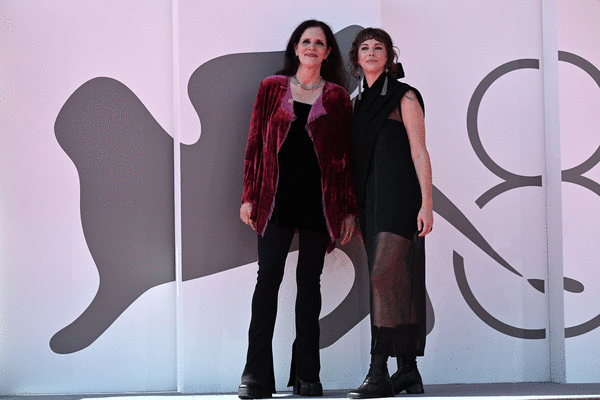
For many people in Minnesota during Operation Metro Surge, these images feel hauntingly familiar. The resistance to U.S. Immigration and Customs Enforcement that sprang up in Minneapolis is the subject of a documentary by Minneapolis filmmaker Rachel Lauren Mueller and Oscar winner Laura Poitras, best known for documentaries such as “Citizenfour,” about post-9/11 America and mass surveillance.
The 25-minute “They’re Here” captures Minnesotans who resisted Operation Metro Surge. The film, which debuted at the Venice Film Festival and screened at the New York Film Festival, played in Minneapolis for the first time Oct. 7 at the Riverview Theater. Another screening is planned for Nov. 4 at the Cedar Cultural Center.
The filmmakers were connected by co-producer Adam Mellion, who heard from Poitras after the killing of Renee Good.
“Laura had been following what was going on here, and immediately asked: Do you know anyone who could start shooting right away?” said Mellion. “Rachel’s one of my good friends, happens to be a wonderful director and cinematographer, and I just connected them and let them get to work.”
We chatted with the directors about the film. This interview has been edited for length and clarity.
Q: How did you find Minnesotans?
Poitras: Badass. What can I say? It was an amazing resistance. In the most difficult physical conditions of the cold, even after people had been murdered in cold blood in broad daylight, [people] were still going out and following ICE. That didn’t deter them. And it’s not just a story of an individual hero or a small group of heroes. There were so many people who did incredibly courageous things at an enormous scale.
Mueller: I didn’t grow up in Minnesota, but I’ve lived here almost 18 years. Minnesotans can be hard people to get to know, but once they claim you, they claim you forever. What I saw here was on a grand scale, of Minnesotans being like: “These are our people, and you cannot steal them from us ― and we won’t let you.”
Q: Tell me about what you’ve described as the horror elements of your film.
Poitras: There were certain things that we really wanted to try to do. One was to de-normalize the violence that we were seeing coming out of Minneapolis at this time that was sort of constantly playing on the news, to make it completely terrifying. That it’s not normalized, it’s not something you can just hit “play.”
Mueller: When we think about horror, it’s often what is outside, what you don’t see, that is the scary thing, that is the horrifying thing. And so we were thinking about the cinematography ― it was how to not be reactive in a way that a lot of the other cameras that are out there are being reactive. To be, to place a camera and get a tableau and let the world unfold in front of you ― that was one thing that we held to.
Poitras: We talked very much about just, “Set up the shot and film it,” thinking about films like “Children of Men.” This is dystopian, this is a full-blown paramilitary occupation of a U.S. city, and how can cinema capture that?
Q: What surprised you while making this film?
Poitras: I think this was like a kind of descent into hell. You would think that with this many people taking to the streets to resist, that they would curtail the violence and brutality. And then to see them not do that was, I think, a huge shock and surprise.
©2026 The Minnesota Star Tribune. Visit startribune.com. Distributed by Tribune Content Agency, LLC











Comments