Commentary: Not even Tom Cruise could save 'Digger'
Published in Entertainment News
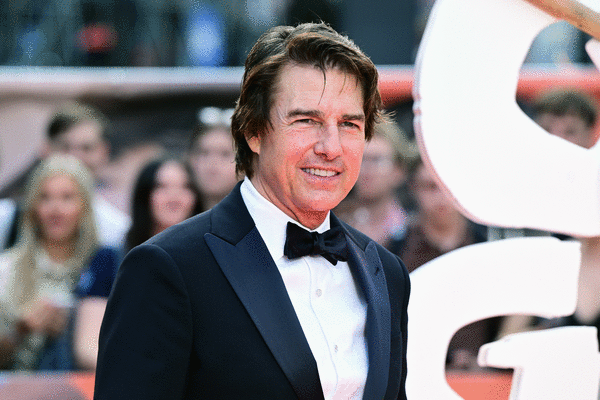
Continuing a concerning trend for Warner Bros. in 2026, its latest release is buried in a financial hole no film can escape. Alejandro González Iñárritu’s "Digger" arrived over the weekend and grossed a measly $8 million domestically against a nine-figure production budget, with the Wrap reporting that the movie is expected to lose $250 million — about $100 million more than was previously projected.
One of the most revealing takeaways from the movie flopping so emphatically is what it says about Tom Cruise, the film’s star. Despite a marketing strategy that leaned on the actor’s exemplary career — along with a press tour that featured a rare sit-down interview with GQ — it marked his worst debut since 2007.
As a result, "Digger" complicates Cruise’s longstanding reputation as a quintessential movie star whose name alone can help sell tickets, and it illustrates how much the nature of movie stardom has evolved.
An A-lister’s box office appeal has become increasingly conditional on a film’s budget, genre and attachment to IP. In Cruise’s case, his recent filmography is built around the proposition that he’s synonymous with audacious stunt work in established franchises. "Digger" is notable because it asks audiences to embrace a Cruise-led vehicle without those trappings for the first time in over a decade.
Cruise’s 20th-century filmography offers a window into what traditional stardom looked like — and what "Digger" was striving for. He regularly collaborated with auteurs like Martin Scorsese ("The Color of Money"), Stanley Kubrick ("Eyes Wide Shut"), Paul Thomas Anderson ("Magnolia") and Cameron Crowe ("Jerry Maguire"). The actor wasn’t tied to a specific genre with these projects; he was one of the major selling points. In that time, stars such as Tom Hanks, Will Smith and Julia Roberts followed a similar blueprint.
Movie stars haven’t gone extinct in the 21st century, but preexisting IP and franchises have proven to be more reliable at attracting moviegoers. For instance, if "Jurassic World" swapped out Chris Pratt for another Hollywood Chris — be it Hemsworth, Evans or Pine — there’s little doubt the film would still gross over a billion dollars. That's the advantage of IP: There’s typically audience buy-in regardless of who has top billing.
Many celebrities have adapted to this reality, and delivering enough hits within the franchise mold can give them more freedom to pursue an original swing. Dwayne Johnson parlayed his success in the "Fast & Furious" films into "San Andreas" and "Skyscraper": original blockbusters built around his charismatic, larger-than-life persona. But when Johnson went outside his action-movie comfort zone with 2025’s "The Smashing Machine" — an awards-minded drama that put the actor in prosthetics to play former MMA fighter Mark Kerr — audiences didn’t follow suit.
Kevin Costner made a similar bet on his star power, albeit through television. As the star of "Yellowstone," he was headlining the most-watched cable series since "The Walking Dead." But after reportedly clashing with creator Taylor Sheridan, Costner left the show to focus on "Horizon," an original, four-part Western epic that he directed, financed and starred in. Although he stayed within a familiar genre, he left behind an established hit to pursue something unproven. The first film in the saga bombed upon release in 2024; its sequel, which was already completed, has been delayed indefinitely.
Of course, audiences will still show up for stars and turn their movies into hits, provided the conditions are right. Zendaya and Robert Pattinson’s 2026 filmographies are a perfect case study. They’ve both starred in dramas ("The Drama," "Primetime") that were sensibly budgeted and commercially successful while also starring in blockbusters ("The Odyssey," "Spider-Man: Brand New Day") with built-in audience appeal beyond their star power. In other words, they’ve found ways to thrive in both original movies where their presence is a major part of the proposition, and tentpoles where they’re a supplementary part of it.
Cruise hasn’t modeled that balance; instead, he’s crafted a persona in which his physicality is as marketable an asset as the IP he headlines. This quality informs the "Mission: Impossible" franchise, which became increasingly predicated on the (admittedly impressive) practical stunts he’s undertaken, including holding his breath underwater for over six minutes, executing a HALO jump, and driving a motorcycle off a cliff. Likewise, "Top Gun: Maverick" embraces that daredevil sensibility with Cruise putting himself in the cockpit of an actual fighter jet.
With Digger, he was clearly harking back to his earlier era of stardom. In that respect, his closest modern-day analogue would be Leonardo DiCaprio, who has continued making auteur-driven films like "Killers of the Flower Moon" and "One Battle After Another" without generating the kind of box office returns that were once expected from a star of his stature.
What DiCaprio’s projects still earn, however, are the critical acclaim and awards recognition that can justify an old-school, star-driven vehicle. But while "Digger" is widely framed as a prestige play — Iñárritu’s last wide theatrical release earned DiCaprio his elusive Oscar — the film has delivered neither the commercial payoff nor the critical acclaim that might have made a successful awards season feel inevitable.
The "Digger" star was already set to return to a familiar franchise model. His upcoming slate includes sequels to "Days of Thunder" and "Maverick," which suggests he understands where his star power is most bankable nowadays. Cruise will keep putting his body on the line to entertain audiences. After "Digger," he may not be as willing to do the same with his career.
———
This column reflects the personal views of the author and does not necessarily reflect the opinion of the editorial board or Bloomberg LP and its owners.
Miles Surrey is a Brooklyn-based culture writer. His work has also appeared in The Ringer, Men’s Health, and Vox.
©2026 Bloomberg L.P. Visit bloomberg.com/opinion. Distributed by Tribune Content Agency, LLC.











Comments