'VisionQuest' review: 'WandaVision' sequel an excellent examination of humanity
Published in Entertainment News
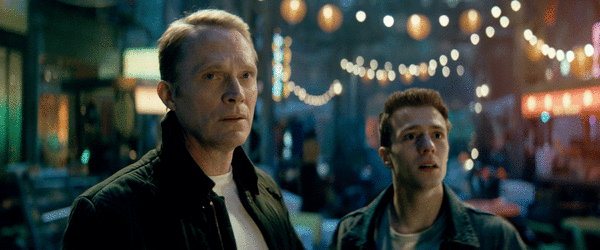
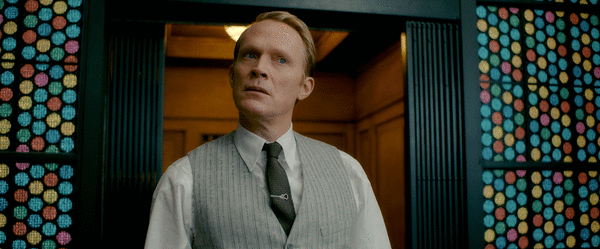


Grief, it would seem, is universal, even if you’re an artificial humanoid with a quantum processor for a mind and the face of Paul Bettany. Such is the central premise of “VisionQuest,” the final part of the Marvel Cinematic Universe’s “WandaVision” trilogy — and the best MCU show since, well, “WandaVision.”
But first, some background (and spoilers): “WandaVision,” the first MCU entry after “Avengers: Endgame,” was an ingenious and heartbreaking examination of Wanda Maximoff’s (Elizabeth Olsen) grief over the death of her romantic partner, the synthezoid Vision (Bettany), with two deceptively simple questions at its witch-magic core: With the power to change reality, what would you do to get back a lost love? And would you ever give it back up? That fantastic show was followed by the uneven “Doctor Strange in the Multiverse of Madness,” a head-trip of a film that showed what happened when Wanda’s grief consumed her. (Spoiler: Lots of violence and lots of deaths, including — seemingly — Wanda’s.) Then came the TV series “Agatha All Along,” a delightfully campy “WandaVision” sequel that followed a centuries-old witch and a teenager (who turned out to be Billy, one of Wanda and Vision’s magically created twins from “WandaVision”) on a quest to obtain what they desire most. Its humor, powered by a dazzling Kathryn Hahn, belied its depth, which was once again mired in shattering loss — but also redemption and hope.
“VisionQuest,” which premieres Wednesday with its first two episodes on Disney+, concludes this setup in wonderful fashion. Following Vision (a returning Bettany, whose top-notch performance made me cry more than once), it tells an affecting story of love and loss, of identity and existentialism, of fathers and sons and the grief of shared trauma — all while dealing with the philosophical questions of whether artificial intelligence can ever be “real.”
Named after but not adapting a 1989 Marvel Comics event (“WandaVision” is actually the closer adaptation of “Vision Quest,” funny enough), “VisionQuest” pivots away from the well-executed gimmicks and mystery-focused structures of the previous two series. Instead, it chooses to be a more direct message of self-discovery, particularly for Vision and Tommy (Ruaridh Mollica), who the show doesn’t even try to pretend is anyone other than Vision and Wanda's son and Billy’s twin. But that’s the rub: Vision isn’t just Vision — the original died in Avengers: Infinity Wars," and the "WandaVision version … well, let's just say it's complicated — and Tommy isn’t just Tommy (equally complicated). How they came to be has left them both with severe identity crises — which is fair, considering all the magic involved. Their clashes and understandings, first as strangers and then as something more fundamental, serve as the emotional heart of the series. It’s a familiar trope — a father and son with a complicated relationship — but one told with finesse and subtlety.
Also familiar, in a good way: Ultron. The genocidal AI from “Avengers: Age of Ultron” has taken up residence in Vision’s gorgeous digital mindspace. (I’m jealous of all the built-in bookshelves.) He’s trapped here, with just the internet and TV shows to entertain him. (The “WandaVision” series is nothing if not a love letter to the power of television.) He still hates humanity, but now it’s just a coin flip if he wants to kill everyone; he’s discovered we are, on occasion, capable of beautiful things. He also finds beauty in our suffering, apparently.
But it’s his many conversations — some heart-wrenchingly serious, most caustically flippant — with Vision and others that makes his return so amazing. James Spader, who voiced the character in “Age of Ultron,” plays him here, and he’s an absolute pleasure to watch. Ultron’s verbal acuity — hypnotic in tone and laced with references to popular TV shows and classical literature and music alike — is second to none, and as sharp as the vibranium that once coated his body, which he lost in that movie.
Other familiar AIs in Vision’s head include J.A.R.V.I.S. (James D’Arcy), E.D.I.T.H. (Emily Hampshire) and F.R.I.D.A.Y. (Orla Brady), each of whom add a well-layered sense of depth to the cacophony in Vision’s mindspace.
But “VisionQuest” doesn’t just take place in Vision’s head. In the real world, Vision is being hunted by the Paladin (Todd Stashwick) while a serial killer named the Butcherbird is taking blood, eyeballs and lives for some mysterious reason. All of these elements, colored by grief in their own ways, eventually come together, though events do get a little … Marvel-y at times in the back half of the eight-episode series. Thankfully, the finale, a powerhouse episode that captures the best and worst of humanity, more than makes up for this slight stumble.
For a show centered on an android, “VisionQuest” is a remarkable dive into the human condition. Yes, there’s all the typical Marvel stuff, including fistfights, superpowers and cataclysmic threats, but it’s so much deeper than that. It’s about the bonds between fathers and sons, about what a family can be, about who we are at our core. Put simply, Vision may be made of vibranium and computer chips, but, for better or worse, he’s just as human as the rest of us.
———
'VISIONQUEST'
Rating: TV-14
How to watch: On Disney+ Oct. 14
———
© 2026 The Seattle Times. Visit www.seattletimes.com. Distributed by Tribune Content Agency, LLC.











Comments