Want to bring in a Chinese EV from Canada? Here's what to know
Published in Automotive News
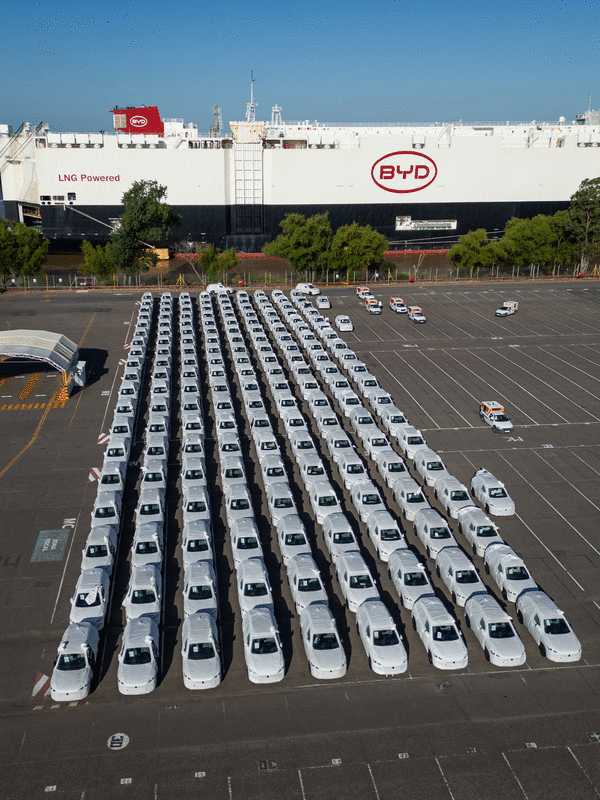
WASHINGTON — Chinese electric vehicles, vaunted for their high tech and low price points, will soon flank the United States auto market from the north and south.
Made-in-China models have already gained a significant foothold in Mexico, accounting for about 1 in 5 new vehicles of all powertrain styles sold in the country last year. And Canada, as of March 1, has begun accepting import applications from Chinese EV makers thanks to a new trade agreement reached in January.
An eventual arrival by the likes of China's BYD Auto Co., Chery Automobile Co. and other formidable EV brands near the northern U.S. border has spooked many in Michigan's auto industry and raised concerns from politicians, such as GOP U.S. Senate contender Mike Rogers of White Lake Township.
"Canada just took Chinese-made cars and dropped them down from 100% tariffs to a 6% tariff," Rogers said in February. Commenting on President Donald Trump's threats to delay the opening of the Gordie Howe International Bridge, he added: "I would like the president to have some leverage to stop thousands and thousands and thousands of Chinese-made cars pouring over the bridge."
But is such a scenario likely, or even possible? And will Michigan residents be able to buy Chinese EVs in Ontario to bring home?
The short answers: Somewhat, but only in a limited capacity. No, they won't.
"A U.S. dealer is not going to be able to go buy a bunch of these vehicles, bring them in and start selling them on day one, as soon as they arrive in Canada," said Tom Healy, an automotive regulatory attorney with the law firm Honigman LLP.
Healy also rejected the idea of Michiganians buying Chinese EVs directly from dealers in Canada: "There's a high likelihood that they wouldn't even get past the border," he said.
In a conversation meant to help separate fact from fiction following Canada's decision to allow up to 49,000 EV imports from the United States' chief geopolitical rival, Healy explained why those purchases would be next-to-impossible nowadays, why they would've been easier in the past, and why some Chinese nameplate vehicles may temporarily end up in the United States despite those barriers.
Chinese vehicles common in these areas
It is likely, Healy said, that the only people able to bring Canada-sold Chinese EVs into Michigan will be Canadian residents on temporary travel — not U.S. residents who shop at dealer lots north of the border. "In the United States, a vehicle can come in for up to a year if it's brought in by a nonresident for personal use," the lawyer noted.
That practice is already common near the U.S. southern border with Mexico. Reddit users in California and Texas frequently post photos of Chinese plug-in vehicles with Mexican license plates on American soil. One user reported seeing one BYD model as far north as New Jersey.
Alejandra Mier y Teran, executive director of the Otay Mesa Chamber of Commerce in California, said in an email that she has seen Chinese EVs on both sides of the San Diego border. She has seen the vehicles on American soil near San Diego, the largest U.S. border city, and pointed out that there are BYD dealers in nearby Tijuana.
Mier y Teran said that may change soon, however, thanks to new Mexican tariffs on Chinese autos following political pressure from the United States.
Scott Webb, president of the New Car Dealers Association of San Diego County, said in an email that he has noticed a "smattering of Chinese brand vehicles from Mexico on the roads of San Diego, but so far, I don’t believe I’ve noticed any EVs."
Webb said it was also common to see vehicles from European and American brands that aren't available for sale in the United States but have crossed the border with Mexican plates. He pointed out a whole Instagram account dedicated to such vehicles.
Similar sightings could start in Michigan in the coming months. But Healy — the Honigman lawyer — emphasized that the owners of those vehicles would need to show their foreign registrations and other ownership documents to customs agents to gain entry into the United States.
And even then, Healy suggested there is no guarantee that the current temporary entrance allowance for foreign residents' personal vehicles will remain in effect. "This is all subject to revision. Customs may, when those vehicles are in Canada, decide that they're just not allowed entry into the United States for any reason," he said.
Imports face regulatory hurdles
There are, theoretically, avenues for Chinese automakers selling in Canada to seek the blessing of American regulators so drivers can legally and permanently bring their vehicles into the United States. But Healy said there would be "administrative and legal hurdles" along the way.
"If a vehicle is less than 25 years old, it has to be brought into compliance with all federal safety standards before it can be imported in the United States," he explained.
The lawyer added that the National Highway Traffic Safety Administration maintains a list of vehicles capable of being brought into compliance. "You can petition the agency to get vehicles added to that list, but it has to be similar to a vehicle that's already sold in the U.S. or have all the safety features required on U.S. vehicles," he said.
Healy noted that Canada does have "very, very" similar safety standards to the United States, but NHTSA would have discretion to decide whether a vehicle is eligible.
After that hurdle, the lawyer pointed out that China-made EVs brought into the United States via Canada would be subject to steep tariffs assessed under the Trump and Biden administrations. Those combined duties exceed 100%, all but eliminating the affordability appeal of the vehicles.
And after that hurdle, there is also a Biden-era Commerce Department rule still in effect that bans the import and sale of passenger vehicles containing internet-connected technology from China. The repeal of that rule would require an act of Congress or a policy shift from the Trump administration.
General restrictions on importing foreign vehicles — from China and elsewhere — are much stricter now than they were several decades ago. "The process used to be easier," Healy said.
"I remember when I was a kid, people talking about their parents, friends, knowing people who would go on European vacations and buy a car. It's not like that anymore. The process has been completely revamped, and you really can't import vehicles that you buy overseas anymore, absent significant expense."
The changes came after Mercedes-Benz dealers lobbied for changes in the Imported Vehicle Safety Compliance Act of 1988, which was later amended in 1999 by the Show or Display rule allowing the import of vehicles with "unusual historical or technological significance."
Healy said trying to use that loophole to buy a Chinese EV wouldn't work because it does not apply to mass-market vehicles.
Trying to buy one anyway
But what if an intrepid, stubborn and foolhardy Michiganian — ignoring all the restrictions — decided to buy a Chinese EV in Ontario and try their darndest to drive it back home?
"The first roadblock they would get is with the (Customs and Border Patrol) agents when they're trying to bring the vehicle into the U.S.," Healy said. "I think the temporary plate from the dealer in Canada would probably set off some alarm bells."
He continued: "Should they somehow manage to get it in, there would be difficulties in registering the vehicle. States maintain lists of recognized manufacturers. And then on top of that, it would also be difficult for them to insure it."
The buyer could try their hand at winning a Show or Display exemption, but Healy said that would be expensive and impractical.
"It's going to be difficult for the average American to successfully navigate the process without legal representation, a consultant or something like that to make arguments and do the research as to why the vehicle should be imported," he said. "And a vehicle that the average American can afford is probably not going to be eligible anyway. It's really for rare vehicles."
And what if a driver lies and attempts to disguise a Chinese EV as some other model? Border authorities have cracked down on such efforts in the past, notably featuring a crusher for illicit vehicles.
U.S. Customs and Border Protection, reached via email, did not provide a comment on whether such heavy-metal efforts might be revived to track Chinese vehicles.
©2026 www.detroitnews.com. Visit at detroitnews.com. Distributed by Tribune Content Agency, LLC.







Comments