Rise in late auto loan payments signals stress on low-income families
Published in Home and Consumer News
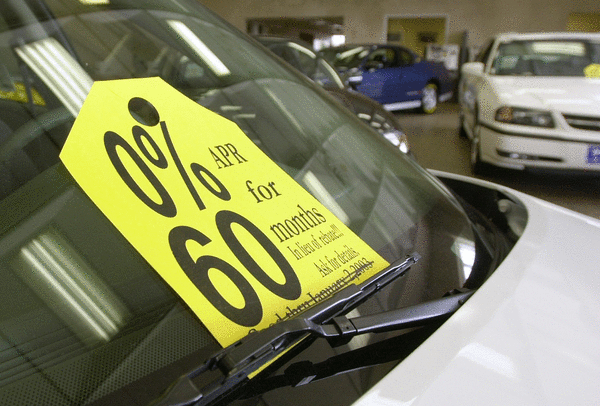
The rise in late auto loan payments is a symptom of an increasingly unaffordable vehicle market, experts say. Households with the lowest incomes are suffering the most.
Auto loan debt is not yet at a crisis point, according to analysts. But economists are closely following late payments as a potential indicator of wider economic stress and trouble for the U.S. auto industry, which has become increasingly reliant on high-price, high-profit pickups and SUVs.
According to a Nov. 24 note from the Federal Reserve Bank, "auto loan debt increased to levels not observed since the Great Financial Crisis (GFC), raising concerns about the health of household balance sheets."
Late payments have been trending up since 2020. About 3.88% of auto loans were past due as of the end of October, according to the Federal Reserve Bank. The rate of late payments has not been this high since 2007 in the lead-up to the Great Recession, when delinquency rates peaked at 4.57% in 2009.
Repossessions hit an estimated 2.3% in 2024, according to the latest available data from Experian and Cox Automotive. Repos were at 3% and greater in 2008 and 2009.
Borrowers who make the least are the feeling the pressure of vehicle affordability the most. Their pain is partly hidden by robust spending by top earners who are propping up the auto industry and overall economy, Bankrate senior industry analyst Ted Rossman said.
“The subprime delinquency rate is about as high as it’s been since the early '90s," Rossman said. "The one somewhat exception is that it actually peaked in January, so this year we saw the highest subprime delinquency rate in about 30 years, a little over 30 years."
“So in other words, it’s worse now than it was during the Great Recession, and the dot.com bust and COVID," Rossman said. "The car repossession rate is at the highest point since the Great Recession.”
Borrowers on average are taking out loans of more than $42,000 loans for new vehicles and $27,000 to buy used, according to Experian data through October. Average monthly payments hit $748 for new models and $532 for used vehicles in that period.
"We’re talking really substantial prices here," Rossman said. "Especially for a two-car family, that could be approaching what you’re paying in rent or mortgage costs.”
The Federal Reserve reported a 30% spike in monthly auto payments between 2020 and 2023, "which in turn contributed to higher auto delinquency rates."
Buyers who took out loans for used vehicles in 2021 and 2022 ― when vehicle prices peaked ― are likely under the most stress, Cox Automotive Chief Economist Jonathan Smoke said in an email.
"While negative equity is common in the first two years of a loan, the depth and duration of underwater loans from 2021 and 2022 is notable," he said. "The stress is likely most acute with buyers who were, at the time, near-prime borrowers who stretched financially to make a purchase and subsequently, with the end of student-loan forbearance, have fallen to a subprime credit tier."
With tariffs, more advanced technology in vehicles, and demand for larger, more expensive SUVs and pickups in the United States, there's little room for automakers to respond with lower prices, said Stephanie Brinley, a principal automotive analyst at S&P Global Mobility.
"They're building vehicles to the lowest price point they can," she said. If automakers made more affordable vehicles "they would lose money on them."
Charity Motors general manager Todd Matthews estimated that requests for free or subsidized vehicles from the Detroit nonprofit went up 20% over the past few years.
"We get maybe a dozen calls a day about someone wanting a free vehicle, or a story that makes you cry," Matthews said. "A veteran, a senior citizen, a mother of five ― we get that all day, every day. It's heartbreaking to work here."
"Not too many people can afford an average car note of what, $800 a month?" he added.
What's driving high payments
Increases in vehicle prices have slightly outpaced wage growth, said Melinda Zabritski, head of automotive financial insights at Experian Automotive. To combat high monthly payments, more prime borrowers are entering the used market, she said.
“It also all comes down to availability. If there’s more availability on the new car side, you’re more likely to have manufacturer incentives," Zabritski said. "If there’s low availability, that’s going to push up prices for both new and used.”
And SUVs and pickups ― pricier than the sedans that used to rule the roads ― are increasingly popular and packed with technology that costs more to make and repair.
“Those are going to be higher price points, so it just automatically drives the used-car market into higher price points just because that’s what’s out there," Zabritski said.
Prices of food and other expenses are up too. Higher interest rates hit new-home buyers harder than people with fixed mortgages.
“One in five new car payments is $1,000 or more a month," Rossman said. "About three-quarters are above $500 a month. This is really straining people’s budgets, and it’s the car price and the associated loan or lease, of course, but it’s also other related things."
To take the edge off high monthly payments, more and more drivers are turning to older SUVs and pickups and increasing the lengths of their loans, Zabritski said.
“Consumers tend to shop for vehicles based on monthly payment,” Zabritski said in a statement.“Although we’re beginning to see interest rates slowly decline, affordability remains top of mindfor many shoppers. It’s not surprising to see some shoppers explore the idea of extending loanterms to secure a lower monthly payment."
Nearly 30% of new vehicle buyers have loan terms of 73 to 84 months, according to Experian. Used buyers have average loans of about 67 months. At the same time, interest rates are higher than during the COVID-19 pandemic but have eased since June from an average of 7.3% to 6.6% in November, while used-car rates have dipped from 10.9% to 10.6%, according to edmunds.com.
Zooming out
The strain on lower-income households to make vehicle payments is not cratering the U.S. auto industry or broader economy, analysts said.
Brinley said unlike during the Great Recession, there's no mortgage crisis now and unemployment is still relatively low, at 4.4% in September, according to the U.S. Bureau of Labor Statistics.
"Unemployment is not the same situation, it's pretty much full employment right now," Brinley said. "Wages are kind of coming up. They're not coming up super fast, but we're in a different environment completely. In the recession period, we had people bail out and just not buy vehicles."
Zabritski said it's "a totally different market than it was back then." She said banks and lenders are planning better for delinquencies and also are not taking huge losses on repossessed vehicles because used vehicles are holding their value longer.
Rossman said spending by top earners continues to insulate the broader economy.
“Consumer spending is really the engine that powers the economy. About two-thirds of economic growth is attributable to consumer spending. And that consumer spending has been surprisingly strong and resilient this year," he said. "Some of it is that people have to, because things just simply cost more, whether we’re talking food, housing, medical care. Just about everything.”
Smoke said for those struggling with high auto payments, next year might be easier.
"Looking ahead, rate relief may come in early 2026, as the Fed is expected to cut rates further and consumers will begin to see the benefit from higher take-home pay and larger tax refunds," he said. "This could improve loan performance and ease lender risk aversion."
©2025 www.detroitnews.com. Visit at detroitnews.com. Distributed by Tribune Content Agency, LLC.






Comments