Illinois researchers say versatile grass could be used for sustainable fuel, building materials and more
Published in Science & Technology News
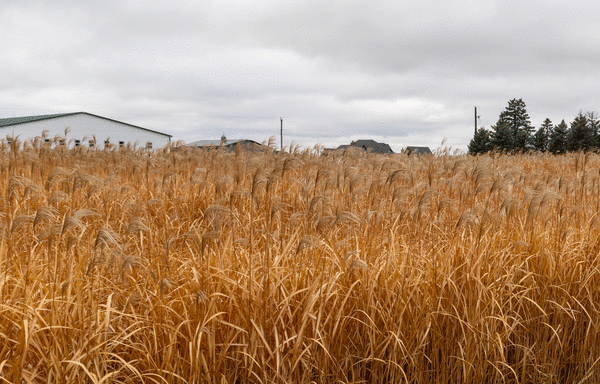
CHICAGO — When you look across a field of miscanthus, it’s “hypnotically beautiful,” says Emily Heaton, whose family farm has for two decades grown the first commercial field of this grass in Illinois. Dense, sun-loving and often called “giant,” it blooms in late summer to fall with a showy silver flower.
Just like cornstalks across the Midwest, this crop grows several feet tall as it reaches up to the sky. And similar to soybean cultivation in the last century, annual production of miscanthus — mostly grown on tens of thousands of acres in the eastern U.S. — is projected to skyrocket to millions of acres by 2050.
The versatile grass has a multitude of end products and uses, including compostable packaging, livestock bedding and erosion control. It can also be used as a solid fuel for electricity and heating, like coal, wood and municipal waste. Scientists are hoping it will open doors to new markets, such as renewable natural gas, sustainable aviation fuel, building materials, and chemicals for household and industrial products.
One variety in particular, Miscanthus x giganteus, has demonstrated “unsurpassed productivity” in the Midwest, according to researchers.
“Miscanthus is a really exciting crop that’s just on the cusp of emerging as a force of the ag-biotech sector,” said Heaton, a professor of crop sciences at the University of Illinois Urbana-Champaign. “As someone who grew up in Illinois, in downstate Illinois, I’m very excited about the opportunities this brings for rural job creation, for rural technology development and community enhancement.”
And it has a smaller carbon footprint than the two row crops that have for decades dominated agriculture in Illinois.
Researchers, growers and industry experts believe in the crop’s potential to strengthen U.S. energy independence, a mission the Trump administration has, for the most part, used to roll back renewable and clean energy incentives, investment and research. It also presents an opportunity for farmers who, affected by tariffs, need additional revenue streams.
“We’re really excited about the prospect of creating domestic supply chains,” said Andrew Leakey, professor of plant biology at the U. of I. and director of the Center for Advanced Bioenergy and Bioproducts Innovation, or CABBI, one of four bioenergy research centers funded by the U.S. Department of Energy, which is studying the possibilities of miscanthus for the country’s agricultural bioeconomy.
For instance, part of the team is working on a new technology to break down miscanthus and convert some of its components into chemicals and oil products for paints, plastics, aerosols, and even into the materials needed for aircraft windows and the hyperabsorbent part of diapers.
All of these are currently made out of petroleum, Leakey said, which is imported.
Since the center’s start eight years ago, Leakey said, scientists from the U. of I. and 19 partner institutions have leveraged and developed technologies to sequence the crop’s genome, genetically engineer and edit it, and use artificial intelligence to more efficiently measure its traits — and turn miscanthus into “a true 21st-century crop.”
A complement, not competition
Despite its growing popularity in the United States, the many benefits and uses of miscanthus are not recent discoveries: It’s an ancient plant that hails from Asia.
“It’s been used for millennia for different bioproducts, everything from forages for animals, but also for roofing materials. And so that was intriguing for us,” both scientists and farmers, Heaton said.
The plant is nonnative throughout North America, where it arrived in the late 1800s, brought in as an ornamental plant.
It spread aggressively in some areas as an invasive, but the commercial kind being grown in the country is a sterile hybrid of the original Chinese silver grass or Miscanthus sinensis and of the Amur silvergrass or Miscanthus sacchariflorus, meaning it doesn’t have seeds and is thus not invasive.
While miscanthus is being studied for use in biofuel, it likely won’t compete with corn production, which has been finely tuned and profitable, for the country’s ethanol market. A third of the corn grown in Illinois is used to make ethanol.
“So we’ve targeted other markets that are more profitable, and they include the (solid) fuel markets,” Heaton said, referring to fossil fuels like coal for energy generation and heating, as well as sustainable aviation fuel.
Miscanthus not only requires little upkeep, but it can also be grown on less desirable farmland.
In Minooka, Billy Murdoch’s business partner Al Kuda bought some land five or six years ago that flooded easily and used to be corn and soybean fields without good yields. After meeting Travis Hedrick, CEO of North Carolina-based AGgrow Tech, the largest producer of miscanthus grass in the country, the pair decided to do a trial run of growing miscanthus on 4 acres.
“We liked the idea of having something sustainable,” Murdoch said. “We’re going to try to give back a little bit, from an environmental point of view, because farm equipment does use a lot of diesel and gasoline.”
Now, the crop covers over 125 acres at their Minooka farm. As vice president of operations at AEC Supply, which sells building and landscaping materials, Murdoch began using the harvested grass encased in netting as an erosion control product to absorb water.
If planted on the margins of food crops, miscanthus crops in Illinois also “can complement the corn and soy ecosystem, not compete with it,” Heaton said. This means potential growers are not presented with an either-or choice; farmers are not forced to adapt to emerging markets at the expense of traditional crops.
“Corn and soybean are very important to Illinois, I don’t think we’re gonna stop growing them anytime soon,” Leakey said. “So we’re viewing miscanthus as something that can complement existing cropping systems, in part, because it grows well on land that is relatively unproductive for our existing crops.”
Heaton said her family farm, where they raise cattle and poultry, has benefited from the presence of miscanthus.
As a perennial, the crop keeps living roots in the ground for most of the year, which helps filter water into the ground instead of letting it flood or run off. It also uses nitrogen from fertilizer, and that is found naturally in rich Illinois soils.
Ultimately, these moisture and nutrient retention qualities improve soil health and water quality, much like cover crops grown to protect soil and prevent erosion, among other things.
“From a farm economy perspective and a rural welfare perspective, this crop is a really nice complement to the crops that we already depend on downstate, the corn and soybean production,” Heaton said. “That opens new doors and new markets for us to innovate, which is really the strength of Illinois farmers, to solve problems and innovate for new domestic abundance.”
High productivity and low risk
Miscanthus x giganteus, commonly called the “Freedom” or Illinois clone, is a hybrid developed at the U. of I. It is used today for solid fuel, animal bedding, packaging products and building materials.
Heaton said it can produce up to four times more organic matter that can be used as a fuel than other similar crops like Bermuda grass, making it economically attractive. Bermuda grass can be used to produce ethanol, among other things.
Also, since it is a perennial, miscanthus only needs to be planted once and can be harvested every year for two or three decades, adding to its cost-competitiveness. In the Midwest, once it is planted, miscanthus takes two to three years to reach full maturity.
“You plant it once, it grows over the course of summer, and then it goes dormant over the winter, and then comes back naturally the following year,” Leakey said.
That means there is only an upfront planting cost for growers, said Hedrick; since 2010, AGgrow Tech has planted over 12,000 acres across 17 states, including Illinois.
“It’s more profitable over time than traditional agricultural crops,” said Hedrick, who is also on the research center’s advisory board. “From a risk standpoint, with being a farmer, it’s just a really resilient crop that is low-risk to grow.”
Because it has a branch-like structure underground, called the rhizome, it can also store energy and nutrients over the winter — allowing it to start growing quickly again in the spring and producing leaves earlier.
“That’s a very efficient way for a crop to grow,” Leakey said, “relative to an annual crop that you have to plant and then just grow for one season, and then you have to plant again the following year.”
The crop also carries out a special kind of photosynthesis that only 10% of plants do, including corn, sugar cane and sorghum.
“You could think of it as being a sort of fuel-injected version of photosynthesis,” Leakey said. “So it doesn’t need to use as much water to make it grow, and it doesn’t need as much nitrogen nutrition, and that’s important in terms of how much it costs to fertilize.”
Hedrick emphasized that miscanthus’s resilience to extreme weather has also made it a very low-risk crop to grow.
“(In) North Carolina, we’ve had a couple hurricanes here that have gone over our farms, and the crop is still productive,” he said. “Out in the Midwest, we went through that derecho that hit a couple years ago that knocked down like 8 million acres of corn (in Iowa). Our crop just made it right through it, no issues. Continues to come back every year.”
Almost 7 million acres of corn and almost 6 million acres of soybeans in Illinois were in the path of the 2020 derecho. The Tribune reported that initial estimates indicated 3.5 million acres of corn and 2.5 million acres of soybeans had been damaged or destroyed.
Chicken and egg
The strongest market in the United States for miscanthus is currently poultry bedding — the benefits of which Heaton can attest to; livestock at her family farm love it.
“Animals are happier, gain weight better, so that they’re more profitable,” she said.
Because it’s harvested dry and it has absorbent properties, it’s very clean and doesn’t retain many germs.
“We’ve learned over the years how to process the grass, chopping it to the right consistency that animals like for bedding,” she said. “So it’s been an evolution of our understanding. But, yes, it’s a very popular bedding.”
She said existing miscanthus markets, such as animal bedding and compostable packaging, enable newer markets like sustainable aviation fuel.
“Miscanthus has so many different opportunities. SiltZero only really serves one particular, small market,” said Murdoch, referring to his erosion control business. “With our miscanthus fields, the yields increase every year, and so we never really run out. So, I mean, we’re always looking for new things to do with miscanthus.”
Leakey said the big challenge for researchers is to help pair up potential producers and potential users of the biomass. He called it a chicken-and-egg situation.
“As a farmer, you absolutely have to have someone to sell it to before you want to plant it,” he said. “But equally, as somebody who might buy miscanthus to turn into high-value products, you don’t want to invest money in a factory until you know you can get a supply.”
It’s not a challenge unique to miscanthus, however. As new crops are grown, producers and buyers have dealt with the same uncertainties in emerging markets.
“So I think that it’s a real challenge, but one that can be overcome, and one that people have overcome on many occasions previously,” Leakey said.
Hedrick has experienced it firsthand at AGgrow Tech, which seeks to connect farmers and landowners to various renewable biomass markets.
“For us, it’s been a challenge, early on, to get markets established. I think that’s the biggest barrier for more miscanthus production in the U.S., is just finding a customer that’s willing to utilize it,” Hedrick said. “I’ve always said farmers will grow anything if there’s a market and it’s profitable, and so for us, it’s (about) getting a market established first, and then those farmers will come along.”
AGgrow Tech’s primary market is poultry bedding, selling to companies like Mountaire Farms, Perdue Farms and Tyson Foods. They also supply to companies making pulp and paper products, as well as erosion control products. The University of Iowa has planted 15,000 acres, which it burns for electricity and heat.
“Using crops that are not only perennial in nature, but they’re also great for the environment, to help fuel our bioeconomy — that’s what we see is the future of miscanthus,” Hedrick said.
Growers like him and Murdoch, who have already bought into the crop’s benefits, are excited to continue supporting new markets for miscanthus.
“We want to see this crop succeed,” Murdoch said.
____
©2025 Chicago Tribune. Visit at chicagotribune.com. Distributed by Tribune Content Agency, LLC.






Comments