AI dominates as CES 2026 opens in Las Vegas
Published in Science & Technology News
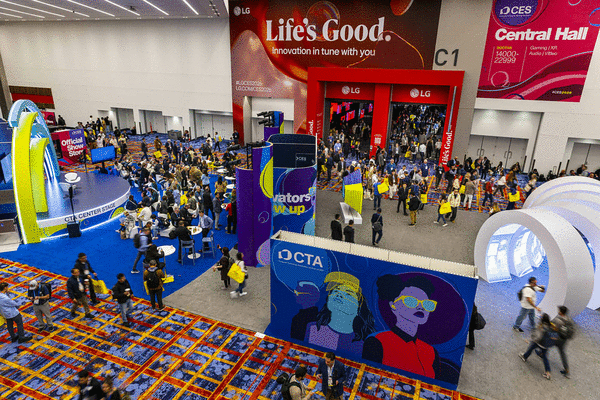
Artificial intelligence dominated the conversation as CES 2026 opened Tuesday. Nearly every major exhibitor framed AI as a tool that can make daily routines smoother, faster and more efficient.
The emphasis was less on far-off science fiction and more on practical systems designed to improve how people live and work right now.
The four-day event takes place across multiple venues, including the Las Vegas Convention Center halls, The Venetian Expo and the Mandalay Bay Convention Center. In addition to the trade show, CES features hundreds of conference sessions with thousands of experts and techies offering insight into the latest trends.
“CES 2026 is where innovators show up — to connect, forge partnerships, and do business on a global scale,” Gary Shapiro, executive chair and CEO of Consumer Technology Association, owner and producer of CES, said in a statement. “All signs point to a phenomenal CES with thousands of exhibitors, a record 3600+ Innovation Award submissions, and innovation across 13 venues and 2.6M net square feet. This is an exciting time for innovation and CES 2026 will have the latest tech in AI, robotics, digital health, mobility, enterprise, energy, immersive entertainment, accessibility and more.”
Industrial and infrastructure companies highlighted this approach through AI-equipped machinery aimed at reducing workloads and minimizing human error. Caterpillar, John Deere and Oshkosh each demonstrated equipment that can analyze real-time conditions and adjust its operations to make construction, farming, airport logistics and emergency response safer and more precise. The companies described these systems as a natural extension of everyday automation rather than a dramatic leap forward.
On the consumer side, the idea of AI improving routine experiences appeared in everything from transportation to home electronics.
Uber, working with Lucid Motors and autonomous tech company Nuro, introduced a new robotaxi with an interior designed for comfort and personalization. Riders can control the climate, seat temperature and music, and the vehicle displays what it is seeing on the road so passengers have full visibility into how the trip is being managed. The companies have already begun road testing in San Francisco and expect the service to expand later this year.
LG also focused on AI as a household convenience. The company’s ultra-thin wallpaper television, which won a Best of CES 2026 award, attracted large crowds. LG also previewed a humanoid robot that is intended to handle simple chores such as folding laundry and retrieving food. Representatives described the robot as an early step toward using AI to assist with time-consuming household tasks.
Non-tech companies also explored how AI can enhance creativity and entertainment.
Lego introduced its new Smart Play platform with sensor-equipped bricks and special minifigures that react to movement, light and proximity. A new partnership with the Star Wars franchise allows users to create interactive battles and scenes that respond in real time.
Delta Air Lines announced a partnership with the Sphere in Las Vegas that will use digital tools to offer SkyMiles members personalized entertainment access and upgraded visitor experiences at the venue.
Across the show floor, countless smaller companies promoted AI as a way to manage home routines, organize digital clutter and simplify everyday decision-making.
___
©2026 Las Vegas Review-Journal. Visit reviewjournal.com.. Distributed by Tribune Content Agency, LLC.






Comments