Commentary: $2,000 tariff checks are a good idea badly planned
Published in Op Eds
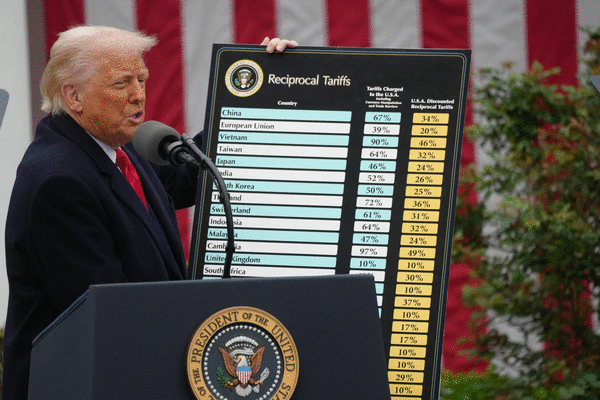
President Donald Trump is promoting the idea of sending a $2,000 check to most Americans funded by revenues brought by his tariffs on imports.
The scheme has received a frosty reception from Trump’s fellow Republicans in Congress and economists alike, and they are unlikely to happen. If the White House really wants to ease the burden that tariffs have created for lower-income households, then it might want to look to our neighbor to the north, Canada, which has become a global leader in making consumption taxes more equitable.
Tariffs, which total around $200 billion this year through October, are essentially a regressive consumption tax. The duties are paid by importers, which then try to pass their added costs to their customers, which typically increases the prices of imported goods paid by consumers. That’s the tax.
Even when the prices paid are the same across all consumers, the loss of purchasing power is greatest for those with the least income. Because lower-income households already spend a higher share of their income, they must spend an even greater percentage of their incomes when prices rise due to tariffs.
The regressivity of the Trump administration’s tariffs is substantial. The Budget Lab at Yale estimates the costs to consumers in the near term will be 2.4% of annual income for households in the bottom earnings decile. For the top decile, it’s only 0.8% of income. The burden is three times larger for the bottom than the top, so tariffs reinforce the “K-shaped” dynamics in the economy. In addition to being less equitable, regressive taxes magnify the severity of a recession, since a household’s after-tax resources fall faster than their income.
Tariffs are clearly not an ideal way to raise tax revenue. But a better design could mitigate some of the economic harm to lower-income households. Several countries use targeted payments to offset the regressivity of consumption taxes. Canada is a prime example. It pairs a value-added tax on most goods and services with quarterly payments to low- and moderate-income households based on family income, marital status and the number of children.
The purpose is to counteract the regressivity of the tax. The total credits accounted for 12% of consumption tax revenues, according to a government evaluation in 2017. The credits more than offset the cost of the tax for the lowest decile of households by income and reduced the cost for other low and moderate-income households with the relief tapering off as income rises. Pairing the consumption tax with the quarterly credits almost entirely reversed its regressivity. In 2022, the Canadian government doubled the credit for six months to help offset the rise in inflation rates.
A revamp of Trump’s $2,000 payments, guided by Canada’s experience, would require several changes. First, payments should be much smaller and calibrated to the burden caused by the tariffs. The tariffs, according to the Budget Lab, cost households in the lowest decile less than $1,000 annually, and the median household cost is $1,400. Next, to compensate for the regressivity of tariffs, the payment should be tied to household income and phased out as income rises.
Also, a quarterly payment or a monthly payment would be better than a large one-time payment. The smaller, recurring payments would more closely match the extra costs incurred from regular purchases of goods. It would also be less inflationary because it would have a smaller effect on aggregate demand. Research on prior stimulus programs showed that consumers spend more from a large one-time payment than from smaller repeated payments. Smaller, repeated payments also spread the boost to aggregate demand out over time, limiting the risk of inflationary supply-demand imbalances.
Easing the burden of tariff policy on lower-income households is particularly important given other regressive policy changes this year. The Congressional Budget Office estimated how the provisions in the One Big Beautiful Bill Act would affect different income groups. While, on average, households were expected to see an increase in resources during the next 10 years from the legislation, those of low-income households were expected to decrease largely due to cuts in Medicaid and food stamps.
The $2,000 checks would be attention-grabbing, but they are poorly targeted and could end up creating even larger affordability problems than the tariffs. The White House needs to be clear about the burden that tariffs as a consumption tax impose and craft policies to lessen the harm on the least well-off. Canada won’t ever be our 51st state, but it can be a role model for our national policy.
_____
This column reflects the personal views of the author and does not necessarily reflect the opinion of the editorial board or Bloomberg LP and its owners.
Claudia Sahm is the chief economist at New Century Advisors and a former Federal Reserve economist. She is the creator of the Sahm rule, a recession indicator.
_____
©2025 Bloomberg L.P. Visit bloomberg.com/opinion. Distributed by Tribune Content Agency, LLC.


















































Comments