Commentary: Pete Hegseth's contempt for military rules of engagement on display in the Caribbean
Published in Op Eds
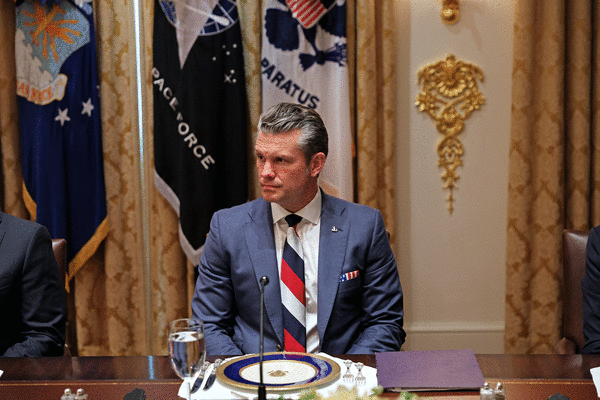
We are starting to see the consequences of Defense Secretary Pete Hegseth’s open disdain for military lawyers. The recent war crime allegation reported by The Washington Post was a long time coming.
Since September, Hegseth has ordered at least 21 strikes on civilian fishing boats in international waters, killing more than 80 people so far in what is being called Operation Southern Spear.
I served as a judge advocate, or military lawyer, for eight years in the Army Reserve, including 3 1/2 years on active duty. As a national security law attorney in Iraq, I advised commanders on the application of the rules of engagement and the law of armed conflict to the full spectrum of operations against the Islamic State in Iraq and Syria. I’ve also been involved with shaping rules of engagement requests during the planning of operations in other theaters.
Even a freshly minted judge advocate out of the basic course might identify Operation Southern Spear’s strikes as violations of U.S. obligations under international law, not to mention Department of Defense policy. Hegseth’s argument that the boats are manned by drug traffickers doesn’t change the legal analysis.
Why are we in this predicament? Because Hegseth has contempt for anyone standing in his way of playing TV solider on Fox News and impressing President Donald Trump.
In his 2024 book “The War on Warriors,” Hegseth recounts openly disparaging the rules of engagement during his 2005 deployment to Iraq and referred to judge advocate generals, or JAGs, as “ jagoffs.” During his confirmation hearing before the Senate, Hegseth described a jagoff as “a JAG officer who puts his or her own priorities in front of the war fighters, their promotions, their medals, in front of having the backs of those making the tough calls on the front lines.”
The Senate, in an act of malfeasance, confirmed Hegseth, and within his first month on the job, Hegseth fired the top ranking legal officers in the Army and the Air Force. Hegseth tried to justify the firings, explaining that these JAG positions were “roadblocks to orders that are given by a commander in chief.”
Hegseth continued to push military lawyers out of their roles advising commanders, going so far as to send them to other departments. For example, in August, DOD memos reached the press, revealing a plan to send 600 judge advocates to the Department of Justice to serve as judges in immigration court. This plan was particularly notable as it placed members of the military in control of civilian court matters that have no military nexus.
In September, Hegseth gathered the military’s top officers for a televised rally. Among his speech’s alarming elements, his most dangerous idea was his open contempt for what he called “stupid rules of engagement.” He proceeded: “We untie the hands of our war fighters to intimidate, demoralize, hunt and kill the enemies of our country. No more politically correct and overbearing rules of engagement.”
Fast-forward to last Friday. The Washington Post reported that a Sept. 2 boat strike left two survivors, until Hegseth issued a verbal order to “kill everybody.” The subsequent second strike eliminated the two survivors.
If the reporting is true, Hegseth committed a war crime. Either the boat crew members were civilians or combatants. If civilians, the law of armed conflict prohibited targeting them at all. If combatants, as Hegseth argues, the first strike would have rendered them “hors de combat.” This status, literally “out of combat,” applies when a combatant is rendered unable to participate in fighting. The law protects hors de combat individuals, and they may not be intentionally targeted.
Also if true, the chain of command that carried out such a patently illegal order facilitated a war crime. Ordinarily, the appropriate step for investigating senior leader misconduct is for the department’s independent inspector general to conduct an investigation into the allegations. However, the DOD’s inspector general, Robert Storch, was one of the 17 inspectors general that Trump fired after taking office. A federal judge ruled in September that the firing was unlawful, but the DOD still remains without a new permanent inspector general.
In the absence of executive branch review, the only available check is congressional oversight.
Regardless of partisan affiliation, elected officials should seek to ensure that the appointed leader of the world’s most powerful military does not continue down the road to war crimes.
I have advised on the application of the rules of engagement and the law of armed conflict on the field of battle, and following these rules helps keep our troops safe. Any soldier, officer, commander, secretary of defense and even president of the United States must be held accountable for violations.
____
Dan Tully is a major in the Army Reserve and a judge advocate, and he is running for Illinois’ 8th Congressional District. Use of military rank, titles, insignia, marks or photographs in uniform does not imply endorsement by the U.S. military or the Department of Defense.
___
©2025 Chicago Tribune. Visit at chicagotribune.com. Distributed by Tribune Content Agency, LLC.


















































Comments