David M. Drucker: The GOP's next leader will need more than populism
Published in Op Eds
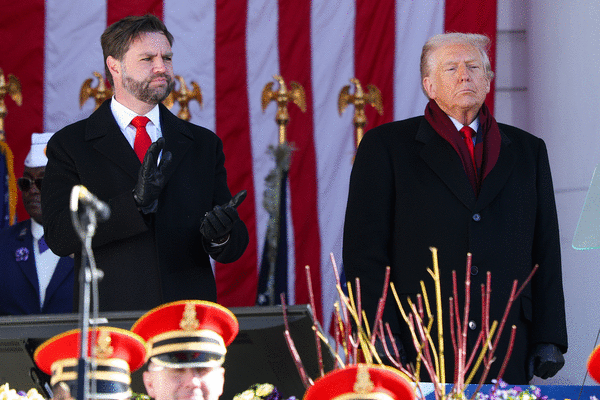
President Donald Trump has always been just insider-enough to placate the Republican establishment and just outsider-enough to excite conservative populists. But keeping that political coalition together will be difficult for his successor in 2028.
Indeed, less than a year into Trump’s second presidency, the electoral consortium that made him only the second president to serve non-consecutive terms is showing signs of strain. That’s the best way to understand Republican infighting over Trump’s handling of the Jeffrey Epstein affair, as well as fresh fighting on the right over whether the GOP should tolerate antisemites and racists for the (presumed) sake of electoral expediency.
That’s also the prism through which to view the Republicans’ intraparty debate over extending Obamacare health insurance subsidies — and the fact that congressional Republicans are beginning to demand more information from the Trump administration about U.S. military strikes on suspected drug traffickers in the Caribbean.
“Trump has truly been a one-of-a-kind political figure,” Jeffrey Brauer, a political science professor at Keystone College, near Scranton, Pennsylvania, told me. “Cracks are beginning to emerge in the MAGA coalition.”
The “MAGA coalition,” aptly named for Trump’s “Make America Great Again” slogan, is often associated with the populist conservatives who have flocked to him. A significant percentage are low-propensity voters, or as Brad Todd and Salena Zito called them in their 2018 book, The Great Revolt: Inside the Populist Coalition Reshaping American Politics, “Perot-istas.” Why?
Prior to 2016, many might not have pulled the lever for a presidential candidate since Ross Perot, another billionaire populist businessman and political outsider, was on the ballot. They might go dormant again after Trump, 79, fades from the scene.
But an often-disregarded ingredient in the president’s success and staying power has been consistent buy-in from establishment GOP figures and regular Republican voters.
While populists have seen Trump as the common-sense, street-fighting political outsider who would finally turn Washington on its head, rank-and-file Republicans influenced by the Reagan era have seen in Trump a boardroom businessman who would roll back government regulations, cut taxes and shrink government.
The big unknown for the Republicans: Can they find a standard-bearer in 2028 with Trump’s knack for attracting support from the two disparate wings of their party?
“Anytime a party loses a dominant figure as its leader there’s always anxiety whether the winning coalition will hold. It happened after Kennedy, Reagan, and Obama,” Republican media strategist Alfredo Rodriguez, who is based in Texas, told me, referring to Presidents John F. Kennedy, Ronald Reagan and Barack Obama.
“Whether the (MAGA) coalition holds together or fractures some is a legitimate question to ask,” Rodriguez conceded. But he added: “The idea the Republican Party is certain for doom without Trump on the ballot is way overblown.”
For now, most Republican insiders I talk to expect Vice President JD Vance, 41, to be the GOP’s 2028 nominee. That’s not rocket science. Vance will likely have the backing of Trump and key members of the president’s family — Donald Trump Jr. in particular — not to mention a growing political machine of his own.
Some party stalwarts speculate that Secretary of State Marco Rubio, 54, is positioned to be selected as Vance’s running mate. (Rubio sought the White House in 2016 and was on Trump’s short list for vice president in 2024.)
Vance leading the GOP ticket would also suit a number of Republican operatives in the president’s political orbit. That fits; Vance has enjoyed a meteoric rise in the Republican Party. However, he can at times ring more populist than Trump and has yet to demonstrate the president’s canny ability to also appease the Reaganite establishment. Still, the vice president’s boosters see a politician with the right political skill set — once he grabs the baton from his boss.
“To me, the bridge between the populists and the establishment — it can be done with humor. I really like what JD Vance did at Halloween, for example,” said Jack Kingston, a former Republican congressman from Georgia who is now a contributor at Newsmax. Kingston was referring to Vance showing some self-deprecating humor by dressing up as an Internet meme of himself.
I’m more interested in the answer to two questions: First, will any substantial, viable Republican dare challenge a Trump-backed Vance after watching what happened to the president’s GOP opponents in 2024? And if so, will any Republican on that list include a Reaganite politician who attempts to push the GOP away from big-government populism and back toward traditional, constitutional conservatism? Senator Ted Cruz of Texas, the runner-up for the nomination in 2016 and known to be interested in trying again, belongs on this watch list.
How Republicans fare in next year’s midterm elections could determine whether there’s a market for that — or at least, whether some enterprising Republican is willing to explore if such a market exists.
_____
This column reflects the personal views of the author and does not necessarily reflect the opinion of the editorial board or Bloomberg LP and its owners.
David M. Drucker is a columnist covering politics and policy. He is also a senior writer for The Dispatch and the author of "In Trump's Shadow: The Battle for 2024 and the Future of the GOP."
_____
©2025 Bloomberg L.P. Visit bloomberg.com/opinion. Distributed by Tribune Content Agency, LLC.









































Comments