George Skelton: Courage lacking to fix state's deep-rooted budget shortfall
Published in Op Eds
SACRAMENTO, Calif. — It’s almost like slapstick comedy — the budget act that California’s Legislature and governor perform every year.
OK, it’s not really funny. But it is a joke — all the gymnastics the politicians go through trying to hide their red-ink spending and convince us they’ve met their legal obligation to produce a balanced state budget.
“Balanced” means having enough money to pay for all the authorized spending. But it’s largely guesswork. And the budget often is balanced only on paper. The state pencils in whatever numbers are needed to “balance” the books.
“They always cook the numbers,” gubernatorial candidate Antonio Villaraigosa told me last spring.
Villaraigosa, former Los Angeles mayor, knows firsthand about “cooking.” He once was in the kitchen as a powerful state Assembly speaker.
“Every finance person does it,” he said. “But there’s got to be a limit. At the end of the day, you can cook [numbers] so much they’re not real.”
The nonpartisan Legislative Analyst’s Office reminded us of this in a recent report. It warned of a growing state budget deficit for the next fiscal year beginning July 1.
In polite language, the analyst basically said that the current “balanced” budget — as Villaraigosa might put it — isn’t “real.”
“The budget problem is now larger than anticipated, despite improvements in revenue, and the structural deficits are significant and growing,” Legislative Analyst Gabriel Petek wrote.
“Structural deficit” is governmentese for taxes and spending being out of balance.
“The Legislature faces an almost $18 billion budget problem in 2026-27,” Petek reported. “This is about $5 billion larger than the budget problem anticipated by the [Newsom] administration.”
“Budget problem” is Sacramento lingo for deficit.
Petek predicts even more red ink in the future.
“Starting in 2027-28, we estimate structural deficits to grow to about $35 billion annually, due to spending growth continuing to outstrip revenue growth,” the analyst wrote.
But that will be the next governor’s headache. It’s not uncommon for a departing governor to dump red ink all over his successor.
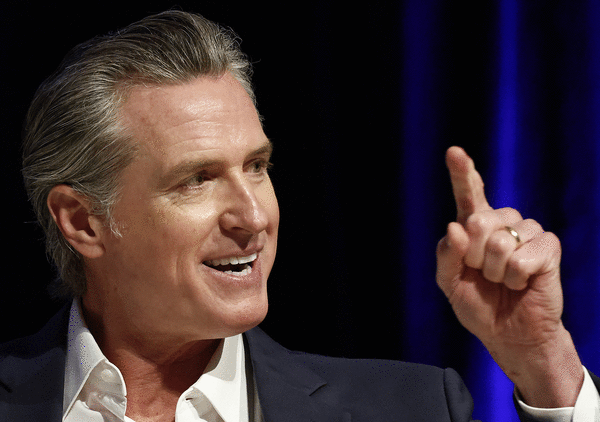
Right now, Gov. Gavin Newsom is finishing up the last budget proposal of his two terms. He’ll send it to the Legislature in early January.
Newsom’s deficit projection will be different from the legislative analyst’s, says H.D. Palmer, the governor’s budget spokesman. That’s mainly because Newsom will be using fresher data, the aide adds. The governor’s projected deficit size still hasn’t been determined, he says.
Translation: It’s still being cooked.
So far in Newsom’s reign, his budgets have mushroomed by 51% to $325 billion from $215 billion. But that’s not extraordinary growth under a California governor, Democrat or Republican.
Why does deficit spending matter? It’s akin to never fully paying off the credit card and wasting money on interest rather than retiring principal debt. In fact, it’s often just piling on more debt.
It’s kicking the can down the road and not ever tossing it in the trash.
The politicians employ various tricks to paper over deficit spending.
The state often borrows from itself — robbing Peter to pay Paul — by shifting money from one kitty to another, usually to the main checking account: the general fund. This often results in the delay or demise of a promised program that was to be funded by the tapped kitty.
Or lawmakers may raid bond money and use it for a purpose disguised as what voters thought they had actually approved.
They’ve even paid state employees on July 1 rather than June 30 so the spending could be counted in the next fiscal year.
All this gimmickry results in an unstable budget system.
The legislative analyst advised legislators to fix the problem with “achievable spending reductions and/or revenue increases” — cutting programs or raising taxes. Duh!
But the Democratic-dominated Legislature won’t do that because whacking certain programs would anger interest groups that support the lawmakers’ election campaigns. And raising taxes in this high-tax state is a political no-no for all but the most lefty Democrats.
Former state Controller Betty Yee, a gubernatorial candidate who once was state budget director, has long advocated reforming California’s outdated and very volatile tax system. It relies too heavily on rich people’s incomes, especially their capital gains fueled by Wall Street. Tax revenue booms in good times and goes bust during recessions.
Yee says if it were politically possible — which it never has been — she’d extend the sales tax to some services used by the wealthy, including country club memberships. She’d also cut back on corporate tax loopholes.
Petek, in his analysis, cautioned that “California’s budget is undeniably less prepared for downturns” than previously. He also said the stock market is “overheated” and “unsustainable.”
But it seems beyond the lawmakers’ ability to creditably balance taxes and spending.
“Legislators inherently think that balancing the budget is the governor’s responsibility,” says Rick Simpson, a retired longtime legislative consultant to several Democratic Assembly speakers. “And it’s way easier to spend than to cut.”
“The leadership in both houses also care a lot more about making the [legislative] members happy than fixing the budget.”
Simpson also blames term limits. They’ve caused legislators to focus less on the state’s long-term interests and more “on the next office they’re going to run for,” he says.
Democratic consultant Steve Maviglio, who also has been an advisor to speakers, says: “There’s no upside for a politician to tackle nagging budget deficits. It’s much easier — and offends fewer allies — to paper it over and dump it in the lap of your successor.”
He adds: “No one runs for office wanting to slash and burn, except perhaps a few Republicans. But even they have pet priorities.”
So, Sacramento’s comedy of errors plays on year after year.
©2025 Los Angeles Times. Visit at latimes.com. Distributed by Tribune Content Agency, LLC.


































Comments