Lisa Jarvis: CDC panel's hepatitis B vaccine vote undid decades of progress
Published in Op Eds
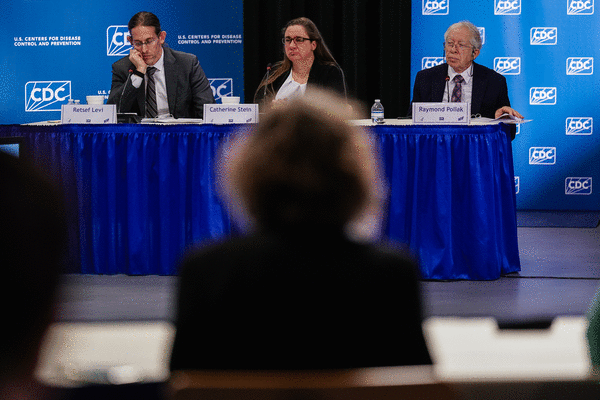
In a stunning decision that defies all expert advice and scientific evidence, the influential group that shapes U.S. vaccine policy will no longer recommend that all infants receive the hepatitis B vaccination shortly after birth.
It’s a dangerous change that will cause real harm, made by a panel — the Centers for Disease Control and Prevention’s Advisory Committee on Immunization Practices (ACIP) — tasked with protecting public health. Equally alarming as the decision itself was the process by which it was made — a process that demonstrates how this committee, handpicked by Health Secretary Robert F. Kennedy Jr., could use its authority to undermine access to and confidence in other routine shots.
And while it had been signaled that the group would make the change, the vote left no doubt that Kennedy’s anti-vax agenda is now being actively implemented.
Amy Middleman, a pediatrician representing the Society for Adolescent Health and Medicine, told the panel it was the first time in her 21 years as a liaison to ACIP that a vote would put children in the U.S. at a greater risk of disease and death. “Data show the universal hepatitis B birth dose recommendation increases adherence to the vaccine,” she said. “Any policy that weakens that recommendation and allows children to fall through the cracks of an imperfect medical system will harm children.”
The data supporting the safety and efficacy of the hepatitis B vaccine is unambiguous — though panel members and the “experts” brought to make presentations during the two-day meeting worked hard to suggest otherwise. Historically, the CDC’s internal experts have played a prominent role in these meetings, presenting vaccine data and answering questions in a cogent, dispassionate, and evidence-based manner. And while Kennedy’s ACIP panel had included presentations from agency scientists in its first two meetings, this time the floor was ceded to vaccine skeptics and deniers. On the topic of hepatitis B, that included climate scientist and vaccine critic Cynthia Nevison and businessman and known anti-vaccine activist Mark Blaxill.
They sifted through the evidence in search of harm. When nothing credible could be found, they cast suspicion on routine side effects, such as fatigue or mild fever, which they instead framed as possible signs of a serious brain infection — despite no supporting evidence. The message throughout was that some signal might have been missed or ignored among the many billions of vaccine doses administered over the last several decades.
Those experts and several ACIP members also downplayed the value of the vaccine, repeatedly suggesting the risk of disease to infants is minimal and advocating for a more personalized approach to vaccination, one that hinges on knowing whether a mother is infected with the virus.
The real experts — namely, pediatricians and hepatitis B researchers — tried to point out the problems with this reasoning. For starters, somewhere between 12 and 18% of women don’t get tested for hepatitis B during pregnancy. Meanwhile, the risk appears low because public health efforts have brought down the rate of infection over the years of sustained vaccination.
“This disease has become a victim of the vaccine,” said ACIP panel member Cody Meissner, one of the few voices of reason. He explained that the infection rates had dropped so low because of decades of recommendations to vaccinate children at birth. “But that doesn’t mean the virus has gone away. It’s a mistake to say, because we’re not seeing much disease, we can alter the schedule,” he said. “We will see hepatitis B infections come back.”
Beyond the terrible outcome for children in the U.S., some of whom will needlessly suffer from a preventable infection, the panel’s proceedings are a harbinger of more bad vaccine decision-making to come. Friday night, President Donald Trump, calling the U.S. an “outlier,” instructed the nation’s health agencies to begin aligning the childhood vaccination schedule with that of peer nations. This project will almost certainly lead to other major changes by ACIP.
The presentations, discussion, and ultimately the vote to change the universal hepatitis B vaccine recommendation lay out a worrisome blueprint for how existing and future vaccines will be evaluated. It’s a simple plan: demand that all shots prove the unprovable. Set an unattainably high bar for safety. Expect an unattainable set of data. Misconstrue the disease’s risk by focusing on the individual rather than the collective.
With those standards, all the clinical and real-world evidence in the universe — and, to underscore, there are vast amounts of data supporting hepatitis B vaccination in infants — is never going to bring many members of the group around.
Those standards seem to be shaped by committee members’ lingering grievances around Covid vaccine recommendations and mandates. The pandemic cemented a view that parents, not the government, should decide what’s best for a child’s health. ACIP cochair Robert Malone got to the heart of the issue on the second day of the meeting: “My personal bias is to enable individual decision making and individual rights over the rights of the collective,” he said. The committee, he said, was “torn by two conflicting points of view,” one, like his, that centers on individual rights and another focused on the benefits to society.
While surely many are sympathetic to the desire for parents to have agency over decisions crucial to their children’s health, Malone’s view — one clearly shared by many others on the panel — is a gross misunderstanding of ACIP’s mandate. The group’s role is to carefully weigh recommendations for the entire population to maximize public health benefits (and minimize risks) from a vaccine.
Meanwhile, as Malone was repeatedly reminded, ACIP’s vaccine recommendations are not themselves mandates. They influence and, in some cases, dictate insurance coverage, shape many states’ public health guidance, and serve as a critical guide for physicians as they talk to patients. Ultimately, though, parents do have the ability to make decisions in concert with their child’s doctor.
But when the CDC’s panel relies on vaccine deniers over experts and applies an impossibly high standard to evaluate vaccines, it isn’t empowering parents to make better decisions. It’s leading them astray. Its advice, then, can no longer be taken seriously, nor can the committee be considered the standard bearer for public health.
----
This column reflects the personal views of the author and does not necessarily reflect the opinion of the editorial board or Bloomberg LP and its owners.
Lisa Jarvis is a Bloomberg Opinion columnist covering biotech, health care and the pharmaceutical industry. Previously, she was executive editor of Chemical & Engineering News.
©2025 Bloomberg L.P. Visit bloomberg.com/opinion. Distributed by Tribune Content Agency, LLC.











































Comments