Commentary: Here are the life-and-death stakes of the debate over Affordable Care Act subsidies
Published in Op Eds
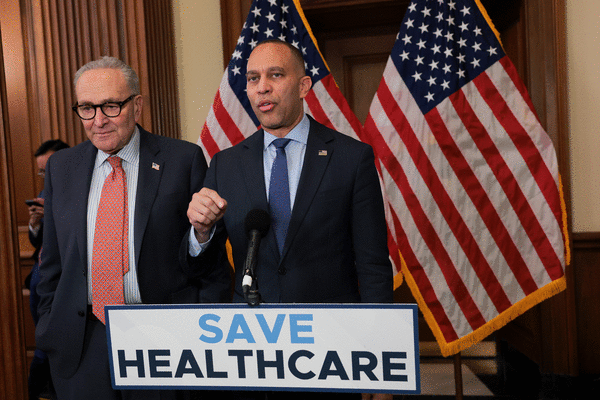
The government shutdown may be over, but Congress still hasn’t solved the biggest problem left on its plate: Extend the expiring Affordable Care Act subsidies to avoid a doubling of insurance premiums or replace them with something new altogether. Lawmakers have committed to a vote in December.
While public debate about the issue has centered on dollars and deficits, the stakes are actually far greater: Access to comprehensive health coverage can determine whether people live or die.
A new idea is now gaining traction among some lawmakers: Let the subsidies expire and replace them with federal deposits into health savings accounts. These deposits wouldn’t lower the cost of buying a plan. Instead, the proposal assumes that people would purchase cheaper, limited coverage — such as high-deductible or catastrophic plans, which often come with deductibles around $6,000 — and then use the HSA funds to help pay the medical bills those plans don’t cover.
But HSA deposits do nothing to prevent the real harm. The health consequences of losing insurance — or of having insurance that is difficult to affordably use — are well documented. A substantial body of research shows a clear relationship between lack of comprehensive coverage and higher death rates.
The U.S. Supreme Court once observed that “the power to tax involves the power to destroy.” In the context of health insurance, the converse is true: Withdrawing support for comprehensive coverage can be destructive as well. It affects not just how people pay for care but also whether they receive care at all.
One of the clearest demonstrations of this comes from a randomized study in which researchers partnered with the Internal Revenue Service to send informational letters about health insurance to millions of households. Only some households received a letter, and because the letters significantly increased enrollment, the researchers could reliably measure the effect of gaining coverage.
The findings were striking: For every 52 people who gained health insurance, one life was saved. Scaled to the 3.8 million people projected to lose insurance by the expiring subsidies, the potential death toll reaches into the tens of thousands — even if the real-world effect is only a fraction of the study’s estimate.
Why does comprehensive health insurance matter so much? There are several proven ways that having meaningful coverage improves health.
One is the ability to seek timely care when something feels seriously wrong. Studies show that people without coverage often delay or avoid going to the hospital when they have serious symptoms such as chest pain or shortness of breath because of cost. These delays can be deadly: Timely treatment for heart attacks, strokes and other emergencies is one of the most consistent ways insurance reduces mortality.
Even when emergencies are covered after the deductible, the fact that patients must pay thousands of dollars out of pocket first leads many to avoid seeking care altogether — and catastrophic plans would amplify this effect. Studies of high-deductible health plans show enrollees delay evaluation of chest pain, avoid emergency departments for concerning symptoms, and experience worse outcomes in heart attacks and diabetic crises.
Insurance also plays a crucial role in catching serious diseases while they are still treatable. People are far more likely to seek preventive care when insurance makes it affordable (or as our own research has found, when insurance makes it free ). A JAMA Oncology study of 177,075 women found those without private insurance were much more likely to be diagnosed with late-stage cancer, resulting in survival rates far lower than women with comprehensive coverage.
Just as important is what happens in the day-to-day management of chronic conditions. A large body of research— including our own— shows uninsured and underinsured people often delay or skip this routine care because of cost, even when they know it will worsen their health. High deductibles re-create this dynamic: Patients routinely forgo essential medications, diabetes management or blood-pressure checks until they meet thousands of dollars in out-of-pocket expenses.
Federal HSA deposits help only at the margins; a modest contribution cannot meaningfully offset a $6,000 deductible. Cost-sharing continues to shape behavior, leading many, and especially those with limited means, to postpone care until it is too late.
As Congress approaches its December vote, it is essential to consider not only the budgetary implications but also the extensive evidence linking insurance to health and survival. The research record is clear: The affordability of real, comprehensive insurance is not an abstract policy question. It has direct, measurable effects on life and death.
____
Wendy Netter Epstein is a professor of law and the former faculty director of the Mary and Michael Jaharis Health Law Institute at DePaul University. She is a public voices fellow of The OpEd Project. Christopher Robertson teaches law and public health at Boston University and Harvard University. His most recent book is “Exposed: Why Our Health Insurance Is Incomplete and What Can Be Done About It.”
___
©2025 Chicago Tribune. Visit at chicagotribune.com. Distributed by Tribune Content Agency, LLC.
















































Comments