Commentary: When did the Supreme Court stop caring about public opinion?
Published in Op Eds
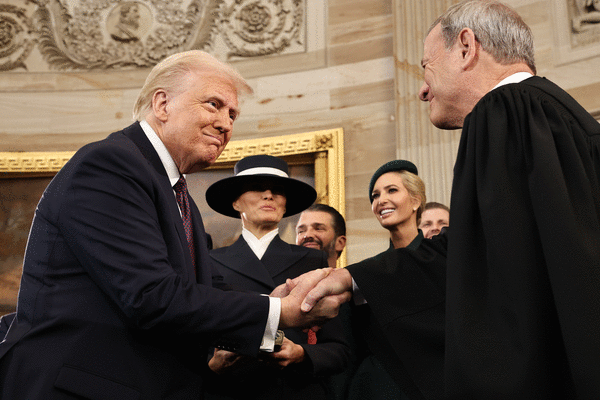
The Supreme Court will decide numerous politically and socially important cases throughout this term, with implications for redrafting congressional maps, campaign finance rules, the death penalty, transgender rights and much more on the docket. But do not expect the court’s decisions on these cases to honor the past.
Under Chief Justice John G. Roberts Jr., the Supreme Court has shown a seeming hostility to the foundational concept of honoring precedent, and neither legal nor institutional precedent now constrain the justices’ decisions to the extent they once did.
Legally, the court questioned 90 years of precedent by allowing President Donald Trump to fire federal agency leaders without cause, and Justice Clarence Thomas has raised doubts about the foundations of some settled law, stating that precedent must be based on more than “just something that somebody dreamt up and others went along with.”
Institutionally, the court has largely departed from historical patterns — especially since about 2016 — relying more on the “shadow docket” and showing less deference to lower courts, including overturning lower court rulings with little explanation.
The Roberts court’s pattern of deciding rulings contrary to public opinion reflects another major departure from tradition. No one expects the court to perfectly mirror public preference, as lifetime appointments and the nomination process — as opposed to being elected — insulate justices from the need to pander. Historically, however, Supreme Court justices have understood the perils of completely ignoring public opinion.
In 1788, Alexander Hamilton noted in Federalist No. 78 that the judiciary “has no influence over either the sword or the purse” and thus cannot enforce its decisions. For this reason, the Supreme Court has an incentive to avoid straying too far from the will of the people. As former Justice Benjamin Cardozo once explained, “The great tides and current which engulf the rest of men do not turn aside in their course and pass the judges by.”
In our previous analysis covering nearly half a century of the Supreme Court’s decisions, we found that when the public becomes more liberal (or more conservative) the court’s decisions tend to follow. This holds even when we consider the pivotal swing justice’s vote. And we find that when the court deviates from public opinion, confidence in the court tends to wane.
This long-standing relationship between public opinion and Supreme Court decisions no longer exists. We’ve separately analyzed the tenure of every chief justice since Earl Warren took his oath in 1953. While public opinion is not the only thing that matters, for more than 50 years, the court was often in sync with the masses during the tenures of Warren (1953-1969), Warren Earl Burger (1969-1986), and Rehnquist (1986-2005). And when public opinion shifted, the Supreme Court followed.
However, when we analyze decisions during Roberts’ tenure as chief justice, starting in 2005, we find a negative relationship, indicating that the court has tended to move away from public opinion. Justice Cardozo’s words no longer apply. Not only are the “tides and current” that affect society passing the Roberts court by, but the court’s decisions have pushed against these tides.
Given the unprecedented negative relationship between the public’s preferences and Supreme Court decisions in recent years, perhaps not surprisingly, the public’s disapproval of the Supreme Court has risen steadily during Roberts’ tenure.
To be sure, the court should not pander to the public. And in rare cases, legal and institutional precedents may need to be reconsidered. But the court’s seeming disregard of precedent and the public under Chief Justice Roberts has undone much of what the Supreme Court has historically stood for.
Unless the court reverses course, public confidence will continue to decline; the Roberts court will be remembered for disregarding long-standing doctrines and potentially permanently damaging the court’s esteemed position.
____
Peter K. Enns is a professor of government and public policy at Cornell University and a co-founder of Verasight.
Patrick C. Wohlfarth is a professor of government and politics at the University of Maryland, College Park.
©2025 Los Angeles Times. Visit at latimes.com. Distributed by Tribune Content Agency, LLC.












































Comments