Commentary: Colleges oversold education. Now they must sell connection
Published in Op Eds
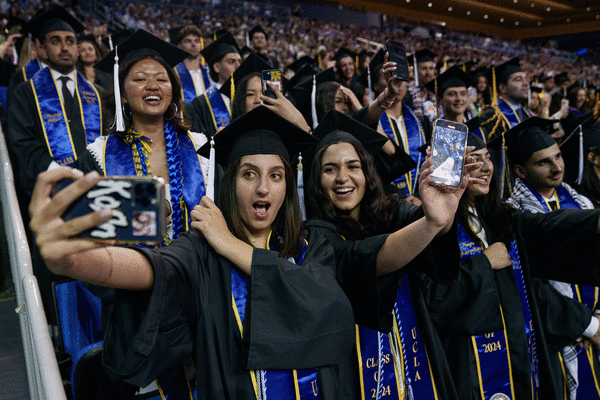
Universities now face twin crises. Artificial intelligence is rapidly eroding their monopoly on instruction, and young adults are experiencing historically high levels of loneliness.
If higher education is to justify its staggering cost, it must confront both realities at once by deliberately designing environments and experiences that foster social connection alongside academics. Done well, colleges can offer something AI cannot replicate.
Gen Z is living through a profound social crisis. Nearly three-quarters of 16- to 24-year-olds report feeling lonely, and young adults now spend 70% less time in person with friends compared with just two decades ago. The share of U.S. adults with no close friends has quadrupled since 1990.
And a growing majority of Gen Z college graduates say their degree was a “waste of money.” We lament that students use ChatGPT to complete their coursework while an entire generation struggles to form lasting relationships — and questions whether college was even worth it.
The pandemic made the stakes plain. When campuses closed, students quickly learned they could stream lectures from anywhere. What they could not access was community. Students didn’t rush back for classes; they came back for the social experience. Universities still offer the rarest commodity in modern life: sustained, face-to-face contact with a diverse group of peers at a critical period of development. Yet most campuses remain organized around the assumption that instruction is the primary product students are buying.
I say this as a tenured professor at USC: My doctoral training included zero coursework in how to teach. That’s typical. Like most of my colleagues, I learned to teach through trial and error, borrowing techniques from mentors and hoping for the best. Academic hiring, pay and prestige hinge overwhelmingly on research output, not pedagogy. Even professors who care deeply about teaching must navigate a system that rewards something else. When those incentives clash, teaching loses. Yet students still collect diplomas, universities still preserve their brands and everyone pretends the emperor is fully clothed.
What should concern everyone working in higher education is that, for many college courses, AI tutors will soon rival or exceed the quality of human teachers, making expert instruction newly abundant. And abundant goods, as any economist will tell you, plummet in price. A recent Harvard study underscores just how dramatic this shift may be: Students using an AI tutor learned more than twice as much, in less time, than those in an active-learning class — and they reported feeling more engaged and motivated.
So what remains scarce? Ironically, the very thing that defined the earliest institutions recognizable as “colleges” in ancient Rome. The collegia were voluntary associations built around shared identity and mutual support — guilds where craftsmen gathered not just to learn trades but to participate together in the meals, meetings, festivals and civic events that shaped urban life. Education was important there, but community was the central mission. The Latin root, collega, means “colleague” — someone you join in common purpose. From the start, belonging and learning were inseparable.
Modern universities still perform this ancient function, but invest in it unevenly. Students’ satisfaction with the quality of student life nationwide has declined, according to a survey of more than 126,000 students across the globe, even as tuition continues to climb. If belonging matters for learning, career readiness and well-being — and decades of research show that it does — it must be intentionally cultivated, not left to chance.
How? By funding student life with the same seriousness universities devote to research labs and medical centers. By hiring professional experience designers — people trained to trace how students actually move through an institution and pinpoint where systems create friction, confusion or isolation. By building multiyear collaborative projects where students pursue real problems together. By creating rituals, traditions and shared experiences that anchor students’ identities and foster a sense of continuity and belonging. These are not “amenities.” They are the new core curriculum.
Most critically, it means recognizing that employers increasingly value exactly these social and collaborative skills that AI cannot provide. As AI handles more analytical tasks, the premium on distinctly human capacities — reading complex social dynamics, building trust across difference, exercising judgment in ambiguous situations — will only grow. Colleges may be the last institution proficient in developing these human capabilities at scale. But only if they design for it deliberately.
Most universities already have pieces of this puzzle — residences, clubs and teams, tutoring centers, mentorship programs. But these are rarely part of an intentional, integrated system. They remain scattered offerings. Belonging is often a matter of luck: Some students find their people; others drift on the margins for years, largely unseen. No respectable institution would leave academic learning to chance. Why tolerate that in the social realm?
The intellectual enterprise still matters deeply, but it will no longer justify the price tag on its own. Universities should embrace AI for instruction rather than resist it. Let adaptive digital tutors handle the foundational transfer of knowledge — the lectures, problem sets and content delivery that can be individualized and accessed anywhere. Then pair that learning with mandatory in-person experiences that are structured, communal and identity-forming.
The university that acknowledges this need first — and builds for it — will define the future of higher education. Yes, students will still earn degrees, but those credentials will certify something different: not just that graduates absorbed information, but that they can navigate complex human systems, build lasting relationships, and contribute to communities. Call it the University of Social Connection or, if you must, the University of Social Credentialing. Either way, the acronym fits.
____
Eric Anicich is an associate professor of Management and Organization at USC’s Marshall School of Business, and is a regular contributor to Harvard Business Review.
_____
©2025 Los Angeles Times. Visit at latimes.com. Distributed by Tribune Content Agency, LLC.





















































Comments