Editorial: Ban social media for teens younger than 16
Published in Op Eds
At the advent of Facebook in 2004, you had to have a college email address to create an account. Mark Zuckerberg’s creation was a relatively controlled, college-age environment in which you could learn more about and interact with your peers.
Those days are long over, and kids as young as 13 now can log into a wide array of social media platforms.
Thus we are living through an age when kids don’t walk down the street alone, but they have full access to everything online. We warn them about strangers, monitor their whereabouts and pad their bike helmets, yet in the digital world, we offer almost no guardrails at all.
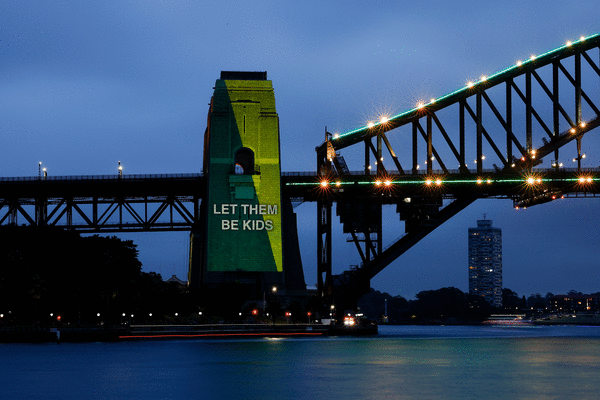
A growing international movement is forming in recognition of the need to do more. Australia’s ban on social media for under 16 went into effect Dec. 10 after years of warnings about youth mental health issues. Denmark has announced plans to move ahead with a ban for anyone younger than 15, and Norway is considering a similar move.
Leaders here need to pay attention. Many already recognize the myriad ills connected to social media usage.
Consider: The impressive former U.S. Surgeon General Vivek H. Murthy in 2024 called for a warning label on social media platforms due to their role in accelerating the mental health crisis among young people. Murthy also visited our offices in 2022 to make that point, among others.
“Right now, young people are being exposed to serious harms online and to features that would seek to manipulate their developing brains into excessive use, which may be part of the reason we’re seeing adolescents spending, on average, nearly five hours a day on social media,” he said in 2024.
This is not simply a matter of teenagers “wasting time” online. As Murthy suggests, algorithm-driven feeds are designed to maximize engagement, often at the expense of well-being, and younger users lack the impulse control to resist that pull. Who could?
“These sites were developed by some of the smartest engineers and technicians out there, and they were designed to maximize engagement time on the platforms,” he told this editorial board when he visited, metaphorically thumping our table. “How can we expect our young people to compete with them?”
A team of researchers found that when adolescents spend more than three hours a day on social media, they’re more likely to report mental health issues. In survey work from Boston Children’s Hospital’s Digital Wellness Lab, teens commonly reported that social media can worsen body image and interfere with schoolwork. Nearly half of teens said social media makes them feel worse about their bodies, and a third said it affects their grades.
The U.S. needs to follow the lead of other countries that are working diligently to protect kids online. Failure to do so means accepting an online culture that is hurting young Americans.
Online, they face social pressure at industrial scale. They often come across predatory and harmful content, and risk being coerced into sharing compromising messages and photos. In extreme cases, online harassment and exposure to dangerous material have been linked to tragic outcomes, including suicide.
We understand the temptation to put this back on the parents, recognizing the importance of moms and dads determining what their kids have access to. But expecting parents to navigate this ecosystem safely and effectively is unrealistic.
Parents aren’t failing and kids aren’t weak. The system is engineered to overpower both.
Bans make everyone uneasy, especially this editorial board, especially because we are so committed to freedom of expression. But overriding that principle is the fundamental need to protect kids from harm. This is not about policing speech; it’s about limiting access to products that end up exploiting developmental vulnerability. Social media companies’ incentives are so misaligned with what’s best for kids that collective action is the only lever left.
Society already restricts access to products deemed harmful to minors, such as alcohol, tobacco and gambling. You can’t buy cigarettes until you’re 18 and you can’t drink alcohol legally until you’re 21. We’d argue social media belongs in this category of powerful, habit-forming products. If you can’t even attend an R-rated movie on your own until you’re 17, kids shouldn’t be able to wander blindly into the wilds of the internet to fend for themselves when we know all too well the dangers they’ll face.
We’re not naive about the limits of enforcement and realize that bans are blunt and imperfect by nature. Kids are smart, and those who want to will figure out how to get around social media bans and launch accounts anyway. Google said Australia’s ban would be “extremely difficult” to enforce. No doubt. And, as with anything, the devil will be in the details with how such a policy is legislated. What, for example, qualifies as “social media”?
Should the ban be set at 14 or 15? Drawing those lines will be messy, but difficulty has never been a sufficient excuse for inaction when children’s safety is at stake. We think 14 would be a lot better than nothing but the evidence suggests to us that 16 is the right age.
We believe a ban would deter enough kids — and sound the alarm for enough parents — to make a difference. In this, the U.S. must not be an outlier but join the international community of concerned nations.
Of course, the tech companies in question will fight this tooth and nail. Indeed, they are already doing so. Their interests here — getting kids young so they’re customers for life — are in direct conflict with what’s best for America’s young people. They see the growing backlash from parents and advocates who have pointed out grave concerns about exposing kids to these networks too young. A 2023 investigation by The Wall Street Journal uncovered that TikTok fed users registered as 13 years old polarizing and violent content. An internal report indicates the company knows of the negative effects their platform can have on young people.
They’re playing catch-up now, with Meta implementing things such as teen accounts for ages 13-17, which are designed to provide more parental oversight and put more emphasis on making sure kids are only seeing content that’s safe for them, for example. Acknowledging that teens need more guardrails is a good step, but it can’t address the full scope of the problem, which is that heavy use of these platforms is incompatible with healthy mental, social and emotional development.
We can no longer give young kids free rein into every corner of the internet, abandoning them to whatever they may find there.
If you find yourself uncomfortable with the idea of forbidding social media for teens, ask yourself: Are you comfortable continuing to run a massive, unregulated social experiment on adolescent brains, or should we accept that imperfect guardrails are better than none at all?
___
©2025 Chicago Tribune. Visit at chicagotribune.com. Distributed by Tribune Content Agency, LLC.










































Comments