Commentary: Nancy Pelosi has distinguished herself as a history-making stateswoman
Published in Op Eds
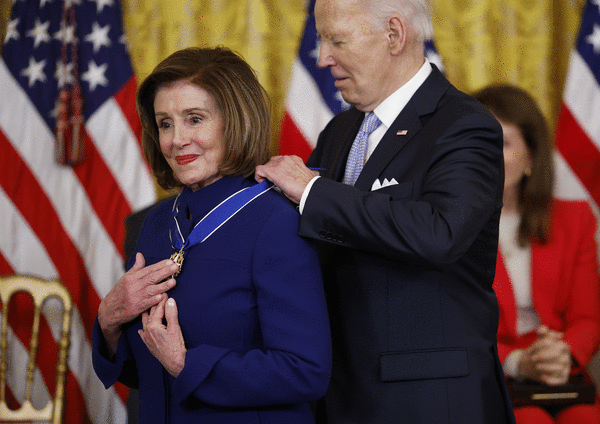
“The difference between a politician and a statesman,” said James Freeman Clarke, a 19th century American theologian and writer, “is that the politician thinks about the next election while the statesman thinks about the next generation.”
Nancy Pelosi, a Democratic congresswoman from California and former speaker of the U.S. House of Representatives, has inhabited the rarefied worlds of both formidable politician and history-making stateswoman.
During her nearly four-decade career in Congress, Pelosi has forged a complex and consequential legacy. Vilified on the right, lionized on the left, and a full participant in a myriad of contentious legislative battles, Pelosi’s legacy is difficult to clearly discern.
Few dispute that Pelosi, who announced she will retire in 2027, has been a skilled and successful politician. She led her party in the House for 20 years, raised $1.3 billion for Democratic candidates, was twice elected speaker, and championed significant health care, environmental, economic and civil rights legislation. She is often referred to as one of the House’s most successful modern speakers.
I believe that history will also depict Pelosi as an impressive stateswoman. Three aspects of her statesmanship are compelling and worthy of reflection.
First, she’s been a visionary leader. For a practical politician, Pelosi has frequently looked to the future and fought for policies with long-term consequences. This was most evident in her lengthy and tenacious quest for comprehensive health care reform. Clearly Pelosi did not achieve this reform on her own, but she played an essential role in crafting the Affordable Care Act and a singular role in securing its passage in Congress.
When faced with extraordinary legislative obstacles, she responded with utter determination. At a news conference when health care reform appeared on the brink of failure, Pelosi presented her way forward: “We go through the gate. If the gate’s closed, you go over the fence. If the fence is too high, we’ll pole vault in. If that doesn’t work, we’ll parachute in. But we’re going to get health care reform passed for the American people.”
The ACA is a landmark law but also an imperfect one. In a better functioning political system, such as one we used to have, Democrats and Republicans would have spent the last 15 years improving the law. Instead, the program has been ensnared in partisan warfare, with the GOP calling for its repeal and replacement but never getting around to offering an alternative. Democrats, in response, have been defensive in protecting their historic accomplishment.
Continuing skirmishes over the law do not minimize the scope of Pelosi’s achievement. “Nothing in any of the years that I was there compares to the Affordable Care Act — expanding health care to tens of millions more Americans. That, for me, was the highlight,” she said.
Second, while Pelosi is an unabashed partisan, she has been willing to set aside partisanship for the national good. When the American economy began to unravel in 2008, the final year of George W. Bush’s presidency, Pelosi had every short-term political incentive to stand back, watch the crisis intensify, and encourage the American public to blame Bush and his Republican colleagues for the meltdown.
Instead, she stepped forward and helped assemble and pass a politically toxic but substantively sound package that stabilized the economy. It’s worth noting that several months later, with the economy still fragile, the newly inaugurated president, Barack Obama, reached out to Senate Republican leader Mitch McConnell and House GOP leader John Boehner and asked for their support for a follow-up package. Both declined to help. McConnell later said that his chief legislative priority was to make Obama a one-term president.
Molly Ball, a Pelosi biographer, summarizes Pelosi’s 2008 financial crisis statesmanship succinctly: “She bailed a Republican president out of a mess of his own making, for the good of the country, at enormous political risk.”
Third, Pelosi has been a voice of caution, forbearance and wisdom. America’s decision to go to war in Iraq in 2003 is widely regarded as one of the worst foreign policy mistakes in the nation’s history. The war and its aftermath gravely damaged the reputation of the United States and disrupted the Middle East. Yet, most of the American foreign policy establishment initially supported the war.
When Congress considered a “use of force” resolution for Iraq in the fall of 2002, Pelosi vehemently opposed it. Speaking on the floor of the House, Pelosi pleaded with fellow lawmakers and the Bush administration to slow down and think clearly. Strikingly prescient, Pelosi warned that an American war in Iraq would be bloody, costly, divert the nation from its battle against terrorism and damage U.S. global prestige. “If we go in, we can certainly show our power to Saddam Hussein,” she said. “If we resolve this issue diplomatically, we can show our strength as a great country. Let us show our greatness.”
Her warnings were dismissed by Republicans and ignored by many congressional Democrats, including Sens. Hillary Clinton, Joe Biden, Tom Daschle and John Kerry and U.S. Rep. Richard Gephardt, all of whom were weighing 2004 presidential campaigns. In subsequent years, Pelosi tried valiantly — and in vain — to force the Bush administration to end the war and withdraw American troops. She was rebuffed, and the nation suffered.
An authoritative study of the costs of the Iraq War by the Watson School at Brown University calculates that the U.S. spent $2 trillion in Iraq over 20 years. About 8,500 American troops and contractors were killed, 300,000 soldiers suffered debilitating injuries and nearly half a million Iraqi civilians were killed.
As her political career winds down, Pelosi is urging us to be vigilant and to protect our system of government and way of life.
“American democracy is majestic,” she said in 2022. “But it is fragile.”
This is a wise warning from a gifted politician and a stellar stateswoman.
____
John T. Shaw is director of the Paul Simon Public Policy Institute. His most recent book is “The Education of a Statesman: How Global Leaders Can Repair a Fractured World.”
___
©2026 Chicago Tribune. Visit at chicagotribune.com. Distributed by Tribune Content Agency, LLC.














































Comments