Conor Sen: This is not the way to make housing more affordable
Published in Op Eds
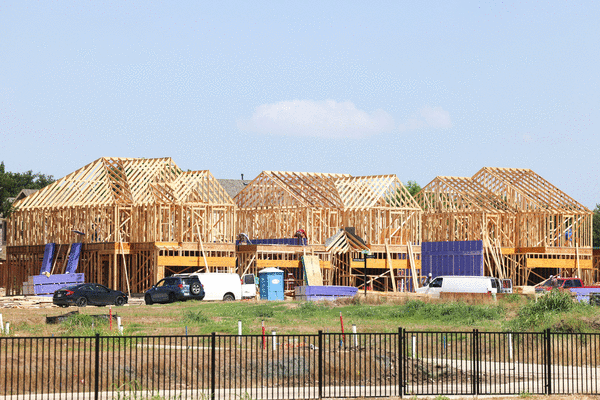
Everybody wants housing to be more affordable. The question is how best to do that. President Donald Trump’s proposal — banning institutional investors from buying single-family homes — has undeniable populist appeal, but it would not do much to make it easier for Americans looking to buy a home.
The basic idea, straight out of Economics 101, is that with fewer buyers, sellers will have to reduce their prices. Unfortunately, that’s not the way it would work in the current housing market. Such a ban would mostly lead homebuilders, many of which are already struggling with profitability, to cut back on production. That would result in fewer homes being built without meaningfully improving affordability.
Overall, investors — including smaller so-called mom-and-pop investors — account for a relatively modest percentage of new home sales in the U.S.: Roughly 4% in 2025, according to John Burns Research and Consulting. But that doesn’t mean the market of available housing would magically increase by 4%; homebuilders might just choose to build fewer homes because they were operating in a riskier environment with fewer buyers.
It’s also important to note that large institutional investors, the target of the president’s proposal, own a very small share of America’s single-family homes — about 0.5%, according to Blackstone and the American Enterprise Institute. When it comes to rental units, the figure is slightly higher but still small: According to Invitation Homes Inc., a single-family rental operator that owns just over 100,000 homes, institutions that own more than 1,000 homes hold just 3.3% of the 14 million single-family rental units outstanding in the U.S. For context, there are about 85 million single-family homes in the country.
Notably, institutional purchases have declined significantly over the past few years for the same reason that households have pulled back on buying homes: Higher interest rates and rising costs have made homeowning less financially attractive than it was in the 2010s.
At the same time, even as they account for a small share of homeowners, institutional homeowners have been useful in providing liquidity and market stability over the past 15 years. During the foreclosure crisis in the early 2010s, home prices were falling, unemployment was high, bank balance sheets were stressed, and demand for rentals outpaced demand for purchases.
Institutional homebuyers played a crucial role by buying up homes and renting them out. More recently, when homebuying demand plunged in late 2022 after the Federal Reserve raised interest rates, homebuilders were able to offload new homes they were struggling to sell to individuals to institutional investors.
Having a known “buyer of last resort” helps give homebuilders the confidence to build more homes than they otherwise might. They know that even if the market gets shaky and individual homebuyers get skittish, institutional investors are willing to buy. This ability to smooth out demand — selling homes primarily to households, a modest amount to build-to-rent operators, and then to institutional investors when market conditions turn challenging — is mutually beneficial. It helps de-risk an industry that’s inherently risky and cyclical, provides steady employment for construction workers and other tradespeople, and reduces the risk of homebuilder bankruptcies.
Aside from all the numbers, it’s worth pointing out the impact of this trial balloon on (for lack of a better word) the vibes of the industry. Homebuilders came into the year hopeful that the federal government would do something constructive to address affordability in 2026. An executive at Lennar Corp., the second-largest U.S. homebuilder, said on an earnings call last month that the company would continue to build homes at a low profit margin because it was optimistic that the White House would “take decisive action to enhance affordability” and boost the industry’s fortunes.
By removing a source of demand from the new home market, this policy would do the opposite. If this is the most the industry can expect from the White House when it comes to housing, then homebuilders may be better off simply cutting production until market conditions improve.
Any good policy to address affordability needs to ensure that it doesn’t result in fewer homes being built. This proposal fails that test.
____
This column reflects the personal views of the author and does not necessarily reflect the opinion of the editorial board or Bloomberg LP and its owners.
Conor Sen is a Bloomberg Opinion columnist. He is founder of Peachtree Creek Investments.
_____
©2026 Bloomberg L.P. Visit bloomberg.com/opinion. Distributed by Tribune Content Agency, LLC.




















































Comments