Commentary: 'Save the whales' worked for decades, but now gray whales are starving
Published in Op Eds
Recently, while sailing with friends on San Francisco Bay, I enjoyed the sight of harbor porpoises, cormorants, pelicans, seals and sea lions — and then the spouting plume and glistening back of a gray whale that gave me pause. Too many have been seen inside the bay recently.
California’s gray whales have been considered an environmental success story since the passage of the 1972 Marine Mammal Protection Act and 1986’s global ban on commercial whaling. They’re also a major tourist attraction during their annual 12,000-mile round-trip migration between the Arctic and their breeding lagoons in Baja California. In late winter and early spring — when they head back north and are closest to the shoreline, with the moms protecting the calves — they can be viewed not only from whale-watching boats but also from promontories along the California coast including Point Loma in San Diego, Point Lobos in Monterey and Bodega Head and Shelter Cove in Northern California.
In 1972, there were some 10,000 gray whales in the population on the eastern side of the Pacific. Generations of whaling all but eliminated the western population — leaving only about 150 alive today off of East Asia and Russia. Over the four decades following passage of the Marine Mammal Protection Act, the eastern whale numbers grew steadily to 27,000 by 2016, a hopeful story of protection leading to restoration. Then, unexpectedly over the last nine years, the eastern gray whale population has crashed, plummeting by more than half to 12,950, according to a recent report by the National Oceanic and Atmospheric Administration, the lowest numbers since the 1970s.
Today’s changing ocean and Arctic ice conditions linked to fossil-fuel-fired climate change are putting this species again at risk of extinction.
While there has been some historical variation in their population, gray whales — magnificent animals that can grow up to 50 feet long and weigh as much as 80,000 pounds — are now regularly starving to death as their main food sources disappear. This includes tiny shrimp-like amphipods in the whales’ summer feeding grounds in the Arctic. It’s there that the baleen filter feeders spend the summer gorging on tiny crustaceans from the muddy bottom of the Bering, Chuckchi and Beaufort seas, creating shallow pits or potholes in the process. But, with retreating sea ice, there is less under-ice algae to feed the amphipods that in turn feed the whales. Malnourished and starving whales are also producing fewer offspring.
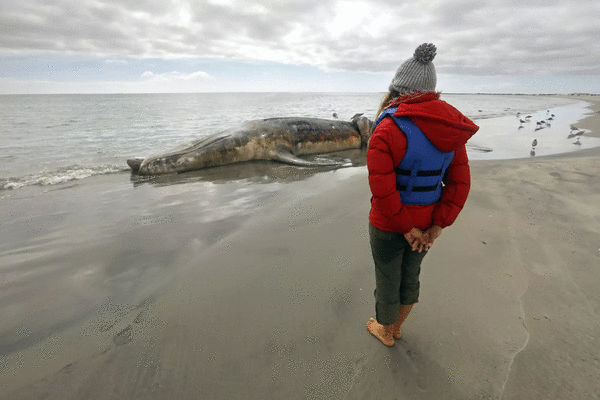
As a result of more whales washing up dead, NOAA declared an “unusual mortality event” in California in 2019. Between 2019 and 2025, at least 1,235 gray whales were stranded dead along the West Coast. That’s eight times greater than any previous 10-year average.
While there seemed to be some recovery in 2024, 2025 brought back the high casualty rates. The hungry whales now come into crowded estuaries like San Francisco Bay to feed, making them vulnerable to ship traffic. Nine in the bay were killed by ship strikes last year while another 12 appear to have died of starvation.
Michael Stocker, executive director of the acoustics group Ocean Conservation Research, has been leading whale-viewing trips to the gray whales’ breeding ground at San Ignacio Lagoon in Baja California since 2006. “When we started going, there would be 400 adult whales in the lagoon, including 100 moms and their babies,” he told me. “This year we saw about 100 adult whales, only five of which were in momma-baby pairs.” Where once the predators would not have dared to hunt, he said that more recently, “orcas came into the lagoon and ate a couple of the babies because there were not enough adult whales to fend them off.”
Southern California’s Gray Whale Census & Behavior Project reported record-low calf counts last year.
The loss of Arctic sea ice and refusal of the world’s nations recently gathered at the COP30 Climate Summit in Brazil to meet previous commitments to reduce greenhouse gas emissions suggest that the prospects for gray whales and other wildlife in our warming seas, including key food species for humans such as salmon, cod and herring, look grim.
California shut down the nation’s last whaling station in 1971. And yet now whales that were once hunted for their oil are falling victim to the effects of the petroleum or “rock oil” that replaced their melted blubber as a source of light and lubrication. That’s because the burning of oil, coal and gas are now overheating our blue planet. While humans have gone from hunting to admiring whales as sentient beings in recent decades, our own intelligence comes into question when we fail to meet commitments to a clean carbon-free energy future. That could be the gray whales’ last best hope, if there is any.
____
David Helvarg is the executive director of Blue Frontier, an ocean policy group, and co-host of “ Rising Tide: The Ocean Podcast.” He is the author of the forthcoming “ Forest of the Sea: The Remarkable Life and Imperiled Future of Kelp.”
©2026 Los Angeles Times. Visit at latimes.com. Distributed by Tribune Content Agency, LLC.




















































Comments