Stephen Mihm: Kraft Mac & Cheese doesn't need to feed our protein obsession
Published in Op Eds
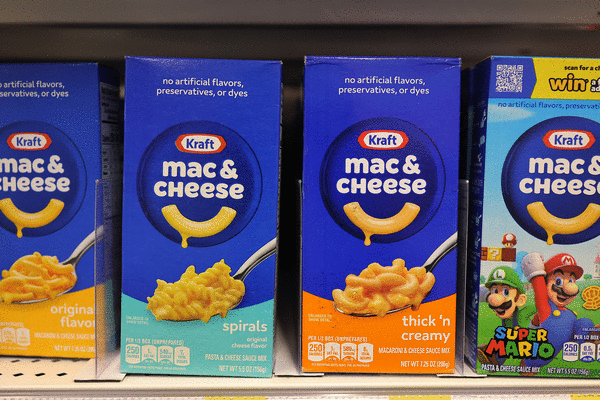
Kraft Heinz’s declining dominance in the mac and cheese industry has been blamed on cost-cutting and bad management decisions. But the company’s biggest challenge is that the rules of indulgence have changed. Comfort food, and increasingly all foods, are expected to do double duty.
Many Americans are no longer content with only eating a bowl of gooey noodle goodness. They want that bowl to come packed with health benefits: more protein, fewer artificial dyes, and an ingredient list that signals they are doing something good for their bodies. It’s unsurprising, then, that — as the Wall Street Journal recently reported — competitors such as Goodles are gaining market share as Kraft loses it.
James Kraft, the founder of Kraft Foods, couldn’t have foreseen a day like this. He had a knack for turning cheap, processed foods into wildly popular pantry staples like Velveeta and Miracle Whip. But it was the “Kraft Dinner,” now known as Kraft Mac & Cheese, that proved his most enduring contribution to the American dinner table.
The company rolled out the product in 1936, describing it in a typical advertisement as “a cheese and macaroni dinner, easily prepared; a dinner for four in nine minutes.” At 16 cents a box, or $3.70 in today’s dollars, it proved appealing to cash-strapped shoppers in the middle of the Great Depression. What really cemented Kraft Dinner’s place in American homes, though, was World War II. The government strictly rationed many foods, with each family given a limited number of “points” for groceries (1). While a pound of bacon might consume seven points, a box of Kraft Mac & Cheese only cost a single point.
A typical wartime advertisement from the company touted that advantage, declaring that its mac and cheese offered “high nutrition for few or no ration points.” In 1943, 80 million boxes were sold.
Unlike many wartime substitutes, like “Mock Goose” (made with lentils), Kraft’s most famous product remained entrenched in the American diet. It offered comfort, convenience and, for the parents of the baby boomers, an easy meal for picky eaters. Sales continued to increase, and Kraft enjoyed a de facto monopoly.
It saw no reason to fix what wasn’t broken and ran the same advertisements year after year with minimal changes. Its appeal as a comfort food lay in its predictability and sameness. And that worked for a very long time — until it didn’t.
Problems arose when “private label” or store brands began to erode Kraft’s market share among shoppers searching for an even cheaper way to satisfy their mac-and-cheese cravings. The company fought back, emphasizing the superiority of its product, as it did in a 1980s ad that claimed “‘No Name’ brands just can’t compete with the cheesy taste of Kraft.”
If cheaper store brands were the company’s only headache, perhaps the story could have ended there. But Kraft had other problems. The mainstreaming of the organic food movement in the 1980s drew unwanted attention to the dangers of additives like Yellow No. 5 and 6 — dyes that the company used to give its mac and cheese that distinctive orange glow.
At the same time, consumer rights activists began pushing Kraft and other food processors to provide an objective accounting of their products’ nutritional value. The campaign, which culminated in the passage of the Nutrition Labeling and Education Act, led to the creation of the ubiquitous black-and-white nutrition labels that now adorn all processed foods.
Studies soon showed that while lower-income, less-educated voters rarely read the labels, well-educated, affluent consumers definitely did, changing their eating habits in response to what they learned. This opened the door for new companies to challenge the legacy brands on the grounds of nutrition and health.
Kraft’s first real challenger materialized around this time. Her name was Annie Withey. An entrepreneur who had already rocked the food world when she introduced Smartfood popcorn, Withey co-founded the successful Annie’s Mac and Cheese in 1989.
Like her popcorn, the boxed pasta eschewed artificial colors and touted its “natural” status, going organic not long afterward. It quickly caught on with more affluent, educated consumers in the 1990s.
The same thing happened to a range of foods, from coffee to ice cream, as legacy brands found themselves confronting formidable competition from upstarts that claimed to be more natural, artisanal, wholesome, nutritious or otherwise superior.
And now the process is repeating itself, with Goodles staking out an even healthier slice of the market. It’s selling itself as even more nutritious than Annie’s, with higher protein and fiber — and touting that it’s the only boxed mac and cheese ever to earn a purity award from the Clean Label Project.What’s a brand like Kraft to do? The Wall Street Journal reported that the company is planning to spend more than $60 million in 2026 to reverse its mac-and-cheese decline, including rolling out higher-protein, higher-fiber options. But this turns Kraft into a follower rather than a leader. Plus, few might see the name Kraft and think it’s going to offer something healthier than the competition.
Instead of running away from its past, Kraft should embrace it. Nostalgia marketing is working for other companies like Frigidaire and Coca-Cola, enabling iconic brands to fend off newcomers by appealing to history. And history is one thing that Kraft has in abundance, giving it plenty of ingredients for a clever marketing campaign.
____
(1) During World War II, the federal government’s Office of Price Administration issued ration books that kept track of these points via removable stamps. When shoppers paid for their groceries, they would hand over cash – and the requisite number of stamps from the ration book. The government dictated both the price and the number of points for every imaginable product, with scarcer items costing more money and requiring more points. As wartime needs changed, the government tinkered with both prices and points.
____
This column reflects the personal views of the author and does not necessarily reflect the opinion of the editorial board or Bloomberg LP and its owners.
Stephen Mihm, a professor of history at the University of Georgia, is coauthor of “Crisis Economics: A Crash Course in the Future of Finance.”
©2026 Bloomberg L.P. Visit bloomberg.com/opinion. Distributed by Tribune Content Agency, LLC.



















































Comments