Commentary: HUD is making a mess of housing policy
Published in Op Eds
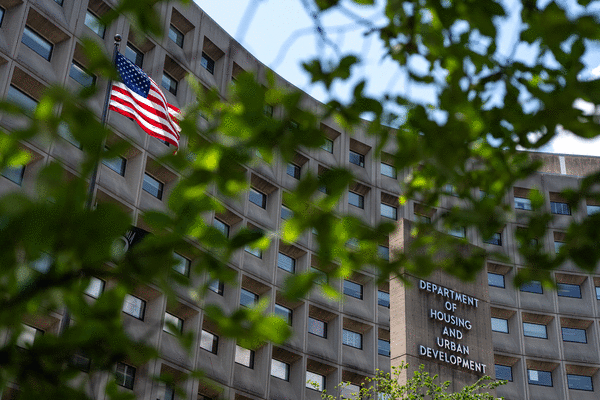
For months now, the Trump administration has pushed a reckless policy agenda on housing and homelessness, with particular focus on the Department of Housing and Urban Development. Instead of improving efficiency and effectiveness, these decisions by the administration and HUD have overwhelmed and confused frontline workers who rely on federal grants to keep vulnerable people housed in their communities.
This started last July, when President Donald Trump issued Executive Order 14321. It reframed homelessness as a public-safety issue rooted in mental illness, called for expanding the use of civil commitment to involuntary hospitalize unhoused people, as well as enstating local bans on homeless encampments, rolling back harm-reduction strategies, and placing new conditions on federal housing assistance.
HUD, meanwhile, has been trying to rewrite federal housing statutes without congressional authorization. By November, the agency had advanced Trump’s agenda by threatening to end two-year funding commitments that were made in 2024 through an unexpected notice. Groups including the National Alliance to End Homelessness sued to block this directive, arguing that HUD had exceeded its authority by imposing major policy changes through a funding notice that allegedly violated federal statute.
In December, a federal court in Rhode Island issued a preliminary injunction that ordered HUD to halt implementation of its funding order. HUD then released a new order on Dec. 20, which was halted by the same judge three days later.
Are you confused? You’re not the only one. I’m a homeless policy researcher who has spoken to 12 local administrators under condition of anonymity about these developments. While these administrators are located in different parts of the United States, their experience of the order and funding notice has been strikingly similar: outrage, panic and confusion.
“There’s a lot of litigation happening right now,” one administrator told me. “What is true today can be very different next week.”
These administrators manage federal contracts, facilitate local compliance with federal requirements and design systemwide homeless policy. While their work is hidden from the public eye, local administrators play a vital role in keeping thousands of people stably housed. Their work depends on predictable funding cycles, staffing plans that don’t change mid-year and federal guidance that doesn’t contradict itself.
Instead, the Trump administration has forced these administrators to make dramatic policy changes that courts may later invalidate, while also worrying that they could put future funding at risk by not abiding by the ever-changing rules.
HUD has provided little assistance to help administrators during this process. Although the agency hosted a webinar the day after its funding notice was published, administrators I spoke to called it an unhelpful “PR stunt” that failed to answer salient questions. Technical assistants, who are supposed to help administrators answer these questions, have been either unavailable or unwilling to provide guidance.
The court’s preliminary injunction may eventually block HUD’s agenda, but we can’t count on that outcome. Either way, the uncertainty with which administrators are currently dealing will have real consequences on the delivery of homeless services in your community. Administrators were forced to spend countless hours during the holiday season preparing a grant bid with an unrealistic deadline that may be invalidated by the court, an allocation of time and resources that prevents administrators from actually helping people in their communities.
Courts can stop HUD from implementing unlawful policies. But they cannot undo the damage to local homeless systems when the federal government becomes unpredictable. And the staff turnover, agency withdrawal and skill loss that result from mistrust will gradually manifest as encampments on Main Streets throughout the country.
____
Dr. Garrett Grainger is a housing policy researcher at Wrexham University in Wales whose writing on homelessness and social policy has appeared in The Hill and on NPR. This column was produced for Progressive Perspectives, a project of The Progressive magazine, and distributed by Tribune News Service.
_____
©2026 Tribune Content Agency, LLC.












































Comments