Editorial: Trump and China make a welcome TikTok deal. There's still plenty to worry about
Published in Op Eds
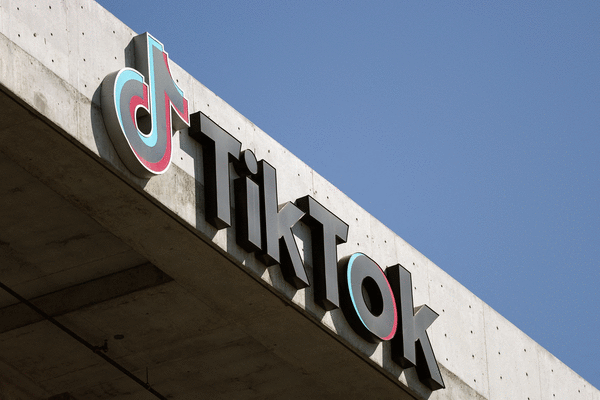
Nearly two years ago, this page endorsed bipartisan legislation, co-sponsored by Illinois congressman Raja Krishnamoorthi, to force the Chinese owners of TikTok to divest the wildly popular app’s platform in the U.S. or see it shut down.
The bill became law with President Joe Biden’s signature and survived a Supreme Court challenge. But then President Donald Trump took back the White House and extended the law’s deadline for action more than once in hopes of forging a deal with the Chinese to relinquish majority ownership.
At long last, we now have such a deal. China-owned ByteDance, which owns TikTok, now will have 19.9% ownership of the U.S. business, the most allowed under the statute. The remaining ownership stakes are held at levels not exceeding 15% by one American corporation (Oracle, which long has done business with TikTok) and a handful of U.S. investment firms.
Problem solved, right?
Maybe. We’re going to need to know more in order to feel confident this transaction addresses the issues that were the reason for the law in the first place.
As the TikTok drama lingered — with Trump clearly unwilling to shut down a social media platform he thought helped him win the 2024 election and the Chinese battling the Trump administration on trade and unrelated technology issues — it was fair to wonder if TikTok just would soldier on in the U.S. for the foreseeable future under this odd legal cloud.
So it’s a positive that there finally is an ownership structure that in broad terms complies with federal law.
But let’s reiterate the details of the original concerns.
Chinese ownership of a platform that now claims more than 200 million U.S. users meant that a substantial chunk of those users — many of them tweens, teens or 20-somethings — would never see content critical of Chinese government policies, since they rely on TikTok as a primary source of news. There were legitimate fears that Chinese control of the algorithm determining what is put before those impressionable eyeballs would open the door to political manipulation as Chinese interests saw fit.
Add to those concerns TikTok’s exacerbating of U.S. political divisions and nurturing extremism by heavily emphasizing content that reaffirms a user’s existing views on the hot-button issues of the day.
And we’ve written recently of the simple brain rot that occurs with too much viewing of the intoxicating short-form videos that make up TikTok’s feed, no small factor in our support of barring social media access for those under the age of 16, a stance embraced by likely presidential aspirant Rahm Emanuel, among several others.
So the American people, we believe, ought to be told far more about how this change in ownership will affect TikTok’s actual operations in the U.S. than what we’ve seen so far in the disclosures about the deal.
It certainly appears like not much is different other than who sits in the boardroom. The CEO will be Adam Presser, deputy to TikTok CEO Shou Chew. The existing Chinese owners will continue to hold the largest stake in the U.S. firm, albeit not the controlling one they have now. What say will the Chinese continue to have over future operations?
More importantly, handling of TikTok’s all-important algorithm will continue to be the purview of ByteDance, TikTok’s Chinese owner, which is licensing the technology to the U.S. business under the deal. As The New York Times reported, that provision could fall short of a key part of the 2024 law, which mandated the end to any “operational relationship” between the Chinese company and the U.S. version.
At the very least, the new owners of TikTok should explain to the public what oversight — indeed, even line of sight — they will have over the algorithm under this licensing arrangement.
More broadly, what are the safeguards that now will ensure Americans’ privacy will be protected and that they won’t be subject to manipulation favoring Chinese interests. Also, some of the American board members of the new operation have very cozy ties to Trumpworld. Oracle, co-founded by Trump pal Larry Ellison, will have a board seat. So will Egon Durban, co-CEO of private equity firm Silver Lake, a 15% owner of the new TikTok business in America. Durban has close business ties to Trump’s son-in-law, Jared Kushner. Vice President JD Vance served as a managing partner at venture capital firm Revolution LLC for about a year and a half, beginning in 2017. Revolution is listed as one of the investors in the new TikTok USDS Joint Venture LLC.
We don’t make a habit of poking our collective nose into private-sector business decisions such as who sits on boards and which executives are tabbed to run things. But this is no ordinary spinoff. There are vital public interests at stake.
Ideally, Congress would hold hearings to ask these very questions and reassure Americans we’re not reliving Pete Townshend’s classic line, “Meet the new boss, same as the old boss.”
And if Republicans running both chambers of Congress decline to exercise that oversight task, which would cause little surprise, we hope the company will take it upon itself to put meat on these meager bones. What is fed to us on our phones has become such a central and worrisome part of our lives that we shouldn’t treat TikTok as just another business deal.
___
©2026 Chicago Tribune. Visit at chicagotribune.com. Distributed by Tribune Content Agency, LLC.




























Comments