Commentary: Donald Trump stirs up trouble in US-Canada relations
Published in Op Eds
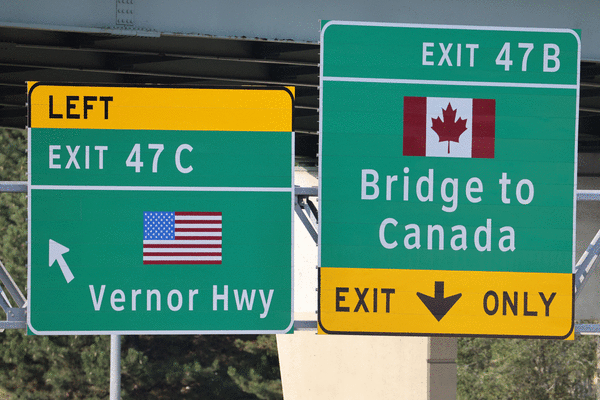
Days after President Donald Trump dropped his tariff threat against eight European countries over their opposition to the United States acquiring Greenland, the self-proclaimed “tariff man” instituted another warning against yet another ally: Canada. “If Canada makes a deal with China, it will immediately be hit with a 100% Tariff against all Canadian goods and products coming into the U.S.A.” Trump wrote on Truth Social last week.
For Canada, U.S. tariffs in the Trump era are nothing new. On March 12, Trump slapped 25% tariffs on all steel and aluminum imports into the United States, and Canada was no exception. Ottawa retaliated shortly thereafter with a similar tariff rate. A month later, the two countries taxed each other’s auto parts as well. Most observers speculated that this tit for tat was an attempt by both countries to enhance their leverage heading into this year’s renegotiation of the U.S.-Canada-Mexico trade accord, a reasonable assumption given Trump’s obsession with reopening deals he previously signed.
The latest tariff threat, however, comes at a time when one of the world’s typically most fruitful and amicable bilateral relationships is getting iced over due to conflicting personalities at the top and a philosophical difference of how international politics should work. Ties between Trump and Canadian Prime Minister Mark Carney, which used to be dominated by mutual praise — Trump called Carney “a world-class leader” during their bilateral meeting at the White House in October — is now hitting speed bumps. Last week, at the World Economic Forum in Davos, Trump explicitly called out Carney during his speech and warned him that if it wasn’t for the United States, Canada would be struggling to survive as a state. Hours later, Trump withdrew his invitation to Carney to join his Board of Peace, a slight that was about as petty as disinviting a friend from your birthday celebration for forgetting to tag you on Instagram.
Even so, personality disputes can be papered over if countries share mutual goals and interests. For the most part, the United States and Canada have been fortunate enough to live in a world where they do. Neither wants chaos and confrontation in the Western Hemisphere; both aim to preserve North America as one of the world’s most lucrative markets; and the U.S. and Canadian militaries operate together on a daily basis through NORAD, the continent-wide defense network that often scrambles aircraft to ward off Russian fighter jets near Alaska. Not to be outdone, Washington and Ottawa share supply chains for everything from agriculture to cars. And at more than $600 billion last year, the U.S.-Canada trade relationship is a moneymaker.
But Trump’s recent antics, his style of negotiation and the constant U.S pressure tactics against Canada have caused unnecessary turbulence. The weekslong drama over Greenland, in which Trump not only sought to use economic pressure on NATO allies but also refused to rule out annexing the Danish territory by force — a threat Trump dropped last week — has given Canada and other middle powers a reason to reassess where they stand. Carney has transformed into a de facto spokesman for those middle powers, none of which want to turn into supplicants or get caught with their pants down between two superpowers, such as the United States and China, that are increasingly using coercion as a method of statecraft.
Carney’s address to the delegates in Davos took the form of a wake-up call to states that had assumed the so-called rules-based international order would be there permanently. Not so, Carney said. Without tying it specifically to the United States, the Canadian prime minister alleged that great powers are now intent on leveraging their economic heft, geopolitical influence and military power to extract concessions from smaller states. Supply chains, the dollar-based financial system and market access, Carney said, are now being deployed as geopolitical weapons. The lesson for Carney and a growing number of Canadians is becoming clearer by the day: “In a world of great power rivalry, the countries in between have a choice: Compete with each other for favor or to combine to create a third path with impact,” he said.
Carney is putting his money where his mouth is. Driven by a desire to lessen Canada’s dependence on the United States, the leader has sought to broaden Ottawa’s strategic relationships with other states. The aim: Take away some of Trump’s power, spread Canada’s chips into multiple baskets and ensure that Canadians have other options if the alliance with Washington descends to lower depths. Last year, Canada signed a defense cooperation agreement with the European Union and negotiated a pact that allowed Canadian defense firms to tap into the EU’s $170 billion loan program meant to spur military modernization. This month, Carney traveled to Beijing in a bid to repair some of the animosity between Canada and China. The gambit worked to an extent; both agreed to lower tariffs on several of each other’s industries, causing Trump to blast Carney for purportedly turning Canada into a transit point for Chinese goods heading to the United States.
Of course, we shouldn’t get too carried away. The U.S.-Canada relationship isn’t going to collapse just because the two guys calling the shots are at each other’s throats. Defense ties remain solid, NORAD is still working as it should, and bilateral trade is so intertwined that walking away from it completely would elicit economic consequences we couldn’t even begin to imagine.
Yet there can still be damage done even if an alliance doesn’t completely collapse. And that’s a pretty apt description of where we are — two allies who still agree on plenty but are not as chummy as they were even a year prior. Trump should ask himself whether stirring a hornet’s nest serves any purpose other than pointlessly alienating a benevolent neighbor that is beginning to pad its insurance policy by reaching out to non-hemispheric powers.
____
Daniel DePetris is a fellow at Defense Priorities and a foreign affairs columnist for the Chicago Tribune.
___
©2026 Chicago Tribune. Visit at chicagotribune.com. Distributed by Tribune Content Agency, LLC.










































Comments