Commentary: Young lawmakers are governing differently. Washington isn't built to keep them
Published in Op Eds
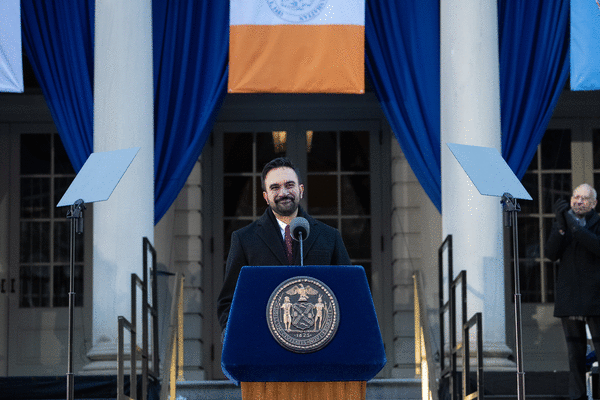
When Zohran Mamdani was sworn in as New York City’s mayor on Jan. 1 at age 34, it became impossible to ignore that a new generation is no longer waiting its turn. That new generation is now governing. America is entering an era where “young leadership” is no longer a novelty, but a pipeline.
Our research at Future Caucus found a 170% increase in Gen Z lawmakers taking office in the most recent cycle. In 2024, 75 Gen Z and millennials were elected to Congress. NPR recently reported that more than 10% of Congress won't return to their seats after 2026, with older Democrats like Sen. Dick Durbin and Rep. Steny Hoyer and veteran Republicans like Rep. Neal Dunn stepping aside.
The mistake many commentators make is to treat this trend as a demographic curiosity: younger candidates replacing older ones, the same politics in fresher packaging. What I’ve seen on the ground is different. A rising generation – Democrats and Republicans alike – is bringing a distinct approach to legislating.
At Future Caucus, we’ve helped more than 1,900 Gen Z and millennial lawmakers work on policy together since 2013, and the reality is that these young electeds, across Congress and statehouses, are better at passing bipartisan legislation. In 2023, Gen Z and millennial state legislators introduced 40% of all bipartisan bills signed into law, despite making up only 25% of state lawmakers. How are they overperforming so significantly?
Ideology is not disappearing. Young officials span the political spectrum, and plenty of them are deeply values-driven. But what they share in common is that many of them are living the same reality as their constituents: student debt, expensive housing markets, rising childcare costs, and wage instability in a rapidly changing economy being reshaped by AI. Those who are somehow not directly impacted by these forces still have a front row seat to their generation’s struggles.
Mamdani’s platform, for example, centered relentlessly on rent, childcare, and transportation. For many young lawmakers, affordability isn’t a sidebar issue, it’s the lens through which nearly every policy debate is viewed. Many of these leaders came of age watching financial crises, institutional failures, and political stalemates. Perhaps as a result, they are less sentimental about party theater and often more willing to test cross-aisle partnerships early, before incentives harden, in order to advance urgent policy priorities.
But here is the uncomfortable truth: Washington and state capitols aren’t designed for young lawmakers. Many face structural barriers that make staying in office difficult: low pay, limited staff capacity, and institutional models that assume outside wealth or exceptionally flexible careers.
As a result, a troubling number of overperforming young lawmakers who are making an impact end up leaving office. Turnover drains committees of expertise, forces constant retraining, and weakens the very bipartisan relationships that make difficult legislation possible. America suffers when the very leaders who are turning the tide on toxic polarization and gridlock are the ones who choose to exit the system.
The opportunity for Washington is obvious: retention has to become a priority, not an afterthought. Without reforms that make public service sustainable, the very leaders showing the greatest promise for productive governance may be forced out just as they are becoming effective.
Some chambers are beginning to modernize: investing in staff capacity, expanding member support, improving safety protocols, and professionalizing a job that still assumes lawmakers have independent wealth or unusually flexible employers. If institutions don’t adapt, they will keep losing exactly the members they claim they want: pragmatic, coalition-oriented, future-focused leaders.
Party leaders and legislative managers have a choice. They can treat this rising generation as a rebrand opportunity with more diverse faces, better social media, and fresher slogans, while rehashing the same old constraining strategies and incentives. Or they can treat it as what it is: a chance to rebuild trust by making governing feel possible again.
This month’s swearings-in mark a measurable and generational shift in political leadership. Whether that translates into durable governing change will depend less on rhetoric than on institutional conditions: incentives for bipartisan work, room for policy experimentation, and the ability to retain talent over multiple terms. The signal is clear. The outcome is still unwritten.
____
Layla Zaidane is the president and CEO of the Millennial Action Project.
_____
©2026 The Fulcrum. Visit at thefulcrum.us. Distributed by Tribune Content Agency, LLC.
















































Comments