Commentary: Alex Pretti's killing highlights the complex intersection of our 1st and 2nd Amendment rights
Published in Op Eds
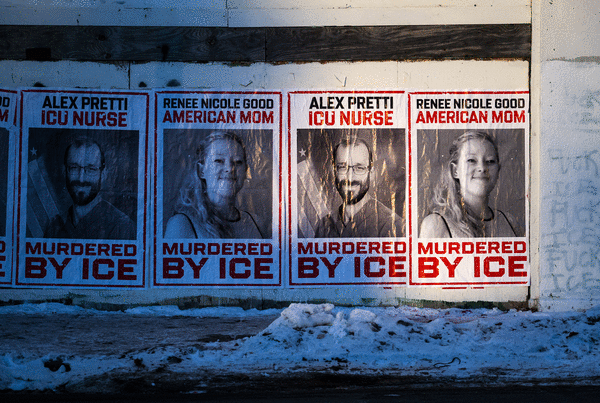
On Saturday, federal agents fatally shot Alex Pretti, a 37-year-old intensive care unit nurse and U.S. citizen, as he helped another protester whom agents had pushed to the ground. Trump administration officials, trotting out the odious narrative tropes used to justify lethal extrajudicial killings, reflexively defended the agents’ actions, calling Pretti a “would-be assassin” and “domestic terrorist” who was “brandishing” a weapon and had “injected himself into a law enforcement operation” to do “maximum damage and massacre” to “patriots.”
The most credible evidence revealed that narrative to be a lie. Pretti, who had a gun in his waistband, was holding his phone when he was shot, at least 10 times, after agents tackled him and took the gun.
Pretti had no criminal record and was a lawful gun owner in a state that allows open and concealed carry. The next day, Homeland Security Secretary Kristi Noem, incanting another common feature of the narrative — hypocrisy — blamed Pretti, claiming not to “know of any peaceful protester that shows up with a gun and ammunition rather than a sign.” Recall that members of this administration, including President Donald Trump, praised armed insurrectionists who stormed the Capitol on Jan. 6, armed white nationalists at the Unite the Right rally, militia men who breached the Michigan Capitol and Kyle Rittenhouse, who drove 20 miles to a Black Lives Matter demonstration with an assault-style rifle and killed two people. Those same people now blame Pretti for his own demise.
Pretti had every right to carry his gun. Our constitutional framework protects the right to bear arms under the Second Amendment and the right to peacefully assemble and petition the government under the First Amendment. I believe neither amendment bestows absolute rights on the individual. When these rights converge — when protesters carry weapons during demonstrations — they create a complex legal and practical landscape, a debate renewed by Pretti’s killing.
While I recognize the right to bear arms, I’m a staunch gun control advocate. I believe military-style weapons, designed for warfare, not hunting, have no place in civilian hands. The Second Amendment doesn’t grant unrestricted access to weapons. Concealed carry laws don’t enhance public safety; they foster fear and suspicion.
I am particularly outraged when armed civilians appear at demonstrations such as Black Lives Matter protests, wielding weapons to intimidate peaceful protesters lawfully exercising their First Amendment rights. Rittenhouse was one of many troubling examples of armed civilians inserting themselves into civil rights demonstrations to create dangerous confrontations that undermine democratic expression. These civilians contrast starkly with Pretti, who never displayed his weapon. Period.
The Second Amendment, ratified in 1791, states: “A well-regulated Militia, being necessary to the security of a free State, the right of the people to keep and bear arms, shall not be infringed.”
For much of American history, the scope of this right remained contested. The Supreme Court’s 2008 decision in District of Columbia v. Heller marked a watershed moment establishing that the Second Amendment protects an individual right to possess firearms unconnected to militia service, particularly for self-defense in the home. This interpretation was extended to state and local governments through the court’s 2010 McDonald v. Chicago decision, cementing the individual rights framework nationwide.
The First Amendment provides robust protection for political expression, stating that Congress shall make no law abridging “the right of the people peaceably to assemble, and to petition the Government for a redress of grievances.” This protection has enabled countless protests, marches and demonstrations throughout American history, serving as a vital mechanism for political participation and social change.
The question of whether protesters may carry weapons during demonstrations sits at the confluence of these constitutional guarantees. The answer is neither simple nor uniform across jurisdictions. Generally speaking, the legal right to carry firearms in public spaces doesn’t automatically disappear when choosing to exercise First Amendment rights. However, this general principle faces significant limitations. States and localities retain substantial regulatory authority over both gun possession and public assemblies. Time, place and manner restrictions on speech have long been recognized as constitutional, provided they are content-neutral and narrowly tailored to serve significant governmental interests and they leave open ample alternative channels for communication. Similarly, gun regulations must satisfy scrutiny appropriate to Second Amendment concerns, though the precise level of scrutiny remains debated in courts.
In open carry states, protesters can often legally bring visible firearms to demonstrations, just as they can carry them on public streets. Yet, many jurisdictions, including Minnesota, prohibit firearms at specific locations regardless of whether a protest is occurring; government buildings, schools, polling places and courthouses commonly fall under such restrictions. Minnesota, unlike states such as Oregon and California, doesn’t ban firearms at protests, demonstrations or public assemblies.
The practical concerns surrounding armed protests are substantial. Law enforcement officials often express anxiety about distinguishing peaceful armed protesters from potential threats, particularly in tense situations in which emotions run high. The presence of weapons can escalate confrontations, transform peaceful demonstrations into volatile situations and potentially chill the speech of others who feel intimidated. Critics argue that bringing weapons to protests transforms political expression into implicit threats, undermining the democratic discourse the First Amendment aims to protect.
Proponents of carrying arms at protests offer different perspectives. They argue that self-defense rights don’t evaporate during political activity, that visible firearms can deter both criminal activity and government overreach, and that exercising multiple constitutional rights simultaneously represents the fullest expression of American liberty. Some point to historical examples of armed self-defense during civil rights struggles, arguing that vulnerable communities have particular reasons to ensure their protection during demonstrations.
Courts have generally upheld reasonable restrictions on firearms at protests when those restrictions serve compelling safety interests and don’t amount to blanket prohibitions on Second Amendment rights. The key legal question often centers on whether restrictions are applied evenhandedly or target particular viewpoints — a restriction barring all firearms from a protest area raises fewer constitutional concerns than one selectively enforced based on protesters’ political messages.
As we continue to grapple with gun rights, public safety and political expression in the wake of Pretti’s horrific killing, the intersection of First and Second Amendment protections at protests isn’t just contentious — it can be lethal.
The challenge lies in ensuring that constitutional liberties don’t become justifications for extrajudicial murder and that robust political discourse essential to democracy can occur without citizens paying with their lives.
____
Bryan Adamson is the David L. and Ann Brennan professor of law at Case Western Reserve University School of Law. He teaches about civil rights, constitutional law, and protest, policing and the First Amendment. He is the author of “‘Thugs,’ ‘Crooks,’ and ‘Rebellious Negroes’: Racist and Racialized Distortions in Media Coverage of Michael Brown and the Ferguson Demonstrations” in the Harvard Journal on Racial & Ethnic Justice.
___
©2026 Chicago Tribune. Visit at chicagotribune.com. Distributed by Tribune Content Agency, LLC.



















Comments