Robin Abcarian: When the government tramples people's rights, the people must take to the streets
Published in Op Eds
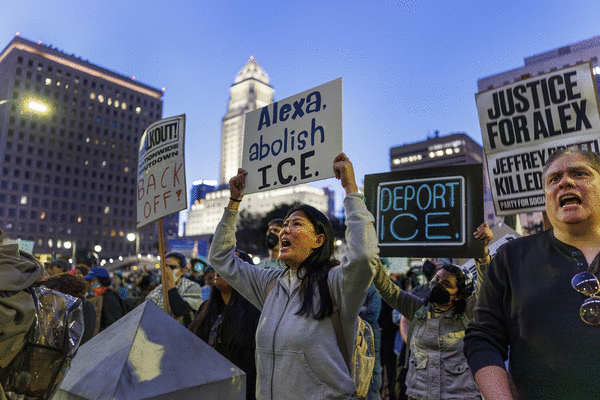
Before June, when the ICE raids first began in Los Angeles, Daniel Sosa had not been active in the immigrants' rights movement. A cannabis dispensary owner, he'd previously directed his political energy to fights around legalization and the implementation of California's onerous rules around weed dispensaries.
On June 6, however, the first day of major, aggressive ICE raids all over Los Angeles County, something changed in him.
"ICE really started snatching people off the streets in L.A.," Sosa told me Thursday. "These are just people that are in my community, and people that I know."
That evening, Sosa joined hundreds of protesters at the downtown Metropolitan Detention Center, the federal prison that sits on Alameda Street next to the Roybal federal building. It has been — and still is — the site of round-the-clock anti-ICE protests. Some protesters were graffiting the building, a few threw water bottles and, according to news reports, some chucked rocks and broken concrete at law enforcement vehicles.
"I don't engage in that stuff," Sosa told me. But he was still caught in the turmoil. A flash-bang stun grenade that exploded close to his ear that night sent him to urgent care the next morning, where he was diagnosed with an inflamed cochlea and given prednisone.
That next evening, undaunted, he returned to the protests. After dark, once again, things got ugly.
"Describe what happened to you," encouraged a KCAL News reporter on the scene, holding a microphone to Sosa, 42, who wore dark glasses and a beanie pulled down over his ears.
"I tasted a little tear gas," Sosa said. "Tasted like fascism."
A few days later, Stephen Colbert aired the clip, which has been viewed millions of times, and pronounced Sosa "the most L.A. guy ever."
What's happening in cities like L.A., Chicago and, of course, Minneapolis, does feel like something out of a dystopian novel about the crumbling of the American experiment. Unidentified masked men carry weapons of war in residential neighborhoods. Their hair-trigger tempers and violent responses to being "disrespected" have resulted in the shooting deaths of Renee Good, a mother and poet, and Alex Pretti, an ICU nurse, and now widespread calls to abolish ICE.
"State terror has arrived," columnist M. Gessen warned in the New York Times last week. Gessen, a Russian dissident, has written extensively about authoritarian regimes.
The trampling of the Constitution and the disregard for due process has indeed made a mockery of America's view of itself as a democracy where the rule of law reigns supreme.
Soon enough, Americans will be able to make their displeasure known at the ballot box (if given the chance). But until then, we must exercise our rights to free speech and assembly. What alternative is there but to take to the streets?
Obviously most people — even those with strong feelings about President Trump's immigration crackdowns, the appalling tactics of ICE agents and the Justice department's overzealous prosecutions of protesters armed with sandwiches — will not get off their couches. They don't need to.
In a 2017 Washington Post essay about the extraordinary nationwide turnout at the "Women's Marches" that were inspired by Trump's misogyny, political scientists Erica Chenoweth and Jeremy Pressman explained why the turnout of an estimated 1.3% of the American population — a seemingly paltry number — was so meaningful.
"Marching requires a much higher level of commitment than voting," they wrote. "It takes more time, is not anonymous, often involves financial costs and could put the marcher in harm's way or at risk of arrest or retaliation."
Chenoweth is well known for popularizing the "3.5% rule," which posits that almost "no government has withstood a challenge of 3.5% of their population mobilized against it during a peak event."
The rule applies to campaigns aimed at overthrowing an unpopular government or achieving territorial independence, but many — including organizers of the ongoing No Kings marches — have adopted it as an aspirational figure. About 342 million live in this country today; nearly 12 million people would have to turn out to test the rule.
In any case, sociologist Zeynep Tufekci wrote in the New York Times in 2017 that mass protests should be looked upon as "a first, potential step."
"A large protest today is less like the March on Washington in 1963 and more like Rosa Parks's refusal to move to the back of the bus," Tufekci wrote. "What used to be an endpoint is now an initial spark. More than ever before, the significance of a protest depends on what happens afterward."
So, something is starting to change. Nearly two-thirds of Americans believe the ICE raids are doing more harm than good. Nearly half support abolishing ICE. And on Friday, the Department of Justice announced it had opened a civil rights investigation into Pretti's killing.
And in response to last week's events, Trump has pulled his Nazi cosplaying border chief Greg Bovino out of Minneapolis. Democrats are urging that Homeland Security Secretary Kristi Noem be impeached. Some Republicans are urging Trump to fire her. Some are even demanding that Trump's virulently anti-immigrant advisor Stephen Miller, who falsely suggested that Pretti intended to massacre federal agents, has to go.
In the meantime, Sosa has returned dozens of times to the Metropolitan Detention Center and does not plan to stop. On Oct. 10, he was there with a custom banner that read "F— ICE."
As Sosa tells it, he was holding his sign when officers chased a protester into the crowd, then ripped his sign out of his hands. Sosa went to his car, retrieved an identical banner and returned. "It was my way of saying, 'You are going to violate my 1st Amendment right to speak? You are going to unreasonably seize my property without due process? You can't stop me.'"
He was arrested, held for about an hour and a half in a cell and now faces two federal criminal Class C misdemeanor charges: obstruction and failure to comply with a lawful order. The maximum penalty per count is 30 days in prison. He's also been arrested six times by Los Angeles police at the protests, but never charged with a crime.
At Sosa's arraignment, he was offered a deal: Plead guilty to one of the charges, pay a $35 fine, receive a year of probation and stay 100 feet away from the detention center. He refused.
"It's important — really important — to exercise our right to speak and to assemble," Sosa said. "It's so fundamental to what America is. We can't just take it for granted because it's written on an old piece of paper. We have to exercise our rights if we want to keep them." His trial is scheduled to begin April 2. He plans to represent himself.
©2026 Los Angeles Times. Visit at latimes.com. Distributed by Tribune Content Agency, LLC.









Comments