Editorial: New Florida DOGE report could be helpful -- if it weren't such a political stunt
Published in Op Eds
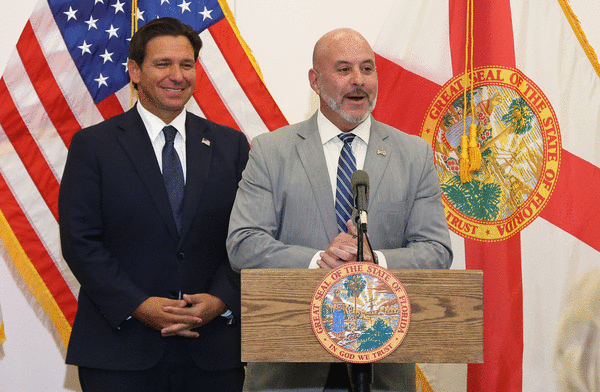
The report the Florida DOGE has recently released detailing spending in the state’s largest cities and counties reads, at times, like a reasonable exercise in fiscal oversight. But too much of it sounds like a list of ideological grievances.
The report, released last week, raises some valid questions: Why did general fund spending in many counties increase so much in the past decade — by more than 80% in Miami-Dade’s case, according to the report. As the Herald reported, spending in Mayor Daniella Levine Cava’s first term outpaced spending under her predecessor.
This should be a starting point to demand more restraint from our local officials. But DOGE makes it hard to parse out what’s legitimate from biased information meant to take power away from local governments and push for property tax cuts.
The 98-page report is riddled with politically loaded language, coupled with vague statements and questionable information. Fiscal audits don’t normally include terms such as “woke ideologies” or “climate hysteria” — or the denial of the impacts of climate change. There is also plenty of flattery reserved for Gov. Ron DeSantis, whose state government spending was not analyzed in the report.
DOGE — Florida’s Department of Government Efficiency — set out to uncover “waste, fraud, abuse and mismanagement,” the Herald/Times Tallahassee Bureau reported. There were no fraud cases identified or any criminal misconduct, the Bureau reported. Instead, the report — released two weeks late, which is, ironically, not very efficient — focused on what DOGE considers excessive or poorly prioritized spending.
There was a lot of complaining about spending on common conservative boogeymen: diversity, equity and inclusion (DEI); subsidies for public radio and climate change. But that’s why local spending is set by local councils and commissions, not Tallahassee — the priorities of cities and counties can be different from those of the state. The goal in this report appears to be to make local jurisdictions seem incompetent and free-spending with your tax dollars.
To be fair, DOGE outlined some items that deserve attention. For example, the report claimed that when DOGE staff asked Miami-Dade where the authorization for spending on certain contracts could be found in the budget, the response from the county was: “’That would require a Herculean effort,’ because the County ‘doesn’t think about’ spending in that way.” The report also stated that Miami-Dade “appears to treat the budget process as a method of securing funding that can be spent through the mayor’s sole control” and that the county is still spending money on bus cleaning services based on COVID standards.
But, then, there is the apparently inaccurate statement that Miami-Dade’s Office of New Americans, which was eliminated in the current budget, “provides significant support for illegal aliens.” The office, however, was created to help legal permanent residents become U.S. citizens.
Miami-Dade’s budgetary issues have been well documented. County leaders closed a $400 million budget shortfall last year but more financial deficits are expected in coming years. It would benefit county taxpayers to have fair and unbiased oversight, but because of the politicization of fiscal responsibility under DOGE, can we trust the report’s findings?
The Florida Association of Counties, a statewide organization that represents counties, said it had “serious concerns about the accuracy of the data and the conclusions drawn from it,” the Herald/Times Tallahassee Bureau reported.
We don’t blame the organization for having doubts. Much in the DOGE report lacks context and further explanation. Among the “examples of excessive spending” by Florida communities are: “Tens of millions of dollars of barely used bicycle lanes in pursuit of a vision of pedal powered commuting that will never be realistic in Florida’s long, humid summers.” Maybe, but where exactly are these bike lanes, and how did DOGE measure their usage? And what expertise does DOGE have on bicycle riding in Florida?
Miami, one of the most humid and hottest parts of Florida, has a vibrant bike community but, because of the lack of biking infrastructure, accidents and deaths are unfortunately common.
If the Florida DOGE were a good-faith effort to make governments more efficient, a report like this could have helped citizens hold their officials accountable. Unfortunately, they will probably find it too hard to parse out legitimate criticism from partisan jabs.
_____
©2026 Miami Herald. Visit miamiherald.com. Distributed by Tribune Content Agency, LLC.


















































Comments