Commentary: What Clint Eastwood's 'Gran Torino' got right -- and what America refused to learn
Published in Op Eds
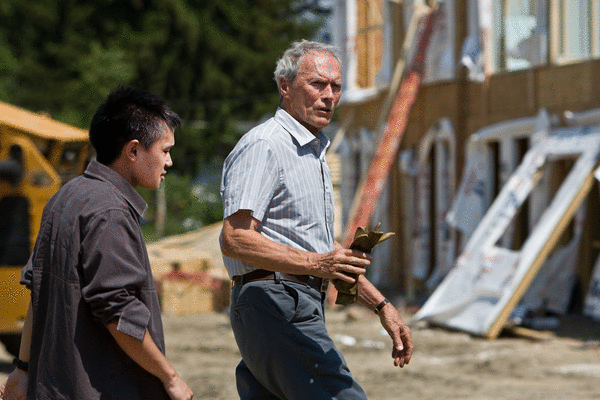
There was a deep chill in the air the day President Donald Trump said he’d consider invoking the Insurrection Act after a U.S. Immigration and Customs Enforcement agent fatally shot Renee Good in south Minneapolis. Something came to mind: Inhumanity follows atrocities as the “jackal follows the wounded beast.” That dictum feels newly relevant amid the popular refrain from Trump’s critics that the cruelty is the point.
I grew up in north Minneapolis, in a neighborhood abutting Olson Memorial Highway, the main road that came to define this working-class, mostly nonwhite part of the city. Many Hmong American families, including my own, have called the area home for decades.
The Twin Cities have become almost interchangeable with Hmong America. Things were different for us here. This seemingly provincial Midwestern metro area was a beacon of cosmopolitanism. Indeed, Olson Memorial Highway wasn’t merely a road or a geographic marker. It was a symbolic one. Here, different corners of the world converged — along with their histories, peoples and cultures — leading toward a multiculturalism in the Midwest that the rest of the country might have aspired to.
For screenwriter and Minneapolis native Nick Schenk, this Twin Cities became the backdrop for his script “Gran Torino,” later turned into a $270 million box-office hit helmed by Clint Eastwood, in which I co-starred as a young Hmong American. (Though the Twin Cities originally inspired Schenk’s writing, the film was ultimately set in Detroit.) Released in 2008, just a month after Barack Obama was first elected president, “Gran Torino” was widely hailed as a post-race, “Obama era” film. Critics and audiences alike touted it as a story of America’s long-awaited multicultural reconciliation.
How better to convey this new era than through Eastwood’s portrayal of white racist curmudgeon Walt Kowalski, a man resentful about his changing neighborhood and ultimately redeemed through his friendship with Hmong American neighbors?
In many ways, my siblings and I, along with our cousins, were the children of the Twin Cities Schenk imagined with zealous enforcement. We were neither the disciplined, austere youths of cinematic stereotypes nor victims of the street violence that surrounded us. Whether we belonged or not, Minneapolis was ours and nothing shook that sense of home.
Last year marked the 50th anniversary of the ignominious end of America’s military misadventures in Southeast Asia. In the aftermath, thousands arrived to U.S. cities like Minneapolis as political exiles and stateless refugees, with no clear account of America’s role in the conflicts or the sputtering crisis that displaced them.
Nearly two generations now separate us from then. Here in Minnesota, where things were truly different for Hmong Americans, those sacrifices seemed to amount to something, offering an answer to that lingering question: Where were we to belong?
Then came the afternoon of Jan. 7, when Renee Good’s death and Trump’s threat of the Insurrection Act delivered a devastating rebuttal. We were reminded of how tentative our belonging is — our being nonwhite, wherever we go, regardless of immigration or citizenship status. The war once fought in Southeast Asia had found us again on the streets of Minneapolis. The gunshots fired that day on Portland Avenue echoed through the city, just as American bombs dropped on Laos had during the Secret War: every eight minutes, 24 hours a day, for nine years.
Through this historic cauldron of such prolific violence we now made our way, yet again. We never escaped it. On the other side, for us Hmong, Lao, Karen and Cambodians, the question this time was where next could we call home, if not here?
Obey, comply and be spared or imprisoned or, worse, killed. Protest correctly, or suffer the consequences. Live fully, with the understanding that individual moral agency is everything, or face deportation to a land we never knew. How are we to choose correctly under such conditions? What’s left is to reckon with “due process,” as Alex Pretti, Renee Good or George Floyd did, meted out to us on the whims of an imperfect, irrational law enforcer. Or like Chongly Scott Thao, taken from his home in January, covered in only his boxers and Crocs.
When Eastwood’s Walt Kowalski ultimately embraces his Hmong American neighbors in “Gran Torino,” it augurs a change promising that yet-unrealized Obama-era vision. What I’ve learned since the film’s release is that the transformation Walt undergoes should be aspired to, not because it is inevitable, but because it is necessary for our collective survival. After all, what is the point of the stories we tell ourselves if we refuse to learn from them or to avoid their mistakes?
I’ll never forget what white viewers confided to me in their responses to “Gran Torino”: that Walt represented the change that they hoped to see in their own lives and families. They believed that change was inevitable. More than 17 years since the film’s release, I hope that belief has not simply hardened into apathy or cowardice as cruelty slinks quietly into place. Now is as good a time as any for the moral clarity they found in the film to pave a way forward, especially here in Minnesota.
Today, in the winter cold of the Twin Cities, I drove through the streets where my siblings and I spent our youth. The stores and eateries where we once found refuge, where we were fed, are now abandoned. All that remains are shuttered businesses where those who once demanded to be served our food now insist we never belonged.
The U.S. is fighting more than its overseas forever wars. The war we cannot afford to ignore is here, at home, our home. We cannot lose.
____
Bee Vang is an actor, writer and inaugural artistic director of the Minnesota Asian American Film Festival. He played Thao in the 2008 film “Gran Torino.”
©2026 Los Angeles Times. Visit at latimes.com. Distributed by Tribune Content Agency, LLC.

























Comments