Mary Ellen Klas: AI has turned Bernie and DeSantis into unlikely allies
Published in Op Eds
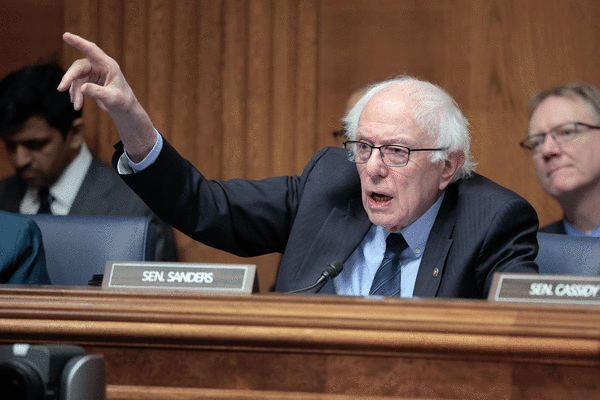
Bernie Sanders and Ron DeSantis don’t agree on much, but the data-center boom is a rare exception. Vermont’s Democratic Socialist senator and Florida’s right-wing governor want to slam the brakes on the hundreds of resource-intensive new facilities springing up across the country to power the artificial intelligence industry. And both point to profits, not the public good, as the real factor motivating the boom.
In many ways, the convergence was inevitable. Public wariness about the data-center industry is growing, and politicians could no longer ignore the outcry. Public skepticism of AI is also ubiquitous. Merriam-Webster chose slop as its 2025 word of the year because, at the same time AI is enabling telemedicine and driving cars, it’s also spreading fake news, nonconsensual nudified images and synthetic propaganda.
So when two politicians representing two ideological extremes start sounding alike, maybe it’s time to listen.
In December, DeSantis convened a roundtable discussion to highlight the growing threat of AI.
“What we don’t want to do is be subsidizing or put a thumb on the scale for technologies that are going to supplant the human experience,” he said.
He called for an “Artificial Intelligence Bill of Rights” to safeguard data privacy, parental controls and consumer protections. And he backed legislation that requires data centers to pay the full cost of their energy and water use and allows local communities to stop data-center construction that doesn’t mesh with their growth plans. “You should not have to pay one dime more in utility costs, water, power, any of this stuff, because these are some of the most wealthy companies in the history of humanity,” he argued.
DeSantis had convened the roundtable just days after the Trump administration issued an executive order seeking to limit state-level AI regulations, warning that “a patchwork of 50 different regulatory regimes” could hinder US competitiveness with China. But DeSantis challenged Trump’s justification for the data center expansion, arguing that the tech industry is motivated to accelerate AI growth — with its “fake songs and fake videos” — because it is driven primarily by profits. “Their goal is not to beat China,” he said.
DeSantis’ comments were remarkably similar to those made by Sanders just weeks before. Sanders had released a report that raised questions about the industry’s impact on American jobs, the economy and young people. It concluded: “Technology can and should improve the lives of working people. But it will not happen if decisions are made in boardrooms by billionaires who only care about short-term profits.”
Sanders has also joined environmentalists and called for Congress to pass a moratorium on building new data centers. “I think you’ve got to slow this process down,” he said.
Both are right. The bipartisan distrust of this industry gives politicians a rare leverage point to push back against the Trump-aligned tech bros and start asking some serious questions about the AI arms race. What is the goal? How much generative AI is necessary? Does America really need AI-generated slop? And isn’t it time to put some quality controls on these resource-consuming giants?
For years, the nation’s tech companies have quietly gone about signing nondisclosure agreements and lobbying elected officials to build data centers to power their AI technology with little regard for the cost and impact on the public. But when the nonstop low-frequency hums from the buildings started to annoy people in neighboring residential communities, when electric bills started to rise for homeowners and small businesses, and when local water resources started to strain from the cooling demands of the massive computers, public protests got louder. Politicians started getting voted out of office. And the industry started to wise up.
“To say data centers are unpopular right now is probably an understatement, to say the least,” Dan Diorio, vice president of state policy for the Data Center Coalition, told a Florida legislative committee in December.
Diorio represents tech giants like Meta, Alphabet and Amazon Web Services, and is making the rounds to statehouses across the country as lawmakers file bills to impose new rules on the companies.
Arizona, Georgia, Maryland and Michigan legislators are considering bills to repeal data-center tax incentives. Georgia, Florida, Michigan, New Jersey, Wisconsin and Arizona are advancing bills to prohibit data centers from entering into nondisclosure agreements that hide details of the development plans from the public. Eleven states are considering legislation to require utility regulators to develop a new rate class so that data centers foot the bill for their power needs. And lawmakers in Georgia, Oklahoma, Vermont and Virginia have proposed moratoriums on new data-center construction.
But politicians don’t move as fast as tech companies, and in many ways, the industry is already several steps ahead of them. At hearings before Florida legislators, data-center developers testified that many companies are bypassing their water challenges by moving to cooling systems that use closed-loop water technology to reduce massive water consumption.
But because demand isn’t slowing for the build-out of centers that use 500 megawatts or more of energy a day — enough to power a mid-sized city — getting sufficient energy supplied in a timely manner, regardless of the environmental implications, is now the industry priority, according to a report last month from industry-focused Data Center Frontier.
Plans are emerging in Florida, for example, to build self-sufficient energy centers using turbines that burn greenhouse gas-emitting natural gas. Developers said the industry is also working on developing small modular nuclear reactions to power data centers. (NPR reported recently that the Trump administration has secretly rewritten environmental, safety and security rules to allow for development of the experimental reactors.)
The energy appetite is insatiable. According to BloombergNEF, data centers’ energy demand will triple in a decade — from 34.7 gigawatts in 2024 to 106 gigawatts by 2035. That’s the equivalent of powering more than 80 million homes.
In many ways, states created this monster. Lured by the economic development potential of the tech industry, state and local governments for years have offered tax breaks to the industry without managing the impact they would have on their energy grid, especially during peak demand.
For his part, DeSantis has hardly been consistent on this issue. Last June, he signed a major tax-relief bill that extended the deadline to apply for Florida’s tax credit for data centers from 2027 to 2037. Even as he says he wants to slow data center development in his state, he’s giving the industry a tax break to encourage it. It’s classic hypocrisy.
Perhaps DeSantis now sees the error of his ways. A version of his bill giving local communities control of their data center fate is moving through the Florida legislature — although it inexplicably gives data centers a one-year exemption from public records requirements. Hopefully, other state and local officials will also listen to the public outcry, put the brakes on data centers, and take a more measured path forward. “They ignored you,” is now an easy campaign slogan. Even AI could write it.
____
This column reflects the personal views of the author and does not necessarily reflect the opinion of the editorial board or Bloomberg LP and its owners.
Mary Ellen Klas is a politics and policy columnist for Bloomberg Opinion. A former capital bureau chief for the Miami Herald, she has covered politics and government for more than three decades.
©2026 Bloomberg L.P. Visit bloomberg.com/opinion. Distributed by Tribune Content Agency, LLC.



















































Comments