Trudy Rubin: At Munich Security Conference, European leaders commit to protect Western values that White House abandons
Published in Op Eds
MUNICH — Last year, at the Munich Security Conference, where top U.S. and European leaders gather each year, Vice President JD Vance gave a shocking speech that nearly broke the NATO alliance of democracies that had kept the peace in Europe for 80 years.
Vance claimed the threat to Europe was “not Russia, not China,” but rather came “from within” our NATO allies themselves — falsely accusing European democracies of stifling the radical, pro-Russia, and sometimes neo-Nazi parties that the Trump White House openly supports. The veep never even mentioned the threat from Russia, or its war on Ukraine.
The acrid impact of that speech has hung over U.S.-European relations and the future of the NATO alliance over the past year.
“Under Destruction” was the title of this year’s conference, held at the elegant Bayerischer Hof hotel. Its annual security report opened with these grim words, aimed at the “current U.S. administration”: “The world has entered a period of wrecking-ball politics. Sweeping destruction — rather than careful reforms and policy corrections — is the order of the day.”
And yet, this year, I heard a startlingly different tone from European leaders. Stunned by Trump’s demands and disdain, awakened by Russian aggression against Ukraine and much of Europe, furious at President Donald Trump’s threats vs. NATO ally Denmark to seize its sovereign territory of Greenland, European leaders have woken up to the need for dramatic changes — though not in the way envisioned by Trump.
“Europe has just returned from a vacation from world history,” stated German Chancellor Friedrich Merz, who like other leaders here, recognized they had depended for too long on an American ally they trusted for their postwar defense.
Merz chose to speak first at the conference, taking a European leadership role (while insisting, with a nod to his country’s history, that Germany would “never again go it alone”).
“The international order based on rights and rules is currently being destroyed,” he said. “But I’m afraid we have to put it in even harsher terms. This order, as flawed as it has been even in its heyday, no longer exists.”
Merz added, “It does not mean that we accept it as an inevitable fate. We are not at the mercy of this world. We can shape it. And I have no doubt that we will preserve our interests and our values in this world if we step up together with determination, with confidence in our own strengths.”
Indeed, the message of this European leaders meeting in Munich, in sharp contrast to European paralysis at Vance’s onslaught last year, was that they must and can organize to defend against Russia while protecting democratic values — and Ukraine — even if the United States won’t.
Of course, skeptics, including Trumpers, will claim that Europe has become irrelevant. But what I heard this weekend is far more realistic than Trump’s fantasies about a Ukraine deal that bows to Putin and envisions big business deals with Russia.
Pressed by Trump (and this was a good thing), NATO allies have significantly increased their defense budgets. Now that the U.S. has cut off almost all aid to Ukraine, Europe is paying for all U.S. weapons that are purchased for Kyiv, and the EU has pledged to cover most of Ukraine’s military budget for the next two years.
But, unlike the U.S. president, the Europeans recognize that Ukraine is a symbol of the threat posed by an imperialist, aggressive Vladimir Putin.
“With the beginning of Russia’s aggression, we entered a new phase of open conflict and wars, which changed the [security] situation more than we ever thought possible a few years ago,” Merz continued.
The Kremlin also pushes claims of defending its “Russian civilization” to include any territory where it falsely claims that Russians are mistreated. This could include the Baltics, Poland, parts of the Arctic, all of Ukraine, Moldova. The list goes on.
European officials are acutely aware of Russian threats, since they are the constant victims of Russian sabotage, underwater cable cutting, and political assassinations, all of which the White House downplays.
During the conference British intelligence announced they had proof that Russia had assassinated opposition leader Alexei Navalyny in prison with a rare toxin, just as Russian agents murdered a Russian dissident on British soil.
What I heard over and over was European astonishment that the White House ignores the massive slaughter of civilians by Putin, while pressing only for concessions by Ukraine. President Volodymyr Zelenskyy spoke bluntly at Munich about the need for more air defenses, but only Europe is responding.
Indeed, Ukraine was central to the whole conference, with many speakers, warm applause, and frequent sessions featuring Ukrainian military innovations, while Europeans emphasized the importance of Ukraine’s trained army to Europe in the future.
There was constant praise for Kyiv as the defender of Western values, holding the line between Russia and the democratic West.
Yet, it was clear from the American position at Munich that the administration sees the world entirely in a different light.
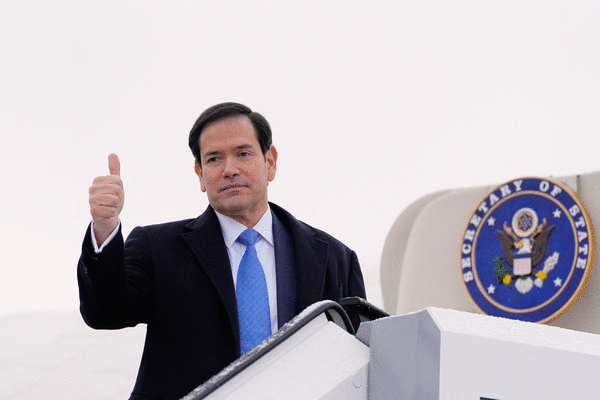
No doubt aware that Vance redux would have been booed off the stage, the White House dispatched the somewhat more diplomatic (but far less powerful) Secretary of State Marco Rubio who soothed European fears slightly with an emphasis on continued U.S.-European ties. However, Rubio pointedly never mentioned the Russian threat hanging over Europe in his speech. He pushed the same nationalist MAGA line about the main threat to “thousands of years of Western civilization” coming from immigrants and multilateral ties.
More disdainful was Deputy Secretary of Defense Elbridge Colby, who praised Secretary Pete Hegseth repeatedly and fulsomely, and insisted that the essence of Trump foreign policy was “hard-nosed common sense.”
“You can’t base an alliance on sentiment alone,” he insisted, in a discussion held in the Bar Montez at the Rosewood Hotel, without taking any questions. “Maybe there is a difference in values.” Then he laughed that he had only heard the words “rules-based international order” once in Munich so “that is a piece of progress.”
It is not clear whether the Europeans can achieve the weapons production goals they discussed and develop an integrated military force that takes over ground protection of Europe within NATO by the end of this decade. And leaders I spoke with recognize they can’t succeed alone without active partnership with — not subordination to — the United States.
But what I heard in Munich made clear that they are far more aware of the threat democracies face and the values that need to be protected than is the White House.
“We will preserve our interests and values if we step up together,” said Merz.
That is wise advice that the White House continues to ignore.
___
©2026 The Philadelphia Inquirer, LLC. Visit at inquirer.com. Distributed by Tribune Content Agency, LLC.



































Comments