Commentary: Don't let natural gas exports wreck the Gulf of California ecosystem
Published in Op Eds
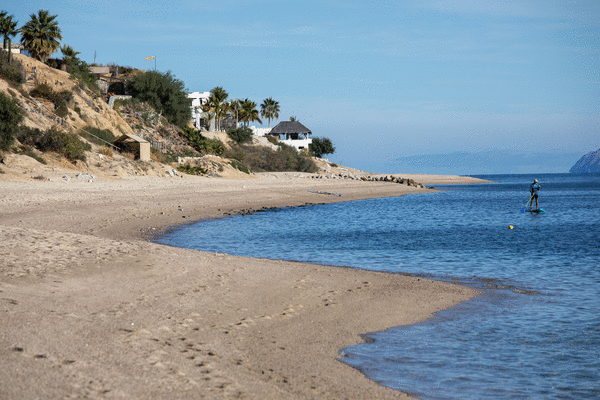
As the effects of climate change intensify, it has become standard practice for major corporations to pledge their support for environmental sustainability. This is as it should be, because genuine corporate engagement is essential to the success of our collective response — and it makes good business sense.
Sempra, one of California’s largest public utilities, is no exception, with commitments to “reduce present and future greenhouse gas emissions” and “protect and preserve biodiversity.” Unfortunately, these words are irreconcilable with Sempra’s plans to build a destructive fossil fuel project in the Gulf of California, also known as the Sea of Cortez. This narrow sea in Mexico is the site of rich biodiversity unsurpassed anywhere on Earth.
Decades ago, citing its exceptional diversity of marine life, legendary ocean explorer Jacques Cousteau nicknamed the gulf the “Aquarium of the World.” Confirming its global importance, UNESCO designated its islands and protected areas a World Heritage Site. Today, incredibly, this natural gem lies directly in the bull’s-eye of U.S. fossil fuel companies and their financial allies as an industrial sacrifice zone for the production and transport to Asia of liquefied natural gas.
Last October, at the quadrennial meeting of the planet’s largest network of conservation experts, convened by the 1,400-member International Union for the Conservation of Nature, the World Conservation Congress resoundingly approved a resolution urging the U.S. and Mexico to prohibit LNG industrialization activities in the region to protect biodiversity, ecosystems and local Indigenous communities.
Sempra apparently didn’t get the message. In fact, it is promoting one of three major LNG terminals proposed on the eastern shore of the gulf. Called Vista Pacifico LNG, Sempra’s project is anticipated to liquify 200 billion cubic feet per year of natural gas piped from the gas fields of west Texas for export to Asia. Located at Topolobampo, directly across the water from Loreto and La Paz, the project would comprise a 5-million-ton-per-year floating liquefaction unit, a 180,000-cubic-meter tank, an LNG jetty, a gas pipeline and other related facilities.
Nothing about this dystopian vision in the Aquarium of the World is compatible with Sempra’s explicit environmental commitments. As emphasized by the recent World Conservation Congress, the gulf is a recognized sanctuary of global conservation value. It has not only been a World Heritage Site since 2005, but a Biosphere Reserve since 1993, a Migratory Bird Refuge since 1978, and, over many years, the site of Ramsar Convention Wetlands of International Importance, including the wetlands proposed for the Vista Pacifico project itself.
The indisputable scientific bases for these designations are the iconic habitat and rich diversity of species themselves: 39% of all marine mammal species, eight species of great whales (including the endangered blue and fin), 891 species of fish (including endangered whale sharks), five of eight species of sea turtles (including the 2,000-pound endangered leatherback), rebounding numbers of giant manta ray, and millions of marine birds.
As a major contributor to a wave of LNG export projects in the region, Vista Pacifico threatens not only to industrialize this natural sanctuary but also to extend the global climate crisis. Cumulatively, these projects would enable significant quantities of greenhouse gas emissions (with an increase in air pollution in the gulf region alone estimated to equal yearly emissions of 130,000 passenger vehicles) as fossil fuel dependence continues for decades in Asia.
Beyond the effects of increased air pollution, water contamination and habitat degradation associated with this industrialization, the consequences of using the uniquely biodiverse gulf as a shipping channel for massive LNG vessels are staggering. According to a July study by the Autonomous University of Baja California Sur, the ships transiting the gulf, each the length of three football fields, would inevitably result in ship strikes and an exponential increase in ambient ocean noise in key habitats of marine mammals whose survival (including communication, feeding, finding mates and reproducing) depends on hearing and being heard. Unavoidably, endangered whales and other marine life would die as a direct result of LNG development, and the region’s robust fishing industry and the communities it supports would be jeopardized.
There may never be a clearer prescription for destruction of a natural World Heritage Site than this, and it must not stand. In 2026, the future of the Gulf of California presents a crossroad for the planet and a fundamental choice for Sempra. We urge the company to adhere to its own environmental standards and cancel Vista Pacifico.
____
Mary D. Nichols is counsel for the Emmett Institute at UCLA Law School and former chair of the California Air Resources Board. Joel R. Reynolds is senior attorney and founding director of Marine Mammal Protection at the Natural Resources Defense Council.
©2026 Los Angeles Times. Visit at latimes.com. Distributed by Tribune Content Agency, LLC.


















































Comments