Commentary: What 'America' meant before 1776, and who 'Americans' are today
Published in Op Eds
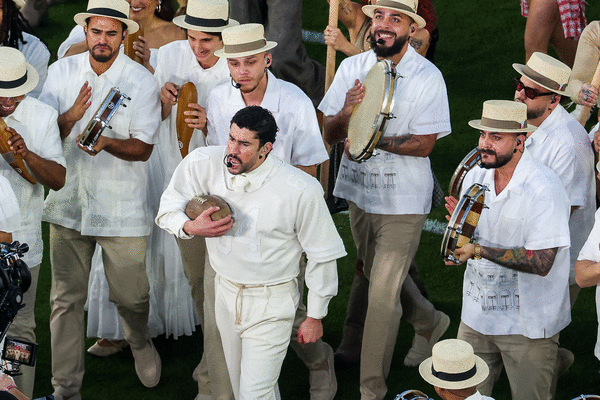
Who gets to be “American”? In the United States, it’s become a fiery political question with life-or-death consequences.
On one side is Team MAGA, for whom “America” means the U.S. and “American” signifies a U.S. citizen — in many of their minds, specifically a native-born, white, Christian U.S. citizen. They routinely deny that the category of “American,” even if limited to meaning “individuals born in the United States,” includes more than 100 million people who are brown, Black or Latino.
Contrast that with the big-tent conception of “American.” Although it long predates the founding of the United States, it apparently bears repeating in the present day, considering the closing of the Super Bowl halftime show and the number of people offended by its truth-telling.
“God bless América.” The electrifying final movement of Bad Bunny’s performance exploded the familiar refrain to include in its blessing a roll call of most of the countries of the Western Hemisphere, proceeding from south to north. The shoutout ended with Puerto Rico, the unincorporated U.S. territory that is the birthplace of Bad Bunny, also known as Benito Antonio Martínez Ocasio.
This was fitting because the term “America” began life not as a label for the United States (nor “American” for its white Anglo citizens) but as a place name for somewhere else entirely.
In 1507, the German mapmaker Martin Waldseemüller coined “America” in honor of the Florentine adventurer Amerigo Vespucci, who had recently made voyages to the coast of northeast Brazil. Waldseemüller inscribed “America” on a globe, a cosmography (a written description of the earth) and a gigantic printed world map 8 feet by 4 feet 6 inches.
In the far west of the map is a narrow sliver of land receding sharply into the distance, its shape barely recognizable as today’s South America. At its center is that place name: “AMERICA.” In the slim accompanying volume of cosmography, written in Latin, he explains that he coined “America” as a feminine form, in Latin, of “Amerigo.” As Waldseemüller saw it, voyages to the west by the likes of Vespucci had revealed outlines of a new, fourth part of the world — a new continent.
Half a millennium later the U.S. Library of Congress bought the only known copy of this map for $10 million, then the largest sum the institution had ever paid for a single item. The map that, in 2007, was the property of a German prince with a castle is now housed in a purpose-built, hermetically sealed case in the Library’s Jefferson Building. For some, the map they call “America’s Birth Certificate” is the greatest jewel in the library’s glittering crown, a foundational document in U.S. history.
Yet when Waldseemüller devised this map, most of what’s now part of the United States was completely unknown to Europeans.
North of the slender landmass labeled “America” on the map is a wispy string of islands topped by a larger, kite-like shape. These sketchy blobs constitute the entirety of Waldseemüller’s knowledge of New World lands north of Brazil. No “AMERICA” appears here. Get up close to the map in its bulletproof case and you realize that the word “America” is nowhere near the United States.
“America” has become a common shorthand for “the United States of America.” But just as “Gulf of [insert your preference here]” implies that said gulf is part of somewhere, “United States of America” implies that the “United States” is part of somewhere larger: of a landmass (or two) called “America.”
If the Waldseemüller map is “America’s Birth Certificate,” then to which “America” does it refer?
For the 16th century mapmaker, America was the partially reconnaissanced landmass located west and south from Europe across the Atlantic Ocean: in today’s South America. In the decades that followed, European cartographers used “America” to refer to the whole of the Western Hemisphere, as we now denote “the Americas.”
It is into this capacious imaginary that Bad Bunny invited viewers, urging them to embrace a supranational American identity that transcends language and nation-states. He drew attention to their common humanity, echoing his Grammy speech: “We’re not savage, we’re not animals, we’re not aliens. We are humans and we are Americans.”
“Seguímos aquí.” We are still here. The show’s closing words recall the resilience of the people of Puerto Rico through centuries of formal and informal empire. They also recall how swaths of the U.S. were part of Mexico until the Mexican-American War of the mid-1800s. It was the border that moved around many Latinos, not the other way round. And they remind us of Indigenous America’s 10 millennia of history, culture and settlement even though old-school tellings of U.S. history don’t register “discovery” before Columbus. Latinos and Native Americans, now frequent targets of racial profiling in immigration enforcement, have been here since before the English arrived or the colonies rebelled. Latinos and Native Americans are Americans.
____
Surekha Davies is a historian, speaker and consultant for TV, film and radio. She is the author of “Humans: A Monstrous History” and writes the newsletter “Strange and Wondrous: Notes From a Science Historian.”
©2026 Los Angeles Times. Visit at latimes.com. Distributed by Tribune Content Agency, LLC.




























Comments