Commentary: Germany is thinking the unthinkable on nuclear bomb
Published in Op Eds
It was early 2025 when Vice President JD Vance made his bombshell speech at the Munich Security Conference about Europe’s “threat from within.” A year later, and a continent no longer sure of American security guarantees has used the same event to assess its nuclear options.
Only France and Britain have nuclear weapons in Western Europe. So should other countries, especially the largest power in the neighborhood, become involved? Germany is seriously debating whether it needs the bomb. Haunted by Cold War memories and legally restricted, it’s unlikely to go there. But it should use this historic opportunity to reset its relationship with nuclear technology in all its guises. The shuttering of its atomic power stations is equally consequential for its security, an act of economic self-harm that stops it controlling its own energy supply and hobbles its once mighty industries.
Militarily, Berlin’s nuclear debate has suddenly moved onto territory that would have been unthinkable only recently. Bundeswehr Brigadier General Frank Pieper has argued that his nation “needs its own tactical nuclear weapons,” and fast. Historian Harald Biermann says “we must urgently talk about protecting Germany by means of our own or European nuclear weapons.” The Greens’ Joschka Fischer, an ex-foreign minister, is also arguing for European nukes. This is remarkable for a party that emerged from the 1980s pacifist movement, one whose anti-bomb sentiments inspired huge street protests. “Times have changed,” he says. Clearly.
The geopolitical situation is pushing Berlin into a historic reassessment. Of course, it is no stranger to the idea of deterrence. Under the North Atlantic Treaty Organization’s current nuclear-sharing operation, the country’s air force would deliver American nuclear bombs — there are believed to be between 10 and 15 of them on German soil. But Germany hasn’t had its own atomic bomb program since the Nazi era and its bound by two agreements to stay that way: the Cold War-era Non-Proliferation Treaty and the 1990 Two Plus Four Treaty that regulated German reunification.
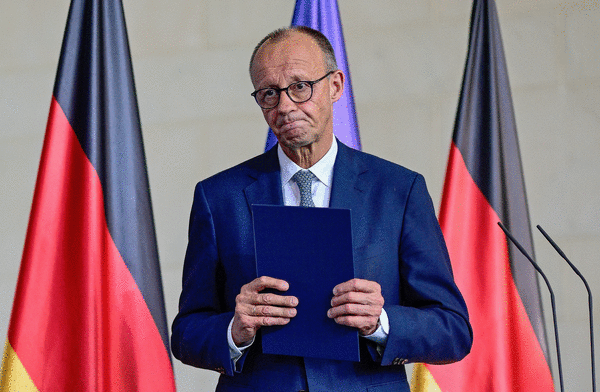
If Germany were to have any decision-making capability on nuclear weapons, it would require legal reform and a fundamental change in strategic culture. Used to taking orders from NATO and the Warsaw Pact respectively, neither of the two German postwar states developed effective military decision making. As late as last year, a National Security Council was finally set up by Chancellor Friedrich Merz to “make the necessary decisions — in the interests of security.” It’s not yet ready to face the biggest questions such as: If Germany had the bomb, who would have their finger on the button?
Still, the debate has become noisy enough for Merz himself to intervene. Pointing to the legal restrictions, he concluded that “it’s not within our own authority to have nuclear weapons in Germany.” However, he didn’t object to the debate: “We know we have to make some decisions on strategy and military policy.” Berlin has reached a stage where, despite its nuclear skepticism, it’s starting to accept there might be a valid counterargument.
Even if it doesn’t jump straight to the conclusion that the age of Donald Trump demands German nuclear bombs, it could at least reassess its short-sighted decision to quit the civilian use of nuclear energy. Berlin shut down the country’s last reactors in 2023 at the height of an energy crisis caused by its dependency on Russian oil and gas. It has replaced some of the lost imports with liquefied natural gas, 96% of which it imported from the U.S. last year. Dependence has shifted, not disappeared.
This exposure is as much a factor of national strength as military deterrence. The world’s third-largest economy imports almost 70% of the energy it needs. That’s a huge vulnerability. Foreign states, whether the US or Russia, know this is Germany’s geopolitical Achilles’ heel. It also causes enormous tension in Europe at a time when the continent wants to rally together.
Germany’s electricity demand depends so much on fluctuating renewable power that there is now a German compound word for windless, cloudy weather: Dunkelflaute (dark lull). During such spells of bad weather for solar and wind farms, the country takes electricity out of the European network. Sweden’s Energy Minister Ebba Busch has quipped that she often anxiously studies the weather forecast to see how much electricity her ally will take from her own country.
If Germany is ready to debate the military use of nuclear technology, then why can’t it step back and reconsider civilian use, a field where it has the expertise and legal authority to change tack? Merz has called the nuclear exit “a bad strategic mistake” and admitted “we now don’t have enough capacity to produce energy.” But he stopped short of drawing any conclusions from that.
This skepticism toward nuclear technology is deeply ingrained in the national psyche. During the Cold War, both German states had an arsenal of nuclear weapons stationed on their soil. They had a front-row seat when the world moved close to the brink. But times have indeed changed. Europe and Germany are no longer split in half. The continent wants to stand united and be independent and powerful enough to defend itself. Its largest economy, and cornerstone, must play its part.
Right now a German bomb isn’t realistic. What the country can do is make a conventional military contribution befitting its heft, explore forms of collaboration with French and Brititish nuclear programs and improve economic independence. If Germany has learned to stop worrying about the bomb, perhaps it can learn to love nuclear energy again, too.
____
This column reflects the personal views of the author and does not necessarily reflect the opinion of the editorial board or Bloomberg LP and its owners.
Katja Hoyer is a German-British historian and journalist. Her latest book is Beyond the Wall: A History of East Germany.
©2026 Bloomberg L.P. Visit bloomberg.com/opinion. Distributed by Tribune Content Agency, LLC.



















































Comments