Commentary: Protecting wolves protects the world
Published in Op Eds
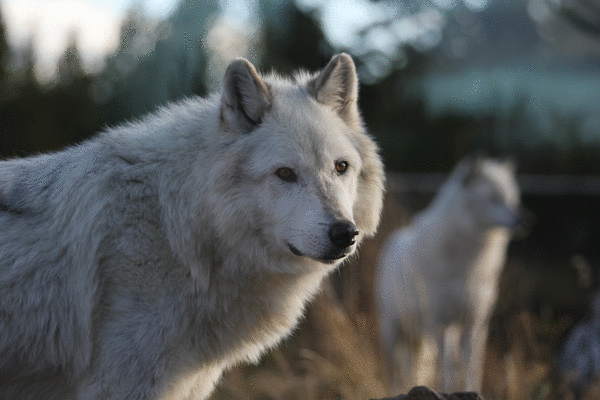
On World Wildlife Day (March 3), we’re asked to reflect on what it means to protect the earthlings who share this planet with us. Few animals reveal the answer more clearly than wolves.
Gray wolves have been protected under federal law for decades, yet their future remains perpetually under threat. This raises a practical and ethical question: Why would we roll back protections for one of nature’s most effective ecosystem stewards?
Wolves are a keystone species—meaning their presence helps regulate entire environmental systems. When they’re allowed to exist, landscapes stabilize. When they’re relentlessly targeted, nature begins to unravel. By influencing where and how other animals move and feed, wolves help prevent overgrazing, allowing forests, grasslands and waterways to recover. This benefits countless species, from birds and beavers to fish and insects, and helps preserve the natural places people value.
Despite this, wolves have been maligned for generations through fairy tales, fearmongering and exaggerated claims pushed by trophy-hunting interests. The result is a level of hostility that’s not rooted in reality.
Despite hunters’ claims, federal data show that only a tiny fraction of the nearly 10 billion land animals humans kill for food each year are ever taken by wolves. Far more die from illness, weather extremes, birthing complications or human-caused neglect. Even domesticated dogs kill more farmed animals than wolves do. When losses do occur, ranchers are already reimbursed. Scapegoating wolves doesn’t protect livelihoods—it distracts from real solutions.
There is also no evidence that killing wolves reduces conflicts. In fact, indiscriminate killing often makes things worse by disrupting pack structures. Younger, inexperienced wolves are then more likely to seek easier targets, increasing the very problems that lethal policies claim to solve. Nonlethal deterrents—such as improved fencing and visual barriers—have proved far more effective, without inflicting suffering or destabilizing habitats.
Wolves are also not a threat to humans. They’re naturally wary of and actively avoid us. Attacks are extraordinarily rare, especially when compared to dangers we accept every day, such as riding in vehicles. Fear of wolves stems from folklore, not facts—and hunters’ continued pursuit of them only reinforces why wolves have every reason to keep their distance.
Wolves matter because of who they are.
They’re intelligent, social individuals who live in close-knit family groups. Wolves mate for life, cooperate to raise their young and communicate through complex vocalizations and behaviors. When even one wolf is killed, the loss fractures families and sends shockwaves through packs—creating chaos not only for wolves but also for the living landscape that depends on them.
Wolves were nearly exterminated across much of the United States by government bounties and widespread poisoning. Protection under the Endangered Species Act allowed surviving populations to begin a slow, fragile recovery. Today, that progress is once again being undermined by aggressive state policies that prioritize killing over science and stewardship.
World Wildlife Day invites us to recognize a simple truth: Killing wolves doesn’t solve problems—it creates new ones. Science shows that healthy ecosystems need wolves. Ethics remind us that wolves are not pests or trophies but sentient beings with families and a rightful place in the natural world.
The question isn’t whether wolves deserve protection under the law—they do. The deeper question is whether we’re willing to protect the natural balance that sustains us all.
_____
Scott Miller is a staff writer for the PETA Foundation, 501 Front St., Norfolk, VA 23510; www.PETA.org.
_____
©2026 Tribune Content Agency, LLC.





















































Comments