Editorial: Conservatives aren't the only ones saying Democrats have a public-sector union problem
Published in Op Eds
For years now, conservative voices have railed against the outsize influence of public-sector unions on the running of American cities, with Chicago serving as one of the leading examples. Now, more left-of-center voices are sounding the alarm and saying the stakes for Democrats in charge of America’s largest cities couldn’t be higher.
The highest-profile recent example came Sunday when CNN’s Fareed Zakaria, who hosts a thoughtful Sunday show on issues of the day, aired a segment on blue cities. Pegged off New York City Mayor Zohran Mamdani’s recent $126 billion budget, Zakaria made a stark pronouncement: “Blue cities are out of control. Promising more, spending more, delivering less and pushing off the fiscal problems to some future date.”
Sound like any city you know?
Zakaria isn’t a journalist who routinely trots out Heritage Foundation talking points. He’s a frequent and effective critic of President Donald Trump.
He’s not alone. The New York Times on Monday published an op-ed by Nicholas Bagley, law professor at the University of Michigan, and Harvard visiting fellow Robert Gordon headlined, “Mamdani will need to change how he governs.”
The two identify the generous pension benefits city workers receive as a key reason city taxpayers can’t afford their own municipal governments. “The question is whether one segment of workers should retire with greater security than others, at the expense of services the public depends on,” they wrote.
A rhetorical question. No reasonable person (other than maybe the members of these unions) could be in favor of that.
In other words, Democrats, the call now is coming from inside the house.
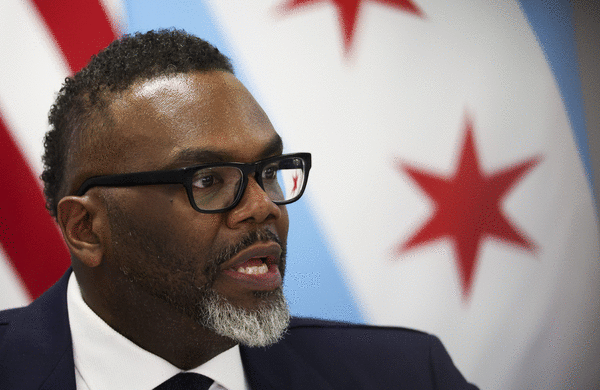
This page has been making these same arguments for years, so we quote from these sources (and there are others in the center-left lane we could cite) merely to say the alarm bells are ringing ever more shrilly for Democratic politicians like Chicago Mayor Brandon Johnson and, yes, Gov. JB Pritzker. Both continue to saddle taxpayers of the future with paying for the exorbitant promises of today.
What makes their actions so egregious is that, unlike when Illinois politicians of yesteryear refused to cover the costs tied to keeping their public-sector union campaign donors happy, even the most low-information voters among us are aware of the fiscal disaster from appeasing unions representing state and municipal workers. And yet the people we elect keep digging the hole deeper anyway.
The best recent example locally was Pritzker’s deeply unfortunate decision last year to sign into law a measure sweetening the pension benefits for Chicago cops and firefighters hired after 2010, which saddles Chicago taxpayers with an estimated additional $11 billion in liabilities over the next 30 years. Mayor Johnson did precious little to stop that bill from passing despite the severe damage it did to the finances of the city the mayor is sworn to protect.
“The pension promises are so large that they will surely bankrupt the city at some point,” was Zakaria’s take on Chicago.
A reminder. This wasn’t Fox News. This was a CNN broadcaster saying this.
Our point isn’t mainly to reiterate arguments we’ve made before. It is to say that the failure of blue-city governance, not confined to Chicago, is now a national conversation piece. And the protests of some progressives notwithstanding, it’s increasingly a set narrative.
The future of Chicago and other big American cities isn’t all that's at stake for Democrats. These failures help contribute to the lack of confidence Americans in general have in Democrats’ ability to run things — their governmental competence. For a party that brands itself as the believer in government as a force for equity, justice and prosperity, this is a perilous flaw.
Yet, to this point, we’ve seen little willingness to confront the primary impediment to writing a desperately needed new story for our big cities — the unwillingness of unions representing public workers even to discuss contributing to solving fiscal problems so immense that at least in Chicago’s case they risk insolvency.
It’s past time for Democrats to engage in a little tough love with their union friends. As California is amply demonstrating with the hasty exits of many of its billionaires in the face of a potential state tax on their unrealized paper wealth, taxing the rich (at least by itself) is no panacea.
And if a little spine-stiffening is what these Democratic officeholders need, they need look no further than their own voters. In 2024, Chicagoans were allowed for the first time in city history to vote for members of the Chicago Board of Education. In the contested races in which a candidate endorsed by the Chicago Teachers Union faced a challenge, voters rejected the CTU-backed option in six of nine districts. Heading into that election, CTU, which had propelled its own organizer, Brandon Johnson, into the mayor’s office the year before, was believed to have an immense advantage. Instead, the union got shellacked.
Since that time, Johnson and CTU have failed time and again to convince a school board in which 11 of 21 members are appointed by the mayor to back them on a number of fiscally imprudent proposals. Why? Those board members, many of whom will face voters this coming November, can see that the unholy alliance of the city’s most powerful public-sector union with the mayor’s office leads only to unaffordable tax bills, with precious little in return for their constituents’ families.
President Franklin Delano Roosevelt once warned against allowing government-worker unions to collectively bargain for fear that taxpayers would get the shaft. Far too late to do anything about that.
But we have another FDR aphorism for big-city Democrats far too worried about offending their union friends: There’s nothing to fear but fear itself.
_____
©2026 Chicago Tribune. Visit chicagotribune.com. Distributed by Tribune Content Agency, LLC.















































Comments