Allison Schrager: America's human capital is eroding
Published in Op Eds
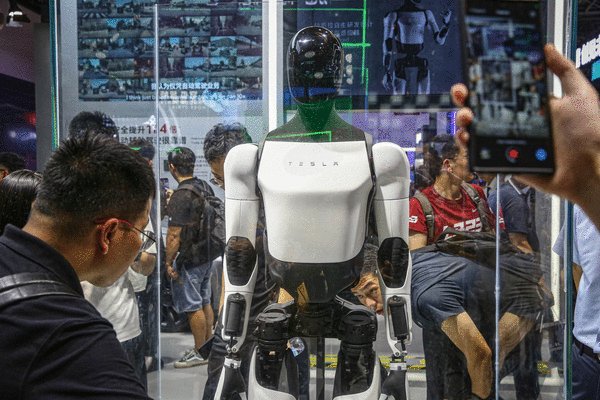
America is having a collective freakout about jobs — specifically, that soon AI will do everything and leave everyone unemployable. This concern is not necessarily misplaced, but it is better understood as part of a larger worry: that one of the country’s most critical resources, human capital, is eroding.
A large, diverse and highly skilled labor force is what made the U.S. an economic powerhouse. Now both the stock and value of its human capital is degrading, and almost no one is doing anything to stop it.
The biggest threat to America’s human capital is fewer humans. As the population ages and migration declines, the size of the labor force is shrinking. More broadly, a shrinking population means fewer workers and consumers — and, in many rich countries, more young people working to pay for the costs of older workers’ retirements and the government’s debts. This is a big threat to economic prosperity that the U.S. has usually mitigated though immigration, which is not a likely solution this time.
There is another way a country can get by with a shrinking population: if its workers become more productive. If a young worker is so smart and skilled he can produce the output of three workers, then an aging workforce is less of a problem. In the 20th century, as technology made workers more efficient and people became more educated, human capital in America became much more valuable.
There are some preliminary signs that productivity is rising now. After years of middling numbers, labor productivity increased in 2025. But these encouraging numbers aren’t providing much comfort, because people are worried that AI will be so productive that the need for human workers will decline anyway. If technology displaces workers, then the value of their human capital can be wiped out entirely.
Again, I am not saying this isn’t a valid worry — only that it is as old as time. In the past, technology not only made labor more productive, it also increased the demand for labor. Some jobs were lost, but new and better ones were created; wages and employment went up. Some people who work in technology argue that this time is different, but it is way too early to know for sure.
First, widespread AI-induced job loss, or even a lack of hiring, can’t yet be seen in the data. Many industries that use AI are the same ones doing the hiring. It is true there is less job growth overall, but much of that can be explained by cyclical changes to the economy and a fall in migration.
Second, a lot of the speculation about the end of jobs is coming from people who’ve never worked in the jobs they presume will disappear. You never know what a job entails and what it takes to be good at it unless you’ve done it. A wealth manager, for example — one of the jobs said to be on borrowed time — doesn’t just write reports and pick stocks. They (the successful ones, at least) cultivate relationships and function almost as therapists. Those softer skills may become even more valuable as AI becomes more prevalent, freeing up time to spend on deeper relationships and more clients. In that case, AI could make human labor more valuable, and people will still have jobs.
As in the past, the most important question may be how we manage the transition to a new technology, which is often long and difficult. A mismatch between skills and technology could mean a short-term decline in human capital, even if productivity numbers increase.
Historically, the mismatch was addressed through education, which improved with each generation, enabling workers to work with new innovation. But education may no longer be serving the same purpose — as more of the population goes to college, it may be reaching a point of diminishing returns. Even more concerning is that educational standards are weakening at both the secondary and post-secondary level. Too many graduates have weak critical thinking skills and are facing technology that is getting smarter faster than they are.
Paul Krugman famously said, “Productivity isn’t everything, but in the long run it is almost everything.” That “almost” is crucial: Even if U.S. productivity increases, if its human capital degrades, it will be in trouble. Even high productivity numbers may not be enough to pay the government’s debts, and there will be many people unhappily and under-employed.
That scenario is not inevitable. AI cannot by itself improve America’s economic and demographic growth. That will require better education that trains students to think rigorously, as well as immigration that prioritizes highly skilled migrants. What’s required, in other words, is a strategy to improve our human capital.
_____
This column reflects the personal views of the author and does not necessarily reflect the opinion of the editorial board or Bloomberg LP and its owners.
Allison Schrager is a Bloomberg Opinion columnist covering economics. A senior fellow at the Manhattan Institute, she is author of “An Economist Walks Into a Brothel: And Other Unexpected Places to Understand Risk.”
_____
©2026 Bloomberg News. Visit at bloomberg.com. Distributed by Tribune Content Agency, LLC.




















































Comments