Editorial: Iran strikes won't succeed without a real strategy
Published in Op Eds
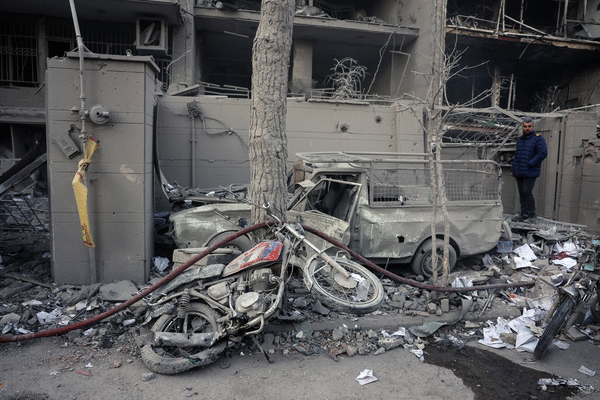
The president has a long history with Iran: pulling out of the nuclear deal negotiated by his predecessor in 2018, killing a top military commander in 2020, dropping bunker-busters on Iranian nuclear sites last year. What he’s always lacked is a coherent strategy. Having launched the U.S. on perhaps the riskiest gamble of his two terms in office, he owes the American people one.
The airstrikes now raining down on Iran, a joint U.S.-Israeli effort that quickly eliminated Supreme Leader Ayatollah Ali Khamenei and other high-ranking officials, have no doubt been well-planned. Yet it remains entirely unclear why they were necessary. The grievances cited by the president for authorizing the operation — Iran’s support for terrorist attacks, the killing of Americans in Iraq, the pursuit of nuclear weapons technology, the threat to U.S. bases and allies in the region — are long-standing. In reality, after last year’s airstrikes, the regime is further from a nuclear bomb than it’s been in years, and the Pentagon estimates it couldn’t build an arsenal of missiles capable of reaching the U.S. for a decade. No imminent threat required such force.
Instead, the White House seems to have backed itself into a war. Its intense sanctions campaign contributed to an economic crisis in Iran that provoked widespread protests in late December. The president encouraged the demonstrators without having the military assets in place to prevent Iranian security forces from slaughtering thousands of them. He belatedly ordered two carrier strike groups to the region to back up his threats and gain leverage in negotiations, but he seemed unsure of what concessions to seek or accept. Now, impatient with the progress of talks, he’s greenlighted an operation to decapitate the regime and destroy its military capabilities, hoping that will create enough of an opening for an internal opposition to seize power.
Such an outcome would be welcome. The Islamic Republic has been a disaster for its people and a menace to countries in the region and beyond. Its leaders have isolated and impoverished their populace in pursuit of a nuclear enrichment capability with little purpose beyond eventually developing a bomb. There’s a chance the regime is brittle enough that it could crack, local opposition in different parts of the country could work with its remnants to assert control, and something better might emerge.
That, however, is nowhere near the likeliest scenario. There’s virtually no evidence that airstrikes alone can topple a regime as entrenched as Iran’s. Even if the U.S. and Israel end operations in a few days without suffering major casualties, most retaliatory strikes are intercepted, and Iranian military and nuclear capabilities are severely degraded, hard-liners from the Islamic Revolutionary Guard Corps would still have a far better chance of seizing power than unarmed and leaderless civilians.
Without a clearer plan for what comes next — how to identify and support potential opposition leaders, entice regime defectors, prevent another massacre of protesters, organize international support for a change in government, secure stockpiles of highly enriched uranium, and so forth — the U.S. risks an outcome that will be worse for Iranians and quite likely for Americans, too. A cornered regime could lash out at U.S. and Israeli interests well beyond the Middle East. At a minimum, the U.S. would have to divert resources and attention back to the region and away from more important theaters, as it did after its war of choice in Iraq. It would do so after having depleted stocks of scarce missile interceptors in this fight.
The American people didn’t ask for this war. They’re owed not just a better explanation, but also a wide-ranging effort by the administration to ensure that the risks being taken by troops in the field, the costs paid by civilians in the region and the damage done to U.S. credibility aren’t in vain. Congress, which has abdicated too many of its oversight responsibilities already, ought to rouse itself to demand one.
____
The Editorial Board publishes the views of the editors across a range of national and global affairs.
©2026 Bloomberg L.P. Visit bloomberg.com/opinion. Distributed by Tribune Content Agency, LLC.




















































Comments