Commentary: Militarily, the Iran war is a success. But what are the US goals?
Published in Op Eds
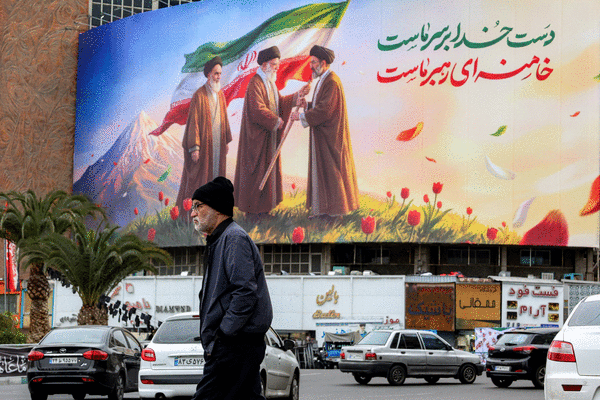
From a pure military-centric perspective, the ongoing U.S. and Israeli war against Iran has been a smashing success. Yet in terms of strategy, the air campaign, now in its second week, is very much a discombobulated mess: U.S. goals are constantly shifting, metrics for victory are nebulous, and the emergence of a coherent endgame is nonexistent.
Militarily, nobody in their right mind can claim that Iran isn’t on the ropes. U.S. and Israeli airstrikes are pummeling the country’s military capabilities, taking out its leadership structure and thrusting the Iranian regime into its most vulnerable state since the nearly decadelong war with Iraq in the 1980s. Dozens of senior Iranian officials and commanders — chief among them Ayatollah Ali Khamenei, the country’s longtime supreme leader — have been killed, a consequence of superior U.S. and Israeli intelligence as well as shoddy Iranian tradecraft.
The Iranian government’s physical infrastructure is under assault: The parliament building and the Assembly of Experts building have been struck, and the Islamic Revolutionary Guard Corps’ headquarters is now a pile of rubble. The Iranian navy, never impressive, is for all intents and purposes defunct. According to the Israel Defense Forces, 70% of Tehran’s missile launchers have been taken out, which means that as the war continues, the Iranians will have to take extra precautions to preserve their remaining stock.
In total, the U.S. and Israel have conducted thousands of airstrikes since the war began on Feb. 28. The number goes up every hour, in large part because Iran no longer has an air defense system. The U.S. Air Force can basically do whatever it wants, when it wants, without having to worry all that much about anti-aircraft fire. President Donald Trump is marveling at the tactical success and using every public event as an opportunity to remind the American people just how great the air campaign is going.
“Somebody said, ‘How would you score it from zero to 10?’” Trump said Friday. “I said, ‘I’d give it a 12 to a 15.’ Their army is gone. Their navy is gone. Their communications are gone. Their leaders are gone.”
However, all the military successes in the world don’t add up to much if the campaign itself is untethered to a clear set of realistic goals. And therein lies the big problem with the Trump administration’s war of choice against Iran (minus the questionable legality of it): Two weeks into the conflict, the American people are still clueless as to what the joint U.S.-Israeli operation is meant to accomplish. Even more worrisome, U.S. officials back in Washington seem just as confused about what victory looks like.
The answer depends on who you ask. Defense Secretary Pete Hegseth has articulated goals that are strictly military: Destroy Iran’s missile capability, its navy and its ability to project power against the United States and our partners in the Middle East. Secretary of State Marco Rubio has been slightly more ambitious, stressing that Washington is not only aiming to eliminate what Iran has but also to prevent the Iranians from rebuilding their ballistic missile program — an operation that suggests similar bombing runs could very well occur in the months and years ahead. Vice President JD Vance has focused almost exclusively on annihilating Iran’s nuclear program.
And then there’s Trump, who sounds like George W. Bush at times by pressing the Iranian government to reform and demanding a say in the appointment of Tehran’s next supreme leader. Trump also talks about Iran’s unconditional surrender without really detailing what those surrender terms might look like.
Of course, it’s likely a moot point. If the selection over the weekend of Mojtaba Khamenei, Ayatollah Ali Khamenei’s second-oldest son, as the next supreme leader tells us anything, it’s that Iran is by no means interested in catering to Trump’s demands anyway.
This might seem like a shock to some given the evisceration of Iran’s military capability. But in reality, this kind of stubborn resistance shouldn’t be a surprise. For this nearly half-century-old regime, the current war is the definition of an existential conflict. Negotiating your own surrender, particularly in the face of superior U.S. military firepower and an American president who believes he’s entitled to pick who will lead Iran in the future, is simply not an option. Better to fight than throw down your arms and hope Trump takes pity on you.
And fight is precisely what the Iranians are doing. Tehran can’t possibility compete in conventional military terms with the United States, let alone the United States and Israel together. But what it can do is create havoc in global energy markets, put pressure on Washington’s Gulf Arab partners and close ranks internally to ensure intra-regime divisions are minimized.
For the most part, the Iranians are accomplishing all three of these things. Iranian ballistic missile and drone attacks on Saudi Arabia, Qatar, the United Arab Emirates, Bahrain and Oman, in addition to Iranian-sponsored Shia militia attacks in Iraq, are forcing some of the world’s biggest oil heavyweights to cut production. The Strait of Hormuz, through which approximately 20% of the world’s energy flows, is essentially off-limits to tanker traffic.
As a consequence, oil prices have gone above $100 a barrel for the first time in four years, and average prices at the pump have risen by 16% over the last week. Natural gas prices, meanwhile, have nearly doubled since the war started, a development that is especially painful for Europe, which is increasingly relying on the Gulf as a source after it cut most gas shipments from Russia.
Iran’s objective is primitive but easily explained: Hunker down and survive the bombardment until the economic reverberations grate on Trump long enough for him to call it quits and declare victory. Meanwhile, Trump’s objective is still up in the air and depends on the day.
____
Daniel DePetris is a fellow at Defense Priorities and a foreign affairs columnist for the Chicago Tribune.
___
©2026 Chicago Tribune. Visit at chicagotribune.com. Distributed by Tribune Content Agency, LLC.





















































Comments