Editorial: Really? The return of military conscription is an 'option to keep on the table'?
Published in Op Eds
When Fox News anchor Maria Bartiromo asked White House press secretary Karoline Leavitt Sunday whether the war in Iran might require ground troops or even a military draft, Leavitt responded in general terms that neither possibility was “part of the current plan right now,” but that the president “wisely keeps his options on the table.”
That Leavitt didn’t dismiss the notion of bringing back military conscription prompted a lot of coverage of that part of the interview afterward, and has stoked anxiety among some parents of teen boys and young men.
Talk about an unforced error. That kind of ambiguity about something as serious as the draft is careless and unnecessary, especially as the Trump administration sends mixed signals about when the war will end — first within weeks, and now “very soon.”
True, this was not an explicit statement confirming that resuming military conscription would be pursued for the first time in more than 50 years. And, in fairness, Bartiromo’s question focused on the potential that the U.S. would be deploying troops on the ground. But Bartiromo also asked directly about the possibility of reinstating the draft. Leavitt should have shut down that speculation immediately, not left theoretical doors open.
Please, by all means, take the possibility of a draft off the table. The possibility should have been easy to swat down. This kind of talk is also politically foolish and risks alienating the many Americans who already distrust this war.
The Vietnam War relied heavily on the military draft and became the defining modern American conflict shaped by conscription. The U.S. drafted its last soldier on June 30, 1973.
Vietnam and the fear and anxiety caused by draft announcements and lottery drawings left Americans in the ensuing decades with a strong distaste for war; unsurprisingly, we have fewer active service members today than we did back then. The U.S. military has about 1.32 million active-duty members today, slightly fewer than during the Iraq War. By 1973, the year the draft ended, the total size of the U.S. military was 2.3 million.
It’ll be even harder to attract volunteer members without clarity of purpose and a more disciplined message from the top.
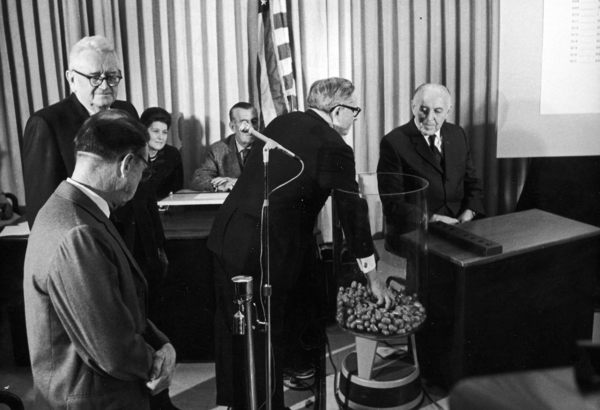
Few who didn’t experience it can appreciate how conscription worked during Vietnam. At the beginning of the war, draft-age men received “Greetings” letters ordering them to report for induction. Starting in 1969, to make the process more transparent, the government held live televised and radio-broadcast lotteries to draw birth dates from a glass jar to establish an order of call.
For those who weren’t alive or old enough to witness the draft, it can feel like a distant, outdated concept, but selective service had long been part of the U.S. military tradition before Vietnam. Ten million American men were drafted for World War II and 2.8 million for World War I. And that was when the U.S. population was far lower.
The point is, conscription may feel impossible today, and while we’d agree that it’s highly unlikely, use of this tool shouldn’t be discussed lightly. Young men are still required to register with the Selective Service System when they turn 18, even though the United States has relied on an all-volunteer military ever since Vietnam.
Donald Trump was elected in part because of his staunch opposition to the foreign entanglements that consumed George W. Bush’s presidency. President Joe Biden finished the job Trump began of withdrawing the last U.S. troops from Afghanistan less than five years ago. Since Vietnam — even during the intense American military involvement overseas during Bush’s presidency — we recall no president or senior administration official being foolish enough to raise the prospect of a return to the draft.
That Trump now has launched a war of choice against Iran — a nation of more than 90 million people — has taken many Americans by surprise. And the polls show a majority disapprove.
One way to ensure disapproval from an even greater majority of Americans is to dangle the possibility of conscripting their children into whatever foreign adventures Trump pursues in the future. With his press secretary having failed to do so, Trump himself ought to close the door firmly to talk of bringing back the draft.
___
©2026 Chicago Tribune. Visit at chicagotribune.com. Distributed by Tribune Content Agency, LLC.



















































Comments