Commentary: As an immigrant, I'm safer in San Quentin than if paroled
Published in Op Eds
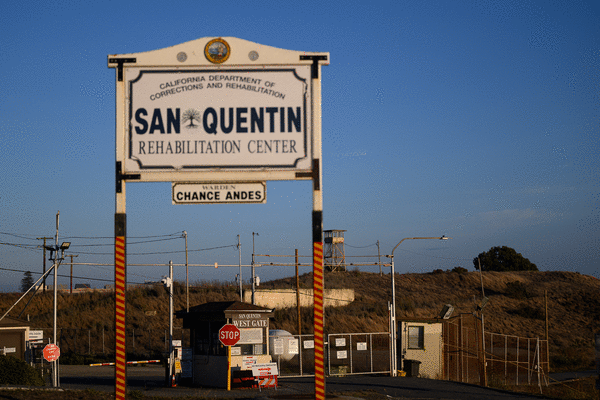
Three decades ago, I was sentenced to life with the possibility of parole in California. A lost, scared teenager, I found myself in a maximum-security prison: Pelican Bay Security Housing Unit. Stuck behind the cubic holes of a metal door, I was one of the many thousands of men sent to solitary confinement. Whenever I was taken out of the cell, my every movement was meticulously monitored. Two officers locked chains around my waist and irons on my ankles.
In these small corridors of eight cells per pod, I was taken away from the world and surrounded by a violent prison culture. Anxiety consumed me. In the abyss of isolation, my only human connections were my next-door neighbors.
I refused to give up. Unable to read or write, I picked up an English dictionary, pen and paper. I devoured books, determined to learn everything about “The Land of the Free.” The more I learned, the more I identified with my new home. I came to love my adopted country and never gave up on the possibility of a second chance — maybe even a house with a white picket fence to live the American Dream.
To be found eligible for parole, I would have to be deemed by the parole board to be rehabilitated and no longer a danger to public safety. That is the stated goal of time spent in California prisons.
Under the state’s model of “normalization,” I’m called by my name, not a number. I’m treated as a person to create conditions as close as possible to life outside of prison. The California Model has given me the opportunity to work with the San Quentin prison administration on projects that advance social justice and rehabilitation. Juvenile lifers like me have a recidivism rate of less than 2%.
All incarcerated people are apprehensive about transition to the outside world. But in my case, the prospects are so daunting that I am no longer even seeking parole. If I were freed, I would go straight into the arms of Immigration and Customs Enforcement.
In 2023, California passed Assembly Bill 1306 to prevent transfers into ICE custody once an incarcerated immigrant is granted parole or compassionate release. But Gov. Gavin Newsom vetoed the bill. Since 2019, California prisons have transferred more than 12,000 people into ICE custody. The state would do the same to me if I were released.
In ICE custody, I would certainly be caught up in mass deportation to El Salvador, a nation I left behind as a 12-year-old. There, I could face yet another life sentence in an El Salvadoran mega-prison, the infamous Terrorism Confinement Center, or CECOT. El Salvador imprisons people they believe to be associated with gangs, which would include me because I tattooed myself as a teenager. Being sent to CECOT is even worse than the solitary confinement I experienced here in California. I would be trapped inside a prison system built to isolate people and destroy human connections. It is a virtual death sentence.
My older brother Gabriel is living this reality right now.
He was sentenced to life in California prison at 16 years old. After 32 years incarcerated, he was granted parole, only to be delivered into the hands of ICE. In September 2024, he was transported to CECOT.
Gabriel cannot make phone calls, receive visitors or even write to my mother to let her know he’s alive.
“They just killed my son,” exclaimed my mother over the phone. I felt powerless, gasping for air as I processed this horrible news. “I will never see him again. He is practically dead,” she said. She also told me that if she fails to send $7 a day to the Salvadoran prison system, Gabriel, if still alive, would probably starve to death.
Trapped between California’s normalization model and CECOT’s black hole, I find myself between the cement walls of two distinct prison worlds.
I’m glued to my TV in the prison cell. I see ICE agents chasing brown people across the fields that they harvest to feed Americans. I ask myself: “Is this the America I learned about? Do immigrants’ lives matter?”
Malcolm X, who also learned to read and write in prison, fought against the injustice and hatred of racism, and Martin Luther King Jr. preached the power of love and the value of equality. This is the America I learned about.
In today’s America, however, real freedom is not an option for me.
____
Edwin E. Chavez has been incarcerated for 32 years, currently at San Quentin Rehabilitation Center. He is involved in restorative justice and rehabilitation efforts.
©2026 Los Angeles Times. Visit at latimes.com. Distributed by Tribune Content Agency, LLC.






















Comments