Commentary: Stop fighting voter ID. Start defining it
Published in Op Eds
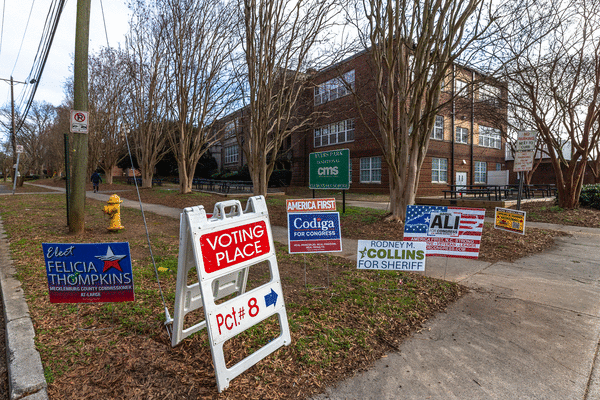
President Donald Trump doesn't need the SAVE America Act to pass. He only needs the debate to continue. Every minute spent arguing about voter suppression repeats the underlying premise — that noncitizen voting is a real and widespread problem — until it feels like an established fact. The question is whether Democrats will contest Republicans’ definition before the frame hardens.
Trump's claim that 88% of Americans support the bill traces to a Pew Research Center survey — a survey that found 83% support a “government-issued photo ID to vote,” not extreme vetting for proof of citizenship. That support included 95% of Republicans and 71% of Democrats, indicating genuine, broad, bipartisan support for a basic civic principle. That's worth taking seriously.
What the poll doesn't show: support for mandatory submission of complete state voter rolls to the Department of Homeland Security; criminal penalties for local election officials who make paperwork errors; a verification database with a documented error rate that regularly misidentifies naturalized citizens as noncitizens; an effective date dropped in the middle of primaries already underway. These are not voter ID provisions. They are enforcement mechanisms that poll respondents were never asked about.
The Pew data makes this gap concrete. It found that 58% of Americans support unrestricted vote-by-mail, including 32% of Republicans. And 59% support automatic voter registration, while 58% support same-day registration. Yet Trump's expanded version of the SAVE Act would eliminate mail voting for nearly everyone and require in-person registration. The survey confirmed majority support for a system that verifies who you are, while making it *easier* to participate. The SAVE Act delivers the opposite.
The SAVE Act bundles a popular principle with deeply contested restrictions and misrepresents a poll to call the whole package a mandate. Think of it this way: We all agree cybersecurity matters. Strong passwords and two-factor authentication make sense when protecting things that matter. But good cybersecurity isn't about eliminating all risks; it's about finding the threshold where protection is meaningful without defeating the purpose. Anyone who has worked in a large organization knows what happens when security becomes the overriding concern: Legitimate work gets blocked, necessary tools become inaccessible, and the safest option from the security team's perspective is a computer that does nothing. The network is perfectly secure. It's also perfectly useless. The SAVE Act never looks for that threshold. By its reasoning, the safest election is one where the barriers to participation are so high that only the most determined voters clear them. That's not election integrity. That's a smaller democracy.
And the bill is only part of the story. While Congress debates the voter ID question, the Trump administration has been pursuing election control through other channels simultaneously — FBI subpoenas for 2020 election records, DOJ lawsuits against 29 states and D.C. demanding unredacted voter rolls containing Social Security numbers and driver's license data, and directing spy agencies to share classified intelligence with a White House election investigator. Taken together, these are not election integrity measures.
The debate Trump keeps resurrecting was never just a policy fight over voter ID; it’s a Trojan horse for future election denial. Every floor speech and news cycle spent arguing the point only reinforces the false assertion that elections are insecure. That's not a side effect of demanding ever stricter versions of the bill, that's the point. Defeating the bill won't end that campaign. It extends it, adding "Democrats blocked it" to a problem frame that was never really about legislation in the first place.
Which means the only move left is to change what the debate is about.
Democrats aren't wrong to call this voter suppression, but that label has stopped landing. There are also real strategic reasons to resist any voter ID framing: It risks legitimizing a problem definition built on exceptionally rare evidence, and it creates friction with civil rights coalitions that have fought these laws for decades. Those are valid concerns. But a better strategy is available: Stop fighting voter ID and start defining it.
If broad public support for voter ID is real — and the Pew data confirms it is — then Democrats should propose a genuine voter ID system that actually delivers what those poll respondents said they wanted. Such a bill would expand rather than restrict acceptable forms of ID, provide free and accessible identification to every eligible citizen, and pair standard verification activities like getting a driver's license with automatic voter registration. It would explicitly exclude the DHS data sharing, the criminal penalties, and the error-prone databases the SAVE Act smuggles in alongside the provisions Americans actually support. Republicans say only the right Americans should vote. Democrats should be arguing that all of them should.
This is a flanking move, not a concession. It forces opponents to argue against a bill that gives every American free identification and easier access to the ballot — in line with what 83% of Americans support. It puts SAVE Act backers on the defensive, requiring them to explain why their version of voter ID needs a federal surveillance apparatus and criminal penalties for paperwork errors attached to it.
The messaging campaign needs to start now: a counter-bill introduced and named, talking points in circulation, surrogates making the same simple argument on every platform. The goal isn't immediate passage; it's to put SAVE Act supporters on the defensive before the frame hardens. With less than eight months until midterm elections, the window to reframe this debate is open — but not indefinitely.
____
Dana Dolan, Ph.D., is Affiliate Faculty at George Mason University's Schar School of Policy and Government, where she specializes in policy process theory. She analyzes voting rights and other policy debates in real time at Views Through a Policy Prism ( http://danadolan.substack.com ), applying academic frameworks to understand how policy problems get defined, how solutions move through the political process, and who controls the terms of debate — topics that are rarely more consequential than in an election year.
____
©2026 The Fulcrum. Visit at thefulcrum.us. Distributed by Tribune Content Agency, LLC.

















































Comments