LZ Granderson: Trump wants to 'take' Cuba, but we've done that repeatedly before
Published in Op Eds
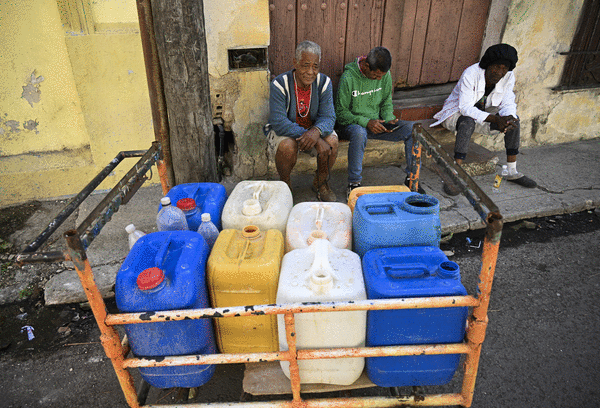
During President Barack Obama's first term, when the U.S. and Cuba initially made attempts to thaw our icy relationship, I visited the island country as part of an educational delegation.
We met with government officials including Mariela Castro, the daughter of then-President Raul Castro, as she was working on pro-LGBTQ+ legislation. We visited the burial site of national hero José Martí, who is credited with sparking the revolution that freed the nation from Spain. And we spent time at San Juan Hill, site of the most significant battle in the Spanish-American War, after which the U.S. essentially took Spain's place.
So when President Donald Trump floats the idea of a "friendly takeover of Cuba" or "taking Cuba in some form," do keep in mind we did that already, back in 1898.
Soon after Spain withdrew its troops from Havana, U.S. forces began an occupation that would last three years under the guise of stability. Meanwhile the large sugar and tobacco plantations that once belonged to former colonizers were quickly being absorbed by American corporations — not by Cubans. That's why, before leaving, the U.S. required an amendment be added to the country's constitution making it legal for the U.S. to overrule domestic policies. A second U.S. occupation soon followed.
By now it was clear to Cubans still recovering from the war for independence that freedom from Spain did not mean sovereignty. When it comes to the foreign policy of the most powerful nations, protecting economic interests will always trump the needs of the local population. The tension between the U.S. commerce-driven society and the sovereignty of our trading partners is what dictates our relationship with nations rich in natural resources. Case in point: The roots of our decades of conflict with Iran do not trace back to religious expression or form of government but rather access to oil. At one point during the 1950s, 90% of Cuba's mines belonged to U.S. companies.
Trump can contemplate taking Cuba, but the reality is the U.S. "took" Cuba decades before Fidel Castro, Raul's brother and predecessor, introduced communism or his family rose to power. We "took" Cuba before President Kennedy initiated his crippling embargo in 1962. The reality is Cuba has been ours since the Treaty of Paris was signed nearly 130 years ago. And the U.S. began that relationship with the free Cuban people, many of whom had been enslaved by Spain, not by inviting them to the negotiation table in France but by dictating terms.
It's a story I was told often by locals as I made my way around the country. Whether the communist government instructed the people I spoke with to share that story isn't clear. What is clear is that it's true. The lack of consideration for the citizens of Cuba mirrored the negotiations for the Louisiana Purchase between the U.S. and France, which did not include input from the Indigenous people who were already living on the land. It echoed the rationale for toppling the monarchy in Hawaii and the agreement with Russia that gave us Alaska.
None of this is to suggest that the Castro regime was justified in limiting free speech, imprisoning dissenters or murdering its own citizens. However, it's important to remember how the regime came to be, lest we repeat the same errors. To begin our understanding of the conflict in 1961, with the Kennedy administration's "Bay of Pigs" failure to overthrow Castro, would ignore the stifling economic conditions that existed before both leaders came along.
Perhaps instead of "taking Cuba," we should consider offering the people something they haven't had since the 15th century — true sovereignty. Not the kind that requires parcels of land to be annexed, such as Guantanamo Bay, in exchange for freedom. But the kind where the Cuban people decide the fate of their country's resources regardless of how those choices affect Wall Street.
Given the entanglement of the modern global economy, it is virtually impossible for any industrialized nation to operate completely independently — as demonstrated by the swift rise in gas prices around the world because of the Iran war. However, a change in approach to our relationship with Cuba could provide not only a new trade partner but also a new geopolitical ally, where once the U.S. had a foe. That's not far fetched. Even while the country was being pillaged by American companies, Cuba was among the first countries to join the U.S. in declaring war on Japan after the attack on Pearl Harbor and was a critical ally in the Atlantic.
If we found a way to make amends with our enemies in Germany and Italy after World War II, we can do the same with Cuba — whose biggest offense is wanting freedom.
____
YouTube: @LZGrandersonShow
____
©2026 Los Angeles Times. Visit at latimes.com. Distributed by Tribune Content Agency, LLC.




















Comments