Commentary: If you're going to debate gender, make better arguments
Published in Op Eds
Femininity, we were told in 2025, is just as “toxic” as masculinity. Women — or perhaps, liberal feminism or maybe feminine vices — “ruined” the workplace. Then again, women were also recalcitrantly “leaning out” of the workplaces they had “culturally neutered.”
Last year was the SnackWell’s year of opining about gender in national newspapers: fact-free, filler food, pitched as a healthy answer to the overindulgence of past polemics, but really offering empty calories.
What our decades of research on gender, labor and the organization of work outside and inside the home have made abundantly clear is this: Women continue to carry a disproportionate share of the unpaid labor and cognitive responsibility in the home and at work, with negative consequences for their mental health, career advancement and economic security.
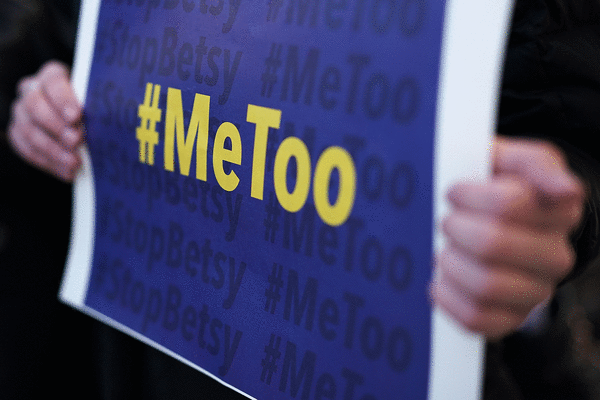
We watched with alarm, then, as some of the most widely circulated opinion pieces in recent months provided the argumentative equivalent of empty calories: vibes. Our culture’s gender discourse lurched into 2026 with little actual data but a strong sense that women, somehow, were “ruining” things, for themselves and others. We saw a reprise of the same issues that have long typified the discourse on gender relations, exemplified by the ongoing reproach that #MeToo had “gone too far” when the reality was that many of the supposedly canceled were back in the public eye with hardly an apology tour. And 2026, far from bringing relief from this fact-free discourse, offered another infuriating example: author Scott Galloway claiming, sans evidence, that “dads are a waste of space” at the beginning of children’s lives and thus that paternity leave is unnecessary.
The problem isn’t disagreement. It’s the absence of argument.
Let’s agree to some rules of engagement for the next (inevitable) battles in the gender wars:
Stop treating anecdotes as counter evidence. In place of solid data, popular discourse too often devolves into a battle of anecdotes, with personal sentiment being elevated to newsworthiness. While there is power in illustrating broader patterns with individual stories, it becomes problematic when the anecdote replaces empirical data altogether.
For example, as part of the “women working is the problem” zeitgeist, the Cut featured an article with the writer working out her personal guilt about how her kid getting cut on some glass was the result of her professional ambition, which she needed to abandon. GQ published a long piece on how “dads are the new moms” ignoring the extensive evidence that women hold much of the home production load even when they earn more.
When each of us present our carefully researched studies documenting women’s disproportionate responsibility for household planning, caregiving logistics and emotional management, we often are met with confident responses from men that, “That’s not how it works in my house.” Not only does this ignore the reporting bias — that if we’re asserting women hold “invisible” labor, men indeed may not be aware how unequally things are distributed — but also it substitutes an individual experience for representative data.
Put trends in context. The economic hardships of men and alienation of boys is real. However, that doesn’t mean there is a “war on boys.” Framing one group’s distress as proof of another group’s excess is not analysis; it is displacement. At the same time, women’s burnout is real. Yet too often, the public narrative treated women’s struggles as evidence that feminism has gone too far.
This reframing was evident in the now-infamous New York Times roundtable conversation in which participants speculated that liberal feminism may have worsened workplace conditions while ignoring the contextual reality that workplaces, and especially people in power within them, are still overwhelmingly male. It made “has feminism failed women” seem like a reasonable two-sided debate.
These context-free assertions can come from people who claim to be on women’s side. The 2025 Lean In Women in the Workplace report resulted in a slew of headlines about an “ambition gap” between men and women, making it easy to miss that the report’s authors attributed it to lack of support for women in the workplace, rather than women’s own preferences. Also missing was the context of the unpaid labor women perform outside the office (even when they’re breadwinners!), limiting how much time, energy and risk they can bring to paid work in the first place.
Name your assumptions. Every argument rests on existing ideas such as beliefs about fairness, work, family and responsibility. Healthy arguments make those assumptions explicit and test them against evidence. Unhealthy ones smuggle them in under the guise of common sense.
The claims of women “ruining the workplace” are built on the faulty assumption that women’s preferences now drive corporate decision-making. The actual data show women leaving the workforce in droves. That is not a culture-war talking point. It is a warning signal. Women are not choosing to exit work because they have “won” anything; they are leaving because the combination of rigid workplace expectations and unequal unpaid labor has become unsustainable, and sometimes because the cost of care for children, elders and others can be so high that going to work is a losing proposition. They are also being pushed out by cuts to female-dominated industries. That is not a happy fairy tale of returning to traditionalism but rather a real threat to the livelihoods of American families.
Because despite the unspoken premise in so much of the discourse that women’s work is primarily about advancing their own ambitions, the reality is that in roughly half of American families, the wife is a joint or primary breadwinner. Women’s work is neither an attack on men nor a frivolous hobby, but a means of putting food on the table and keeping the lights on.
If we want healthier public discourse and a public debate that actually advances our understanding of gender dynamics, we must stop feeding on vibes and start demanding nourishment: transparent data and research, intellectual honesty and the discipline to revise our beliefs when the evidence demands it.
____
Allison Daminger is a sociologist at the University of Wisconsin-Madison and the author of “What’s on Her Mind.” Corinne Low is an economist at the University of Pennsylvania’s Wharton School and the author of “Having It All.” Eve Rodsky is the author of “Fair Play.”
©2026 Los Angeles Times. Visit at latimes.com. Distributed by Tribune Content Agency, LLC.





















































Comments